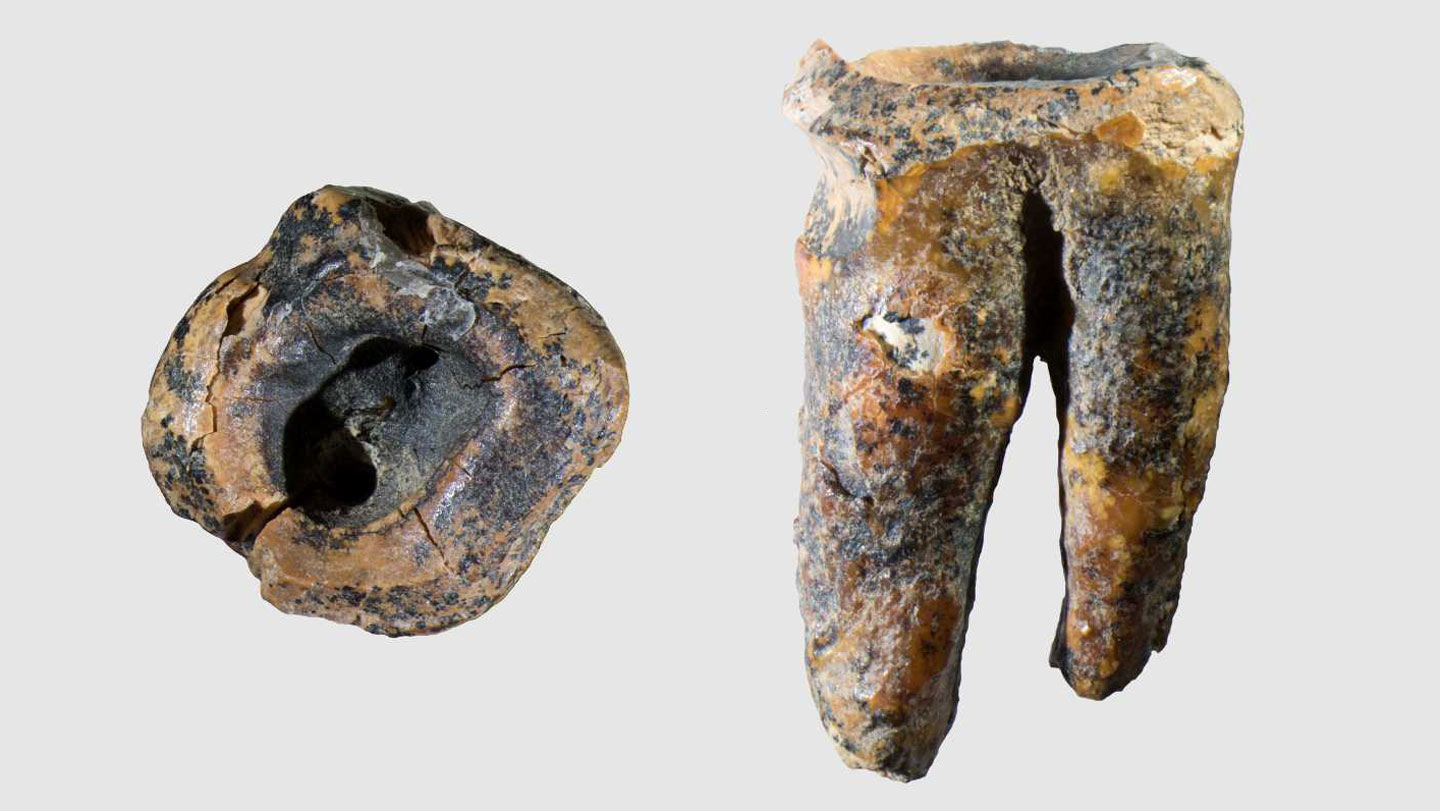
59,000-Year-Old Neanderthal Molar Shows Evidence of Possible Caries Manipulation
Researchers identified deliberate drilling to treat severe caries in a Neanderthal lower molar found in Chagyrskaya Cave, Russia. The find, published Wednesday in PLOS ONE, pushes back the earliest evidence of dentistry by more than 40,000 years and is the first such case identified in any hominin other than Homo sapiens.
Science NewsA Neanderthal adult lower molar named Chagyrskaya 64, found deep in sediment in 2016 at the bottom of the cave's occupational layers in Chagyrskaya Cave in the Altai Mountains of Russia, contains a large rounded hole occupying almost all of its chewing surface that was artificially created.
The Chagyrskaya 64 tooth dates to approximately 59,000 years ago. Micro-CT scans showed demineralization of the enamel and dentin typical of caries that had reached deep into the pulp.
Microscopic analysis and experimental archaeology on modern teeth showed that traces inside the Chagyrskaya 64 cavity are compatible only with the rotational movement of a thin-tipped stone tool drill. The drilling reached the pulp and removed infected tissues. The contours of the cavity are smooth and polished, indicating the patient survived the procedure and continued to chew with the tooth.
A groove attributable to regular tooth picking was found on the side of the Chagyrskaya 64 tooth. Chagyrskaya Cave has been undergoing excavations since 2007 and has yielded more than 70 fossils of Neanderthals who occupied the site between around 59,000 and 49,000 years ago. The molar was found in isolation and not attached to a skeleton.
U.S. researchers was published in the journal PLOS ONE on Wednesday. Spectroscopy showed no residue of beeswax, tar, or other filling materials in the Chagyrskaya 64 cavity. Two cases of caries were found in Chagyrskaya, including one untreated cavity on a deciduous tooth.
Caries was relatively rare among Stone Age hominins, with less than ten cases identified amongst Neanderthal teeth recovered by archaeologists. Rates of tooth decay started to climb in the Neolithic when the carb-rich diet introduced by farming favored the growth of caries-causing bacteria. Grooves attributable to toothpick use have been found on fossils belonging to Homo habilis.

The earliest previous evidence of caries removal came from a Homo sapiens tooth found in Italy dated to around 14,000 years ago. The 14,000-year-old Italian intervention was limited to scraping the enamel. The drilled-out tooth is the oldest evidence of primitive dentistry ever found, eclipsing the old record by more than 40,000 years.
The discovery pushes back the birth of dentistry by tens of thousands of years. It is the first time any evidence of tooth surgery has been discovered in hominids other than modern Homo sapiens. Experiments to reproduce the concavity using thinly tipped stone tools on modern human molars took up to 50 minutes.
Alisa Zubova said the tooth was found at the bottom of the cave's occupational layers. She added: "The tooth's owner suffered from severe caries, and the removal of the affected area was most likely driven by an instinctive urge to reach and eliminate the source of pain. " Ksenia Kolobova stated: "Treating a carious tooth is not just feeding or guarding someone.
It requires diagnosing the source of pain, selecting an appropriate tool, performing a painful, invasive action, and persisting despite the patient's discomfort. That is active, targeted medical intervention. It suggests that Neanderthals understood cause and effect: If I remove the decayed tissue, the pain may stop.
Lydia Zotkina said: "What an incredibly strong-willed person this Neanderthal must have been.
Key Facts
Story Timeline
5 events- 2007
Excavations begin at Chagyrskaya Cave in the Altai Mountains of Russia
1 sourceHaaretz - 2016
Chagyrskaya 64 molar found deep in sediment at the bottom of the cave's occupational layers
2 sourcesScience News · Haaretz - approximately 59,000 years ago
Neanderthal individual undergoes dental drilling procedure on lower molar
3 sourcesHaaretz · Science News · Abc - around 14,000 years ago
Previous earliest evidence of caries removal occurs on Homo sapiens tooth in Italy
1 sourceHaaretz - 2026-05-13
Study by Russian and U.S. researchers published in PLOS ONE
3 sourcesHaaretz · Science News · Abc
Potential Impact
- 01
Revises timeline for emergence of primitive dentistry by tens of thousands of years
- 02
Strengthens evidence of Neanderthal cognitive abilities including cause-and-effect reasoning and targeted medical intervention
- 03
May prompt re-examination of other Neanderthal and early hominin fossils using the new diagnostic framework for signs of dental treatment
- 04
Highlights unusual incidence of caries at easternmost Neanderthal site possibly linked to local oral microbiome
Transparency Panel
Related Stories
app.buzzsumo.comBee-Nav: Tiny Neural Network Inspired by Honeybee Learning Flights Enables Visual Homing in Simulation and Limited Real-World Drone Tests
A Nature research paper proposes Bee-Nav, which trains a small neural network during robotic learning flights to map omnidirectional images to a home vector. Real-world drone tests returned to within 0.5 m of home for all 30–110-m flights using a 3.4-kB network. The approach requ…
pbs.orgFlorida Halts Sloth Imports for Two Months After Dozens Die at Orlando Facility
The Florida Fish and Wildlife Conservation Commission ordered a temporary ban on sloth imports following the deaths of dozens of wild-born animals at a business called Sloth World. The two-month prohibition took effect Wednesday and will last until July 10. More than 98 percent o…
US and Israeli Strikes Kill Supreme Leader Khamenei, Trigger Leadership Uncertainty and Economic Crisis in Iran
Ayatollah Ali Khamenei was killed in a February airstrike on the first day of the war with his son Mojtaba Khamenei injured and unseen in public since assuming power. CNN reported that cooking oil is now six times more expensive in Iran than in Turkey amid nationwide protests tha…