Hungary's Longtime Leader Ousted in National Election After 16 Years
Voters in Hungary removed the incumbent prime minister from office in national elections held on April 12, 2026, electing opposition leader Péter Magyar to head the new government. The opposition party secured a decisive majority, setting a national record for voter turnout. The result ends 16 years of the previous administration's rule and shifts the country's foreign policy orientation.
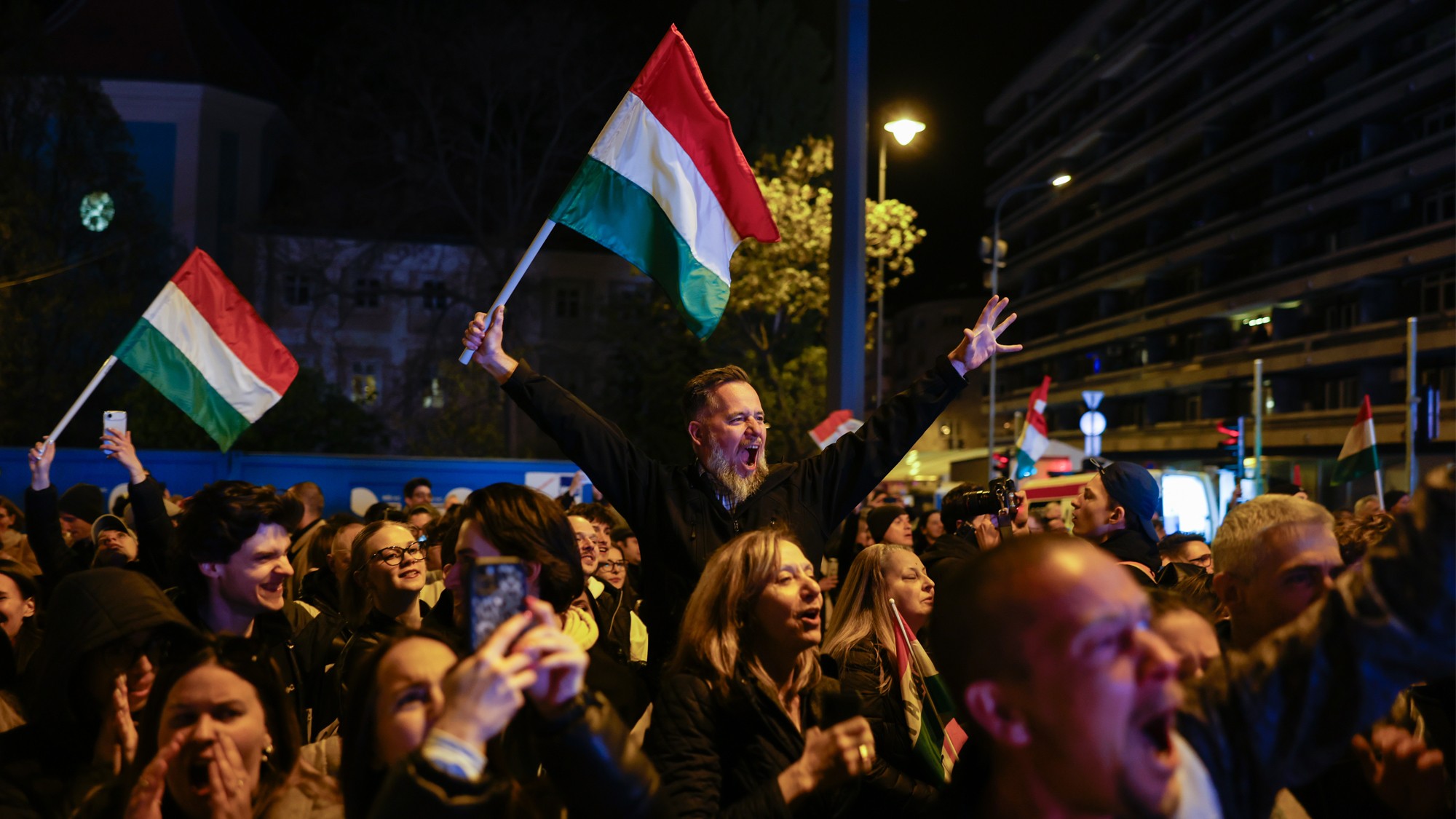 The Atlantic
Hungary's national elections on April 12, 2026, resulted in the ouster of the prime minister who had held power for 16 years. Opposition leader Péter Magyar's party won a decisive victory, gaining control of the legislature with a two-thirds majority. Polls closed three hours before Magyar addressed supporters in Budapest, declaring the replacement of the prior system.
The election saw a national record for voter turnout. Independent polls had shown the opposition leading by a sizable margin prior to the vote. The result allows the new government to amend the constitution and reconstitute key institutions, including those related to media regulation and judicial oversight.
Election Background and Campaign Dynamics The campaign featured competing accusations of foreign influence.
The incumbent administration portrayed the opposition as aligned with European Union institutions and Ukrainian interests. Magyar promised to recover funds frozen by EU bodies due to rule-of-law issues, introduce a wealth tax, and pursue legal action against officials accused of misusing public resources. Economic conditions played a central role in voter concerns.
Salaries in Hungary remain below half the EU average, while state contracts have benefited associates of the prior leadership. One first-time voter described the situation as unlivable but expressed hope for a better future following the election. Western diplomats noted the incumbent's history of mobilizing voters at the last moment and potential for declaring a state of emergency.
However, the opposition achieved a clear win without reported unrest. The European Parliament had classified Hungary's system as an electoral autocracy, where voting occurs under undemocratic conditions.
International Reactions and Implications The defeat carries consequences for international relations.
The prior prime minister received support from governments in the United States and Russia during his tenure. Magyar's victory speech included a call for Russian influence to end, signaling a pivot toward closer European integration. In the United States, Vice President J.
D. Vance had campaigned alongside the incumbent in Budapest the week before the election. S. policy, including staffing from Hungarian-affiliated think tanks. Hungarian sympathies shifted, with one local mayor publicly supporting the opposition and European values on the morning of the election.
The incumbent appeared on screen to concede after the results, acknowledging the defeat and pledging to rebuild. A police officer present described the vote as the last opportunity to remove the prior leadership.
Path Forward for the New Government Magyar, a former supporter of the incumbent who defected two years ago, overcame significant structural advantages held by the prior administration since 2010.
Those advantages included rewritten election rules, reduced independent oversight, and control over media and civil society. The new government plans to build what Magyar called a functioning and humane system. Historical context underscores the significance of the democratic transition.
Budapest's Batthyány Square, site of election night gatherings, commemorates the country's 1848 uprising for self-government and freedoms, which ended in failure. This time, voters succeeded through the ballot. The election's outcome positions Hungary to reverse elements of the prior illiberal framework, which had inspired populist movements abroad.
With fewer than 10 million people, the country's shift affects broader European dynamics and relations with global powers.
Story Timeline
6 events- April 12, 2026 — evening
Péter Magyar addressed supporters in Budapest, declaring victory and the replacement of the prior system.
2 sourcesThe Atlantic · Business - April 12, 2026 — polls close
National elections concluded with record turnout, leading to the opposition's decisive win.
2 sourcesThe Atlantic · Business - Week before April 12, 2026
U.S. Vice President J. D. Vance campaigned alongside the incumbent prime minister in Budapest.
1 sourceThe Atlantic - Two years prior to April 12, 2026
Péter Magyar defected from the incumbent's circle and began leading the opposition.
1 sourceThe Atlantic - Morning of April 12, 2026
A Fidesz mayor in a small village declared support for the opposition on social media.
1 sourceThe Atlantic - April 12, 2026 — post-results
The incumbent prime minister conceded the election in a televised address.
1 sourceThe Atlantic
Potential Impact
- 01
New government amends constitution to reverse prior rule-of-law changes.
- 02
Shifts in foreign policy reduce Russian influence in Hungary.
- 03
Hungary recovers EU funds frozen over governance violations.
- 04
U.S. populist movements lose a key international model.
- 05
Wealth tax implementation targets prior administration's networks.
- 06
Legal actions pursue officials for alleged public fund misuse.
Multi-source corroboration verifies facts, not framing. This panel scores the Substrate rewrite you just read (top score) and the raw source bundle it came from. A positive delta means the rewrite stripped framing from the sources; a negative or zero delta means our neutralizer let some through.
Orban's defeat reflects voter preference for his nationalist policies on migration and EU skepticism, viewing Magyar's win as a risky shift toward Brussels-aligned instability.
- Valence skewnotable“prior illiberal framework; electoral autocracy; undemocratic conditions”systematically negative descriptors for ousted regimeAdjectives and adverbs systematically slant toward one interpretation even though the underlying facts are neutral.
- Loaded metaphorminor“ouster of the prime minister; replacement of the prior system”framing defeat as systemic overthrowSources share the same narrative framing verbs (“sow doubt”, “spark backlash”) — a sign of a shared template, not independent reporting.
- Selective sourcingminor“European Parliament classified; Western diplomats noted”sources lean toward critical view of incumbentEvery quoted expert shares one viewpoint; no counter-expert is given meaningful space.
Transparency Panel
Related Stories
 washingtontimes.com
House Ethics Committee Opens Investigation into Rep. Eric Swalwell Over Sexual Misconduct Allegations
The House Committee on Ethics announced an investigation into Rep. Eric Swalwell on April 13, 2026, regarding accusations of sexual misconduct, including toward subordinates. Swalwell, a California Democrat, suspended his gubernatorial bid amid the allegations. The probe will exa…
 Fotograf: Stefan Lampert. Users Ahellwig, Sebastian8939, Saiki on de.wikipedia / Wikimedia (Public domain)
Fatal Head-On Collision in Niagara-on-the-Lake and Motorcycle Crash in Ballymena on Monday
One person died in a head-on collision involving two vehicles on Niagara Stone Road in Niagara-on-the-Lake. Separately, Jim Wylie, a man in his 60s from the local area, died after his motorcycle collided with a car on Crankill Road in Ballymena. Roads were closed in both location…
 Tammy Lo from New York, NY / Wikimedia (CC BY 2.0)
First Weekend of Coachella 2026 Features Headlining Performances and Celebrity Attendees in Indio
The first weekend of Coachella 2026 took place at the Empire Polo Club in Indio, California, with headliners including a Latina artist closing Sunday night, a singer's Hollywood-themed set on Friday, and a pop star's performance on Saturday. Celebrities such as a model supporting…