88-Foot Nagatitan Dinosaur Remains Discovered in Thailand
British and Thai researchers have identified Nagatitan, the largest and geologically youngest sauropod known from Southeast Asia. The Cretaceous Period fossils, first spotted by a villager in Chaiyaphum province, include a 5.8-foot humerus and indicate the creature weighed 25 to 28 tonnes.
indianexpress.comSkeletal remains of an 88-foot-long dinosaur named Nagatitan have been discovered in Thailand, providing new insight into sauropod diversity in Southeast Asia. The fossils of this member of the sauropod lineage were first spotted by a villager in the country's northeastern province of Chaiyaphum. Scientists then dug up spine, rib, pelvis and leg bones over a period of years.
78 meters) long. Researchers estimated Nagatitan's body mass at 25 to 28 tonnes based on humerus and femur dimensions. Its head and teeth were not recovered in the fossils.
The creature belonged to a subgroup of sauropods that possessed bones with lots of internal air sacs and thin walls, traits that lightened their skeletons. Nagatitan was probably a bulk browser that focused on consuming high volumes of vegetation that required little to no chewing such as conifers and possibly seed ferns, Thitiwoot Sethapanichsakul said.
Sethapanichsakul, a University College London doctoral student in palaeontology, is the lead author of the research published in Scientific Reports.
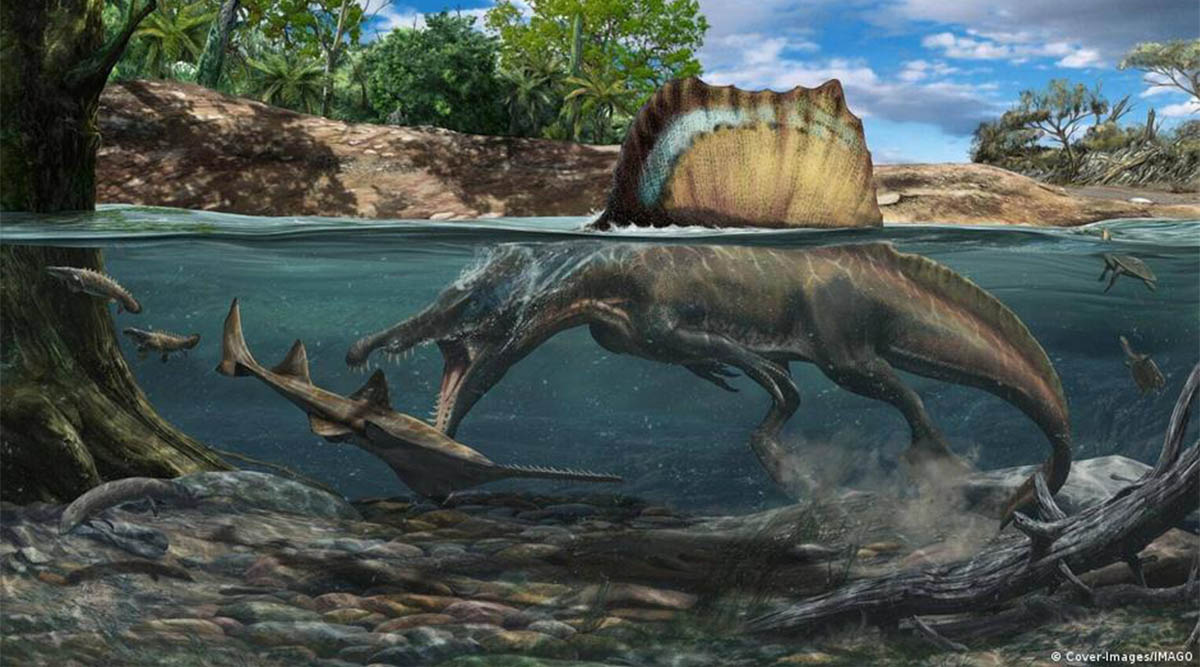
The climate during Nagatitan's time was probably subtropical, with some forests, but also savanna-like and shrubland habitats. Nagatitan lived alongside other dinosaurs as well as flying reptiles called pterosaurs. Rivers at the time were teeming with crocodiles and fish including freshwater sharks.
Predators probably avoided attacking healthy adult large sauropods because of the danger of being squashed, Sethapanichsakul added. At that size, smaller animals were dwarfed by Nagatitan. "Indeed, sauropods are known to have grown very quickly after hatching, and this probably relates to the dangers of predation," Paul Upchurch said.
Upchurch, a University College London paleontologist and study co-author, noted that sauropods included the largest land animals in Earth's history. Nagatitan was huge by any standard but not on the scale of some South American sauropods such as Argentinosaurus and Patagotitan that topped 100 feet long. There are 14 named dinosaurs known from Thailand.
Nagatitan is the largest and the geologically youngest of the sauropods known from Southeast Asia. Nagatitan's name references Naga, a serpent-like being in some Asian religious traditions that is prominently depicted in various Thai temples. The names of several large sauropods include the word titan.
Sethapanichsakul said it might be appropriate to call Nagatitan Southeast Asia's last "titan" because the region became a shallow sea later in the Cretaceous, meaning no more sauropods would live there. This subgroup of sauropods originated around 140 million years ago, achieved a global distribution and around 90 million years ago became the only sauropods left worldwide.
The group thrived until the dinosaur age ended 66 million years ago with an asteroid impact.
The fossils of Nagatitan are from the Cretaceous Period. Nagatitan lived at a time when Earth's atmospheric carbon dioxide levels were climbing, corresponding to high global temperatures. "Sauropods seem to have become particularly large at this time, with gigantic forms living in South America, China, probably North Africa, and now with Nagatitan a fairly large one in Southeast Asia," Upchurch said.
"This possible relationship between large body size and high climatic temperatures is not fully understood, but it's likely that the high temperatures had an impact on the plant fodder that was important to sauropods, which were very large-bodied herbivores," he added. GB News reported on the British researchers' contribution to the discovery.
Key Facts
Story Timeline
5 events- 2026-05-15
GB News reports on the Nagatitan discovery and associated research published in Scientific Reports
1 sourceGB News - Cretaceous Period
Nagatitan lived in subtropical habitats of what is now Thailand alongside other dinosaurs, pterosaurs, crocodiles and fish
1 sourceScientific Reports via GB News - 90 million years ago
Subgroup of sauropods with air-sac bones became the only sauropods left worldwide
1 sourceScientific Reports via GB News - 140 million years ago
Subgroup of sauropods to which Nagatitan belonged originated
1 sourceScientific Reports via GB News - 66 million years ago
Dinosaur age ended with asteroid impact, terminating the sauropod lineage
1 sourceScientific Reports via GB News
Potential Impact
- 01
Increases known Thai dinosaur count to 14 and establishes Nagatitan as Southeast Asia's largest and youngest sauropod
- 02
Provides insight into regional paleoenvironment including coexistence with pterosaurs, crocodiles, freshwater sharks and specific vegetation types
- 03
Adds evidence of sauropod gigantism during high-CO2 warm periods, with presence now confirmed in Southeast Asia alongside South America, China and possibly North Africa
Transparency Panel
Related Stories
The GuardianWHO Chief Visits DRC as Ebola Death Rate Reaches 30-50%
World Health Organization director-general Tedros Adhanom Ghebreyesus arrived in the Democratic Republic of the Congo to support containment of a new Ebola outbreak. The agency revised the death rate to 30-50% based on confirmed cases and recorded 10 confirmed and 223 suspected d…
westernjournal.comGreek National Charged in UK With Aiding Iran-Linked Intelligence Service
A 46-year-old Greek man living in Germany was charged under the UK National Security Act with assisting an intelligence service believed to be Iran by targeting a journalist at Iran International.
straitstimes.comJournalists in Gaza to Receive 2026 Golden Pen of Freedom Award
Three international news agencies will accept the award on behalf of their local staff still reporting from the territory. The World Association of News Publishers cited the journalists' continued coverage under extreme conditions.