AI-Powered System Locates Hidden Sperm, Enabling Pregnancies for Azoospermic Men
A new AI technique developed by Columbia University has helped men with azoospermia, a condition causing little to no sperm production, achieve pregnancies. The Star system identified sperm in cases previously deemed impossible, leading to the first baby born in late 2025 and additional successes. Millions of men worldwide face this infertility issue, with the technology now in regular use.
bbc.comPenelope and Samuel's baby, expected to be the first boy born using the Star system, is due at the end of July 2026. The couple, who battled infertility for two and a half years, learned of the pregnancy in early November 2025 when Penelope received a call from her doctor while driving home from work in New Jersey.
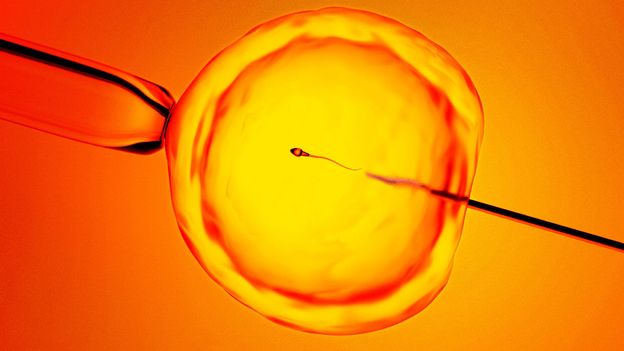
Their success stemmed from the AI-powered Star system, which isolated eight sperm from Samuel's sample after testicular extraction surgery, allowing one embryo to develop into a full blastocyst.
Samuel had been diagnosed with Klinefelter syndrome, a genetic condition affecting males born with an extra X chromosome, often not identified until adulthood. Most individuals with Klinefelter syndrome produce little or no sperm in their ejaculate, known as azoospermia.
Samuel underwent hormone therapy for nine months before surgery at Cornell Medical Center, where specialists initially found no sperm under manual examination, prompting the sample's transfer to Columbia University for Star analysis.
The Star system, developed over five years by Columbia University, uses artificial intelligence to identify and locate hidden sperm in men with azoospermia. It employs microfluid chips with channels as thin as a human hair, through which the sperm sample flows and is scanned by an imager at 300 images per second.
A machine learning algorithm detects sperm cells in real-time with a sensitivity rating of 100%, meaning it can find a single sperm if present, and a robotic system extracts the cells within milliseconds.
Com reported that Zev Williams, director of Columbia University Fertility Center, conceived the idea for the Star system in 2020 after reading about AI used to find new stars in telescope data. 'The picture of the sky was very reminiscent of what we're looking for, and what we see in men who are told they have no sperm,' Williams said.
He noted that the system analyzes hundreds of images per second to detect rare sperm amid debris and cell fragments.
In tests, the Star system found 40 times more sperm than a manual search by a trained human technician. Based on the latest 175 patients, sperm was found in just under 30% of cases. A usual semen sample contains tens of millions of sperm per millilitre, but in azoospermic samples, only a single sperm might be present in the entire sample, or none at all.
The first baby born using the Star system arrived at the end of 2025 to a couple who had struggled with infertility for almost two decades. Since then, the technology has been used regularly at Columbia University Fertility Center, with a waiting list growing to hundreds from around the world.
Eric Forman, medical and laboratory director at Cornell Medical Center, supervised Samuel's procedure and said the tissue was processed in the andrology laboratory before running through the Star system.
Samuel was told he had a 20% chance of having a biological child. 'I was scared. Penelope shared the pregnancy news with him that evening in November 2025, recalling his emotional reaction: 'His face was just a wave of emotion.
Millions of men globally experience azoospermia. About 10% of infertile men have the condition, and 1% of all men are azoospermic. Infertility affects around one in every six people of reproductive age worldwide, with problems getting pregnant at least once in their lifetime, and male infertility contributes to up to 50% of cases.
Penelope described the pregnancy as feeling 'really real now, especially because I'm feeling movement,' after an anatomy scan showed positive results. The couple's journey involved injecting the isolated sperm into Penelope's eggs on the same day as her retrieval to maximize fertilization chances.
Key Facts
Story Timeline
5 events- 2026-07-31
Penelope and Samuel's baby, likely the first boy born using the Star system, is due.
1 sourcebbc.com - 2025-11
Penelope received a call from her doctor informing her she was pregnant; shared news with Samuel that evening.
1 sourcebbc.com - 2025
First baby born using the Star system at the end of the year to a couple after nearly two decades of infertility.
1 sourcebbc.com - 2020
Zev Williams conceived the idea for the Star system after reading about AI for finding stars.
1 sourcebbc.com - 2020-2025
Star system in development for five years before first baby born.
1 sourcebbc.com
Potential Impact
- 01
Growth in waiting lists at fertility centers, straining resources for AI-assisted procedures.
- 02
Need for more clinical trials to assess long-term outcomes and ethical concerns in fertility AI.
- 03
Increased access to fertility treatment for azoospermic men, potentially raising birth rates among infertile couples.
- 04
Potential reduction in emotional distress for couples facing male infertility diagnoses.
- 05
Advancement in AI applications for other medical fields, inspired by Star's success in detecting rare cells.
Transparency Panel
Related Stories
SemaforSamsung Market Cap Tops $1 Trillion as Chip Stocks Rise Amid AI Demand
South Korea’s Samsung saw its market capitalization surpass $1 trillion as semiconductor demand rose. SK Hynix hit a record high and Alphabet advanced on a $200 billion Anthropic deal. AI firms DeepSeek and Anthropic pursue large valuations while analysts note sector momentum.
Brockman Testifies About 2017 Dispute with Musk Over OpenAI For-Profit Shift
OpenAI President Greg Brockman detailed a heated 2017 confrontation with Elon Musk during testimony in the federal trial Musk v. Altman. He described Musk storming around a table and grabbing a painting after rejecting shared control proposals. The lawsuit seeks $150 billion in d…
Palantir Reports 85 Percent Revenue Growth in First Quarter
Palantir exceeded analyst estimates with 85 percent revenue growth in the first quarter, driven by U.S. government and commercial sales. NVIDIA and Corning announced a long-term partnership to expand U.S. manufacturing for AI infrastructure. Several other technology companies als…