technology
Amazon Demonstrates New Warehouse Robots at UK Event, Plans 2027 European Deployment
Amazon demonstrated its current robotics systems and previewed a next-generation Proteus robot at its largest European warehouse in Dartford, with deployment scheduled for the first half of 2027.
 Euronews
Audio version
Tap play to generate a narrated version.
Developing·Limited corroboration so far. This page will refresh as more sources emerge.
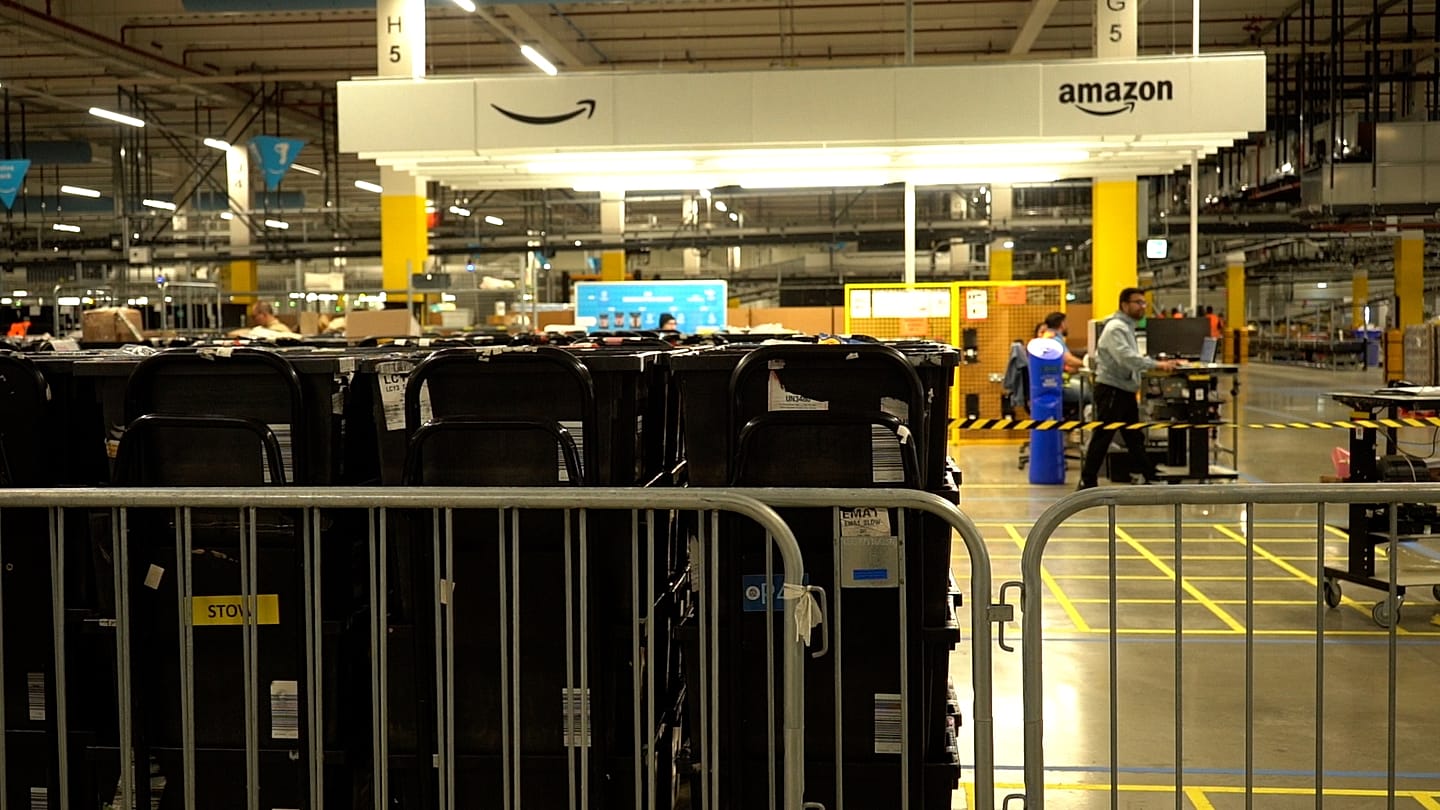
Amazon held its Delivering the Future event on Thursday in the United Kingdom at LCY3, its busiest warehouse in Europe, located in Dartford. More than a hundred journalists and creators attended the gathering at the facility, which covers more than 216,000 square metres and processes 4 million units per week.
The site contains 32 kilometres of conveyor belts and operates with 1,660 Hercules Drives mobile robots on each floor.
These robots move around 21,700 tall yellow storage towers known as pods and can lift up to 567 kg using sensors, 3D cameras and navigation software. Martin Newton, Amazon Tours leader, said the AI used by the Hercules robots to navigate is called Deep Fleet. He compared its coordination role to managing 5,000 cars on the road with no traffic lights.
The robots can also self-report issues for engineers to examine. After items are packed by employees, packages pass through a SICK scanner that measures 3D dimensions, reads shipping labels and directs parcels into the correct lane. The shipping sorter at LCY3 travels 180 km a day inside the facility.
Thousands of employees and associates work at the Dartford site each day. They perform quality control, pick orders from inventory towers and pack items at more than 200 stations across each floor. Amazon said the next generation of its Proteus autonomous robot will handle heavy lifting up to 400 kg.
Scott Dresser, vice president of Amazon Robotics, said of the system: "You tell it what needs to be done. It figures out the priority, the route, the timing. " Euronews saw the previous generation of Proteus, which is currently used in the United States.
