Substrate
politics

Amy Coney Barrett Discusses Public Views of Supreme Court Partisanship at Book Event

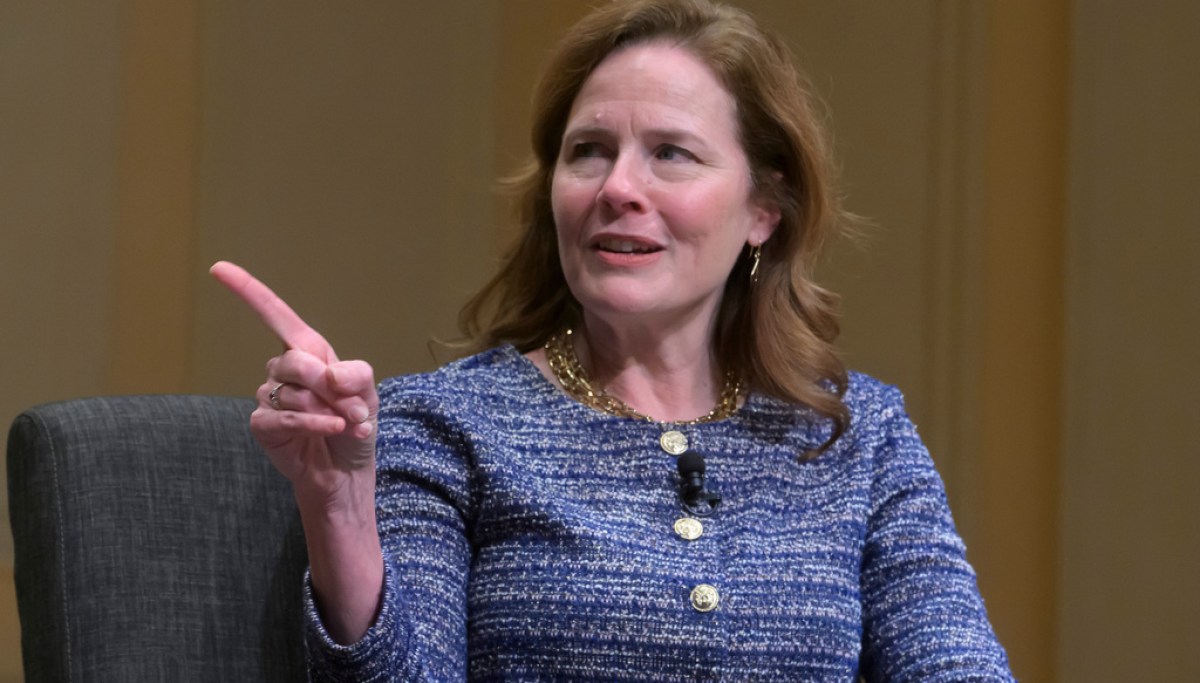
Supreme Court Justice Amy Coney Barrett spoke at a book tour event, arguing that perceptions of the court as partisan are inaccurate and not supported by data. She criticized media portrayals and shared experiences from her time as a law professor. The event occurred at the George W. Bush Presidential Center amid ongoing discussions about the court's image.
Washington Examiner
1 source·May 5, 1:46 AM(1 day ago)·1m read
Amy Coney Barrett Discusses Public Views of Supreme Court Partisanship at Book EventOffice of Senator Joni Ernst / Wikimedia (Public domain)
Audio version
Tap play to generate a narrated version.
Developing·Limited corroboration so far. This page will refresh as more sources emerge.

Supreme Court Justice Amy Coney Barrett argued that much of the public misunderstands the Supreme Court as partisan during a book tour event at the George W. Bush Presidential Center. She addressed the deteriorating image of the Supreme Court as shown in polls over polarization fears, stating that such views bother her because they are not accurate.

Barrett said, 'It bothers me because it’s not accurate. Criticism of the court doesn’t bother me. She added that the idea that the Supreme Court is partisan is 'not consistent with the data,' and emphasized that this narrative persists despite evidence to the contrary.

Reflecting on media coverage, Barrett criticized what she described as a 'bait and switch' where major court cases are hyped beforehand but dropped if the ruling does not follow an ideological split. She said, 'You have this phenomenon where at the beginning of the term, the media will say, ‘Here are the cases to watch,’ and they’ll list a couple big cases.

Barrett continued, 'But the thing about the partisan breakdown is that’s just not true, and those same numbers have continued to play out over the ensuing years.

Barrett urged critical reading of court coverage, stating, 'I think you have to read very critically about the court. She related a time when her law students voiced strong opinions on Supreme Court cases, but almost none had read the opinions when pressed. In her remarks, Barrett reflected on her experiences balancing her job with motherhood.

She stressed the court's role in protecting the rule of law, saying, 'Sometimes protecting the rule of law is not about a result. It’s often that’s usually the least important thing in protecting the rule of law because it is about following the reasoning where it goes. Washington Examiner reported that the Supreme Court secured a conservative majority in 2020.

Key Facts

Barrett addresses court misconceptions
Amy Coney Barrett argued that public views of the Supreme Court as partisan are inaccurate and not supported by data.
Media criticism
Barrett criticized media for hyping cases and dropping coverage if rulings are not ideologically split, calling it a 'bait and switch'.
Rule of law emphasis
Barrett stressed that protecting the rule of law focuses on reasoning rather than results, viewing the court as separate from political branches.
Personal reflections
Barrett reflected on balancing her job with motherhood and shared an anecdote about law students not reading court opinions.
Conservative majority
The Supreme Court secured a conservative majority in 2020.

Story Timeline

4 events
  1. 2026-05-05 (recent event)

    Supreme Court Justice Amy Coney Barrett spoke at a book tour event at the George W. Bush Presidential Center, addressing misconceptions about the court.

    1 sourceWashington Examiner
  2. Recent period (ensuing years after majority)

    Barrett noted that partisan breakdown narratives have not aligned with data over ensuing years.

    1 sourceWashington Examiner
  3. Unspecified past (during her time as law professor)

    Barrett related an incident where her law students expressed strong opinions on cases but had not read the opinions.

    1 sourceWashington Examiner
  4. 2020

    The Supreme Court secured a conservative majority.

    1 sourceWashington Examiner

Potential Impact

  1. 01

    Reinforcement of judicial independence narrative amid ongoing polarization concerns.

  2. 02

    Increased scrutiny of media coverage of court cases, possibly leading to more critical reading by audiences.

  3. 03

    Potential shift in public discourse on Supreme Court impartiality through Barrett's emphasis on data over narratives.

Transparency Panel

Sources cross-referenced1
Confidence score65%
Synthesized bySubstrate AI
Word count306 words
PublishedMay 5, 2026, 1:46 AM
Bias signals removed3 across 3 outlets
Signal Breakdown
Loaded 3

Related Stories

North Korea Updates Constitution, Omits Korean Unification References Amid International Trade FairUser:Langley16 / Wikimedia (CC BY-SA 4.0)
politics1 hr ago

North Korea Updates Constitution, Omits Korean Unification References Amid International Trade Fair

North Korea has revised its constitution to eliminate references to unification with South Korea. The country also opened the Pyongyang Spring International Trade Fair on Monday, showcasing domestic products like the Jindallae smartphone. More than 290 enterprises from several na…

Reuters
South China Morning Post
Japan Times
3 sources
U.S. Pauses One-Day Ship Guidance in Strait of Hormuz as Iran Talks Advancechannelnewsasia.com
politics5 hrs agoDeveloping

U.S. Pauses One-Day Ship Guidance in Strait of Hormuz as Iran Talks Advance

President Trump announced a pause in the one-day-old effort to guide ships out of the Strait of Hormuz, citing progress toward an agreement with Iran. Secretary of State Marco Rubio declared the war with Iran concluded after a month-old cease-fire. The U.S. blockade remains in pl…

The New York Times
National Review
2 sources
Trump Signs Memorandum to Revive Presidential Physical Fitness Award at White House EventOffice of White House Press Secretary / Wikimedia (Public domain)
politics3 hrs agoDeveloping

Trump Signs Memorandum to Revive Presidential Physical Fitness Award at White House Event

President Donald Trump signed a memorandum on May 5, 2026, restoring the Presidential Physical Fitness Award and reintroducing a competitive fitness test in U.S. schools. The event featured student athletes on the White House South Lawn, where Trump demonstrated his signature dan…

Fox News
ABC News
2 sources