Archaeologists Uncover First-Century Villa Near Rome During Emergency Excavations
Emergency excavations at Castel di Guido revealed a large villa with preserved mosaics, painted walls, and a marble statue. The site lies 19 km west of Rome in the ancient region of Lorium.
 The Independent
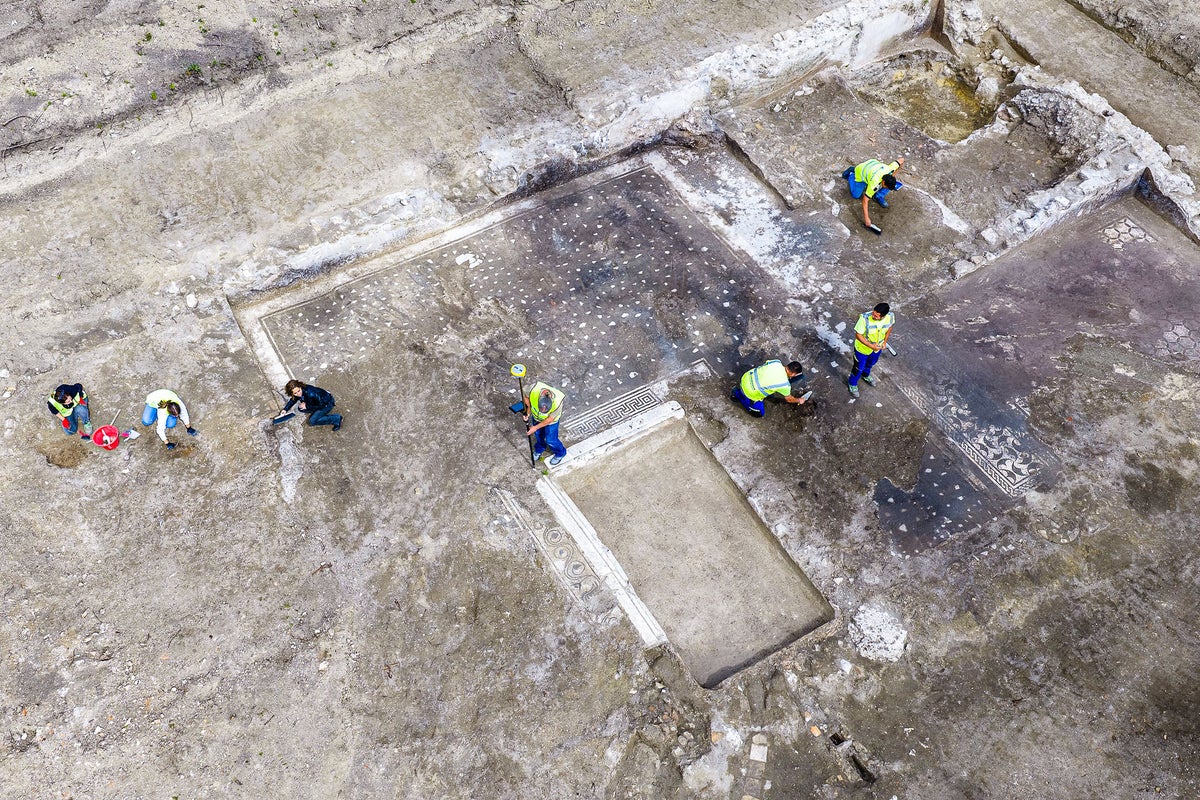
Archaeologists uncovered a large first-century villa during emergency excavations in the Castel di Guido region on the outskirts of Rome. Local police had been alerted to illegal excavations on government-owned land, prompting the rapid intervention that documented and stabilized the structure. The villa sits about 19 km west of Rome’s city walls in the ancient region of Lorium.
5 m high, mosaics, and painted plasters survived in good condition. Researchers identified the atrium, which features a central sunken pool and refined geometric and plant-motif decorations. Three excavated rooms displayed distinct mosaic floors: one with nine black-and-white geometric panels, another with black octagons on a white background, and a third with black rectangle motifs.
Additional mosaic-paved rooms and activity-related structures were also recorded. A fragmented white-marble statue depicting a bearded figure carrying a small animal, likely a calf or piglet, was recovered from the site. Researchers identified the figure as probably the rural deity Silvano.
“The quality of the finds, the mosaic and pictorial decorations testifies to the high social level of the owners of the villa,” the excavation team stated. Evidence indicates the property belonged to Roman aristocracy, possibly close members of the imperial family. ” The villa was likely constructed in the early first century and abandoned in the third.
The Lorium area had earlier yielded a residence linked to Emperor Antoninus Pius, who reigned from 138 AD to 161 AD. Historical records note that the paternal and maternal families of Antoninus Pius lived in Lorium, and the region was frequented by emperors Hadrian and Marcus Aurelius.