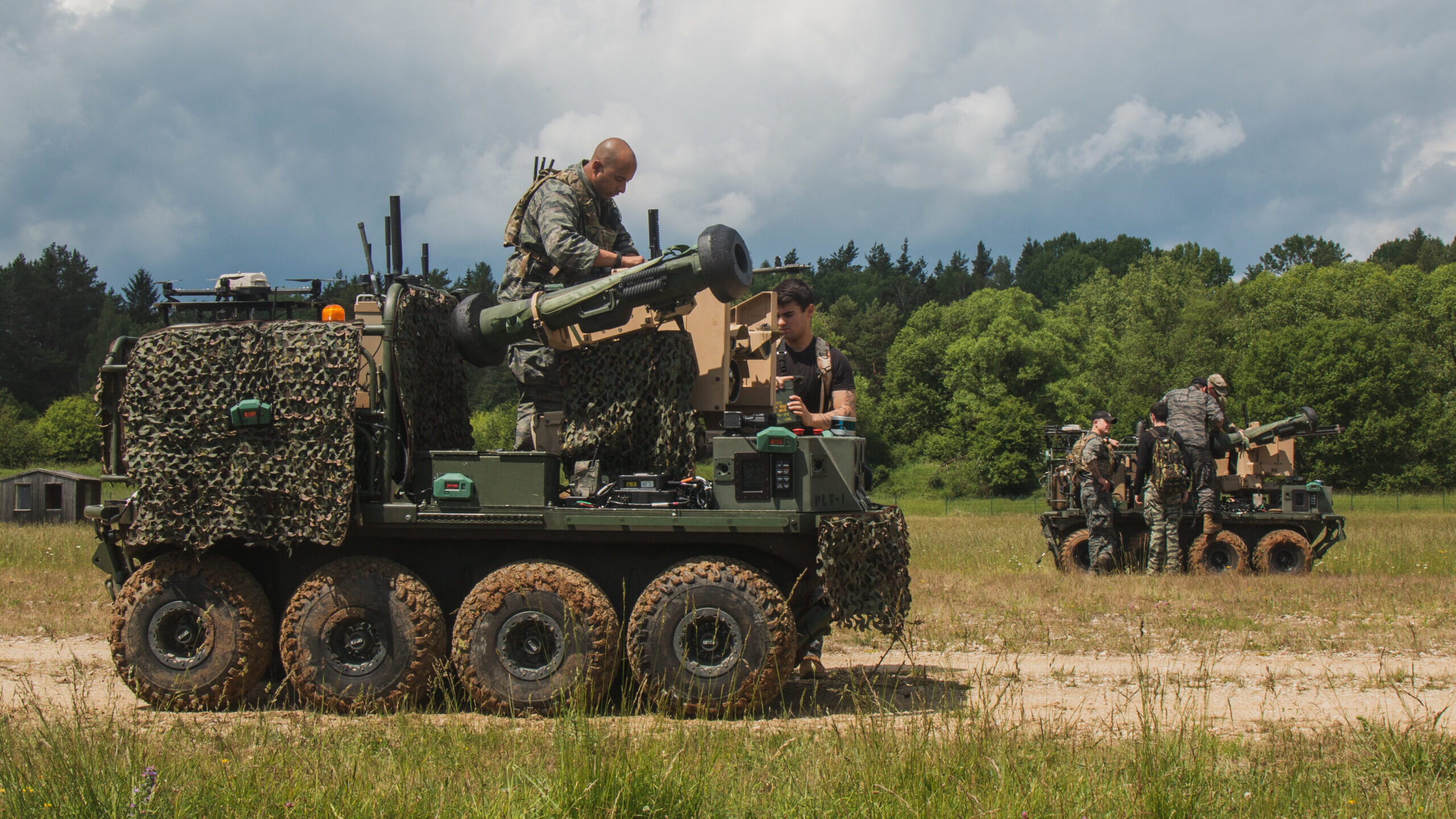
Army Creates New Office to Integrate Existing Unmanned Systems Across Combat Roles
The U.S. Army created the Capability Program Executive Office for Mission Autonomy earlier in 2026 to link drones, robots and other unmanned platforms into taskable packages. Brig. Gen. Anthony Gibbs, who leads the office, outlined its initial priorities of combat engineering, fires and logistics while speaking at a conference in Detroit.
Breaking DefenseU.S. Army stood up the Capability Program Executive Office for Mission Autonomy, or CPE Mission Autonomy, earlier this year to interconnect all unmanned operations from drones to robots. CPE Mission Autonomy will not build or acquire unmanned systems.
Instead it will integrate them into packages of capability that commanders can task much like a manned formation. Brig. Gen. Anthony Gibbs, who leads CPE Mission Autonomy, spoke at the joint Xponential/MDEX conference in Detroit.
He said the office's initial focus areas are combat engineering, fires and logistics. Combat engineering packages will address shaping terrain in the breach prior to ground assault, one of the military's most dangerous traditional missions. These packages will employ a system of systems approach.
The goal is for the mission autonomy packages to interpret a commander's intent, then plan, execute and adjust as battlefield conditions change. "When realized, this capability will be able to understand and translate human intent into mission plans and mission execution, dynamically re-task as needed" based on terrain and the enemy situation, Gibbs said.
CPE Mission Autonomy was formed from pieces of Program Executive Office Ground Combat Systems and Program Executive Office Combat Support & Combat Service Support.
Its components are located in Michigan, Picatinny Arsenal in New Jersey, and Aberdeen Proving Ground in Maryland. It is headquartered at Fort Belvoir, Va. Army Training and Doctrine Command is helping CPE Mission Autonomy prioritize across user communities.

Autonomous combat engineering for mobility, counter-mobility, replacing, displacing and shaping obstacles is the top priority. Fires ranks second. That includes connecting existing systems and fielding automated target recognition and call-for-fire algorithms, which Gibbs described as mature technologies that have been demonstrated for years but lacked a single owner.
"Those technologies are mature, they're just cross-cutting. No one owns them. We're saying we own those spaces," Gibbs said. Sustainment, especially resupply at echelon and casualty evacuation known as CASEVAC, is the third priority.
Ongoing efforts include the Autonomous Transport Vehicle System program and demonstrations of autonomous ship-to-shore resupply using unmanned surface vessels and ground robots. Gibbs noted that in contested areas the Army can no longer assume it will move people and supplies as it did in Iraq and Afghanistan. "If you move exposed, you're going to be targeted," he said.
For CASEVAC, unmanned systems may not be the preferred solution but provide needed options when helicopters cannot safely reach wounded soldiers. Launched effects are not in CPE Mission Autonomy's portfolio, but the office will help enable them. The new organization will develop a reference architecture to onboard new platforms, payloads and technologies in weeks or days rather than months or years.
Gibbs prompted industry to build to open APIs and avoid proprietary interfaces, especially for counter-UAS, electronic warfare and weapon payloads. Counter-UAS and electronic warfare are supporting efforts that can largely be done with unmanned and autonomous systems.
Key Facts
Story Timeline
3 events- 2026-05-16
Brig. Gen. Anthony Gibbs detailed CPE Mission Autonomy priorities and architecture plans at the joint Xponential/MDEX conference in Detroit
1 sourceBreaking Defense - 2026 (earlier this year)
U.S. Army established Capability Program Executive Office for Mission Autonomy (CPE Mission Autonomy)
1 sourceBreaking Defense - 2022
Army soldiers trained with experimental armed robots as part of Project Origin
1 sourceBreaking Defense photo caption
Potential Impact
- 01
Mature automated target recognition and call-for-fire technologies gain dedicated ownership and cross-cutting integration under one office
- 02
Commanders gain ability to task integrated autonomy packages similarly to manned formations, potentially reducing risk to soldiers in dangerous missions like breaching operations
- 03
Resupply and CASEVAC demonstrations using unmanned surface vessels and ground robots receive structured prioritization within broader sustainment efforts
- 04
Industry encouraged to adopt open APIs, which could accelerate fielding of new payloads and platforms from weeks to days instead of months or years
Transparency Panel
Related Stories
The GuardianWHO Chief Visits DRC as Ebola Death Rate Reaches 30-50%
World Health Organization director-general Tedros Adhanom Ghebreyesus arrived in the Democratic Republic of the Congo to support containment of a new Ebola outbreak. The agency revised the death rate to 30-50% based on confirmed cases and recorded 10 confirmed and 223 suspected d…
westernjournal.comGreek National Charged in UK With Aiding Iran-Linked Intelligence Service
A 46-year-old Greek man living in Germany was charged under the UK National Security Act with assisting an intelligence service believed to be Iran by targeting a journalist at Iran International.
upi.comSupreme Court Revives Havana Docks Lawsuit Over Confiscated Cuban Property
The U.S. Supreme Court sent a Helms-Burton Act case back to lower courts for further argument. The suit seeks damages from cruise lines that used docks seized by Cuba in 1959.