Astronomers Detect Thin Atmosphere Around Distant Kuiper Belt Object Beyond Pluto
Astronomers have detected a thin atmosphere around the Kuiper Belt object (612533) 2002 XV93, marking it as the smallest known body with a global atmosphere bound by gravity. The discovery, made through observations in Japan, challenges assumptions about atmospheres on small celestial objects. The study was published in Nature Astronomy.
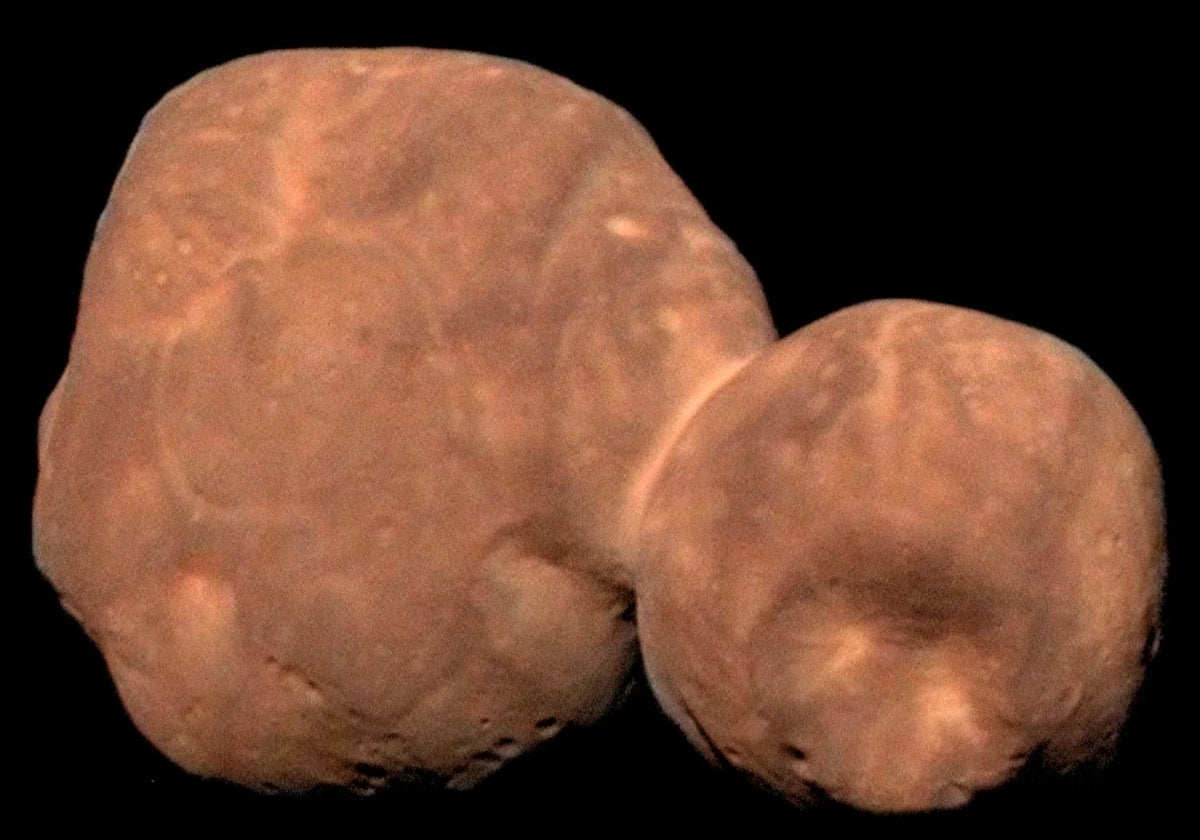
app.buzzsumo.comAstronomers detected a thin atmosphere around the object (612533) 2002 XV93 using three telescopes in Japan. The object, 300 miles (500 kilometers) across, is located beyond Pluto in the Kuiper Belt and classified as a plutino. A plutino circles the sun twice in the time it takes Neptune to complete three solar orbits.
5 billion kilometers) away from Earth, farther than Pluto. Pluto is the only other object in the Kuiper Belt with an observed atmosphere. The atmosphere of (612533) 2002 XV93 is 5 million to 10 million times thinner than Earth's atmosphere and 50 to 100 times thinner than Pluto's atmosphere.
The study was published in the journal Nature Astronomy on Monday. Researchers observed (612533) 2002 XV93 in 2024 as it passed in front of a background star, with the observation occurring on January 10, 2024, according to lead researcher Ko Arimatsu. The telescopes were located in Kyoto, Nagano Prefecture, and Fukushima in Japan.
5 seconds near the edge of the shadow, Ko Arimatsu said. The surface pressure of the atmosphere on (612533) 2002 XV93 is about 100 to 200 nanobars, according to Arimatsu. Ko Arimatsu is an associate professor at the National Astronomical Observatory of Japan.
"This is an amazing development, but it sorely needs independent verification. The implications are profound if verified," said Alan Stern, the lead scientist behind NASA's New Horizons mission to Pluto and beyond, who works at Southwest Research Institute and was not involved in the study.
"It changes our view of small worlds in the solar system, not only beyond Neptune," Arimatsu said in an email.
The object (612533) 2002 XV93 has a diameter of 311 miles (500 kilometers), while Pluto has a diameter of 1,477 miles (2,377 kilometers). 5 billion years ago. The object (612533) 2002 XV93 was discovered nearly a quarter of a century ago.
"This was an exciting discovery to read about," said Scott S. Sheppard, a staff scientist at the Carnegie Institution for Science in Washington, DC, who did not participate in the research. " Sheppard noted the finding highlights recent activity on (612533) 2002 XV93, whether from the eruption of frozen gases or material from a collision.
"This shows the Kuiper Belt is not a cold dead place, but is teeming with activity and has many of the building blocks for life," Sheppard said in an email. Jose-Luis Ortiz, a Spanish astronomer who studies dwarf planets beyond Neptune and was not involved in the research, said the results were interesting but urged caution. "I still doubt that it is an atmosphere.
We need more data," Ortiz told AFP. The likeliest atmospheric chemicals are methane, nitrogen or carbon monoxide, according to Arimatsu. Further observations, especially by NASA's Webb Space Telescope, could verify the makeup of the atmosphere.
"That is why future monitoring is so important," Arimatsu said. "If the atmosphere fades over the next several years, that would support an impact origin. If it persists, or varies seasonally, that would point more toward ongoing internal gas supply" from ice volcanoes.
Arimatsu acknowledged that he could not rule out "exotic alternatives" to an atmosphere, such as a ring close to the body. However, "a nearly edge-on ring does not seem consistent with the main features of our observations," he added. The discovery could offer an unprecedented glimpse into how an atmosphere forms and remains around a small object, changing how astronomers think about objects in the Kuiper Belt.
Key Facts
Story Timeline
5 events- Monday (recent)
The study was published in the journal Nature Astronomy
1 sourceunattributed - 2024-01-10
Researchers observed (612533) 2002 XV93 as it passed in front of a background star using telescopes in Japan
2 sourcesunattributed · Ko Arimatsu - 2024
Astronomers detected a thin atmosphere around (612533) 2002 XV93
1 sourceunattributed - Nearly a quarter of a century ago (circa 2002)
The object (612533) 2002 XV93 was discovered
1 sourceunattributed - 4.5 billion years ago
Trans-Neptunian objects (TNOs) formed as remnants from the solar system's formation
1 sourceunattributed
Potential Impact
- 01
Challenges conventional views on atmospheres for small solar system bodies, potentially leading to revised models of TNO evolution
- 02
May encourage searches for atmospheres on other small TNOs, expanding knowledge of outer solar system dynamics
- 03
Prompts future observations with telescopes like James Webb to verify composition and origin, advancing Kuiper Belt research
- 04
Highlights ongoing activity in the Kuiper Belt, influencing studies on potential building blocks for life in distant objects
- 05
Requires independent verification, potentially affecting credibility of stellar occultation methods if unconfirmed
Transparency Panel
Related Stories
Explosion at China Fireworks Factory Kills 26 and Injures 61 in Hunan Province
An explosion at the Huasheng Fireworks Manufacturing and Display Company in Liuyang, Hunan province, killed at least 26 people and injured 61 on Monday afternoon. Rescue operations concluded with evacuations and production halts at local fireworks manufacturers. President Xi Jinp…
indiatoday.intoday.inTrump Pauses Project Freedom in Strait of Hormuz Amid Progress on Iran Agreement
President Trump announced a temporary pause to Project Freedom, the U.S. effort to escort ships through the Strait of Hormuz, citing mutual agreement with Iran to facilitate finalizing a deal while the blockade remains in place. The decision follows requests from Pakistan and oth…
Australian Government Introduces Levy on Tech Platforms to Support Local News Publishers
Australia's government introduced the News Bargaining Incentive to shield publishers from big tech's use of news content. President Trump imposed a 100% tariff on imported pharmaceuticals, but Australia stated it would not raise drug prices. On International Day of the Midwife, g…