science
Astronomers Identify Metal-Poor Stars Near Milky Way Disk as Possible Remnants of Ancient Galaxy
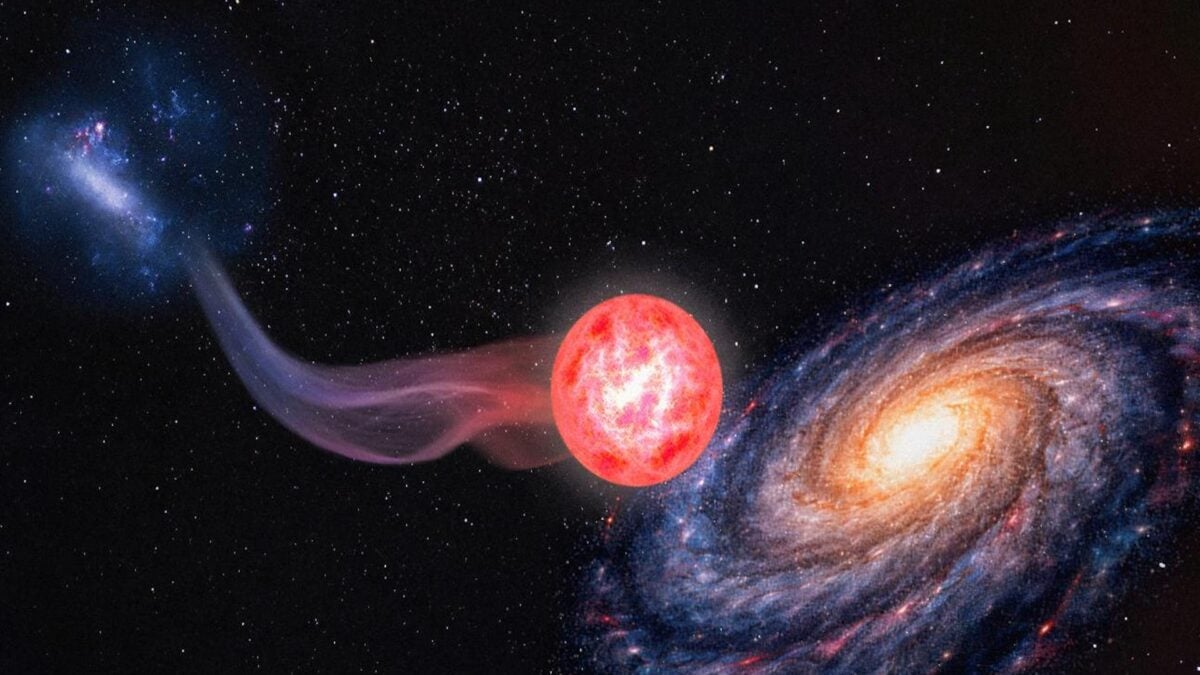
A new study published in May reports that 20 metal-poor stars located roughly 7,000 light-years from the Sun may be remnants of a dwarf galaxy the Milky Way absorbed more than 10 billion years ago. Researchers named the proposed galaxy Loki and used data from the European Space Agency's Gaia telescope and the Canada-France-Hawaii Telescope.
May 23, 7:30 AM·2m read1 source
 gizmodo.com
Audio version
Tap play to generate a narrated version.
Astronomers have identified a group of 20 metal-poor stars near the Milky Way's galactic disk that may be the remains of a dwarf galaxy absorbed by the Milky Way more than 10 billion years ago. The study, published in May in the journal Monthly Notices of the Royal Astronomical Society, concludes that the stars share similar chemical compositions and are older than 10 billion years.
Eleven of the stars follow prograde orbits aligned with the galactic disk while nine follow retrograde orbits.
Observations and Methods Researchers led by Dr.
Federico Sestito at the University of Hertfordshire used observations from the European Space Agency's Gaia telescope, which mapped motions and compositions of 2 billion stars between July 2014 and January 2025. Follow-up spectra were obtained with the Canada-France-Hawaii Telescope.
The stars lie about 7,000 light-years from the solar system. Their metal-poor composition and mixed orbital directions suggest they originated in a single dwarf galaxy that merged with the Milky Way when it was smaller.
The Milky Way is estimated to span 100,000 light-years and contain between 100 billion and 400 billion stars. It is understood to have grown through repeated mergers with smaller galaxies beginning about 12 billion years ago. A comparable earlier merger with the Gaia-Sausage-Enceladus galaxy occurred between 8 billion and 10 billion years ago.
The new findings suggest the proposed Loki merger was of similar scale but left remnants closer to the disk that are harder to detect. Dr. Cara Battersby of the University of Connecticut, who was not involved in the study, noted that very-metal-poor stars preserve information about the conditions of the early universe.
Dr. Hans-Walter Rix of the Max Planck Institute for Astronomy said the chemical abundances serve as a fingerprint linking the stars to a common origin in a now-disrupted satellite galaxy. The study authors state that the merger could have occurred no later than 3 or 4 billion years after the Big Bang.