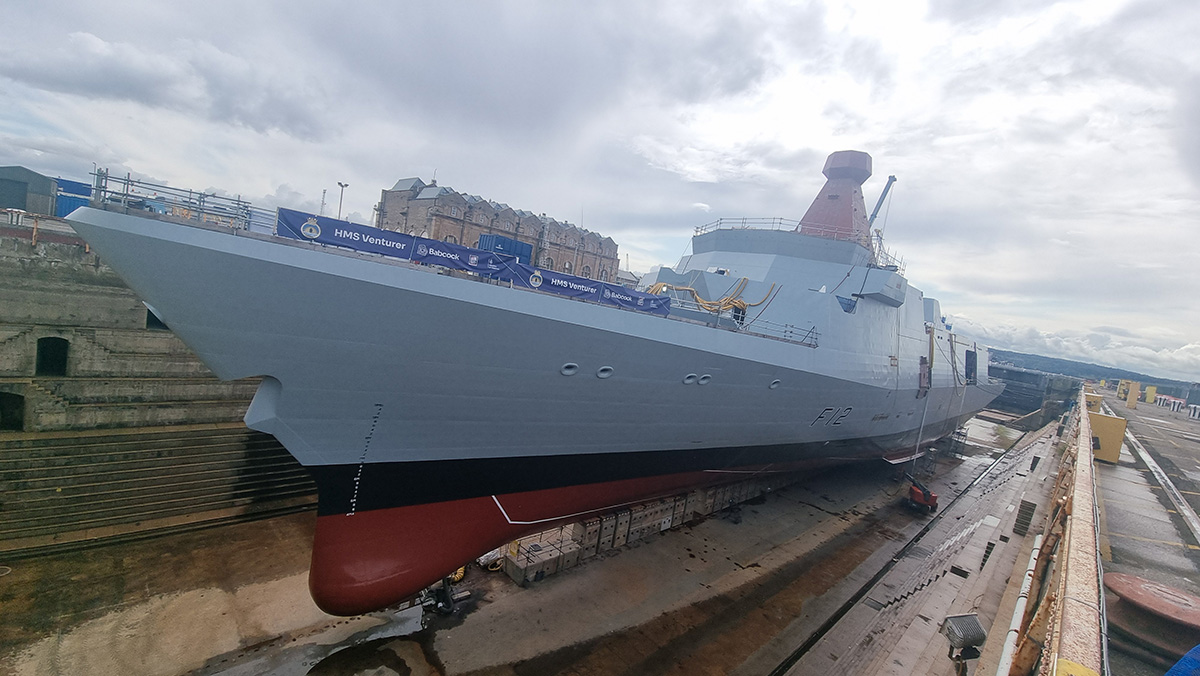
Babcock Reports £140m Remedial Costs on First Two Type 31 Frigates
Babcock International said the first two vessels, HMS Venturer and HMS Active, are out of sequence due to identical mistakes, pushing cumulative losses on the programme above £300 million. Both ships have been floated for fitting out while the company absorbs the overrun under its 2019 fixed-price contract with the Ministry of Defence.
ukdefencejournal.org.ukConstruction errors have forced the first two Royal Navy Type 31 frigates out of sequence, Babcock International confirmed in a trading update on Wednesday. HMS Venturer bore the brunt of the mistakes, with identical errors also made on HMS Active. The defence contractor said the remedial work will cost £140 million and will bring cumulative losses on the Type 31 programme to more than £300 million.
Babcock signed a fixed-price agreement with the Ministry of Defence in 2019 under which the company is responsible for absorbing all cost overruns. Approximately £100 million of the £140 million charge will appear as a revenue reversal in the 2026 financial year. The firm now anticipates operating profits of £293 million for the year ending March, a drop from £363 million the previous year.
Both HMS Venturer and HMS Active have now been floated and are undergoing fitting out. HMS Formidable has had its keel laid and construction has commenced on a fourth vessel, HMS Bulldog. Babcock declined to say whether correcting the engineering errors would result in additional delays.
HMS Venturer was initially expected to enter service in 2023. That target was later pushed back to 2027. The complete five-ship Type 31 fleet is anticipated to be operational by the early 2030s. Type 31 vessels are intended to serve as the backbone of the Royal Navy's future fleet.
The 5,700-tonne warships will measure approximately 450 ft in length, accommodate crews of around 100 sailors and reach speeds of roughly 30 mph. They are capable of deploying helicopters, missiles, armed interceptor craft and drones. The frigates are designed to handle counter-piracy, tackling people smuggling, and full armed conflict.

They are being built to replace the ageing Type 23 frigates currently in service with the Royal Navy. The vessels earned the nickname 'Lidl frigates' due to their planned cost of £250 million per ship. The construction problems compound pressure on the Royal Navy's fleet.
HMS Iron Duke was effectively withdrawn from active duty last week, reducing the number of operational Type 23 frigates to five. Earlier this year, chief executive David Lockwood spoke at Babcock's Scottish shipyard. He described the programme's progress as a "powerful demonstration of the drive and delivery focus" of the Type 31 project.
Lockwood praised the milestones as evidence of "the maturity of our facility, the success of the design and build process, and the skill and dedication of our Babcock team". A Government spokesman defended the project. The spokesman said authorities were "providing world-class shipbuilding in Rosyth" and "sustaining 1,250 jobs for Scottish shipbuilding".
GB News reported the full details of Babcock's trading update and the company's statements.
Key Facts
Story Timeline
4 events- 2019
Babcock signed fixed-price agreement with the Ministry of Defence for Type 31 programme
1 sourceGB News - 2023
HMS Venturer originally scheduled to enter service
1 sourceGB News - Last week
HMS Iron Duke effectively withdrawn from active duty, reducing operational Type 23 frigates to five
1 sourceGB News - 2026-05-13
Babcock announces £140 million remedial costs, cumulative losses over £300 million, and revised profit forecast
1 sourceGB News
Potential Impact
- 01
Royal Navy Type 23 fleet reduced to five operational vessels following HMS Iron Duke withdrawal
- 02
Babcock absorbs full £140 million overrun under fixed-price contract, reducing expected profits
- 03
Continued employment of 1,250 jobs at Rosyth shipyard
- 04
Further potential delay to HMS Venturer and HMS Active beyond current 2027 target
Transparency Panel
Related Stories
ibtimes.comSEC Chair Paul Atkins Says Congress Will Pass Crypto Legislation
SEC Chair Paul Atkins stated he is confident Congress will pass crypto market structure legislation. He added that President Trump will sign the bill into law.
asiaone.comIran Says Strait of Hormuz Management Belongs to Iran and Oman
Iran's Foreign Ministry spokesperson stated that control of the Strait of Hormuz must be decided solely by Iran and Oman. The spokesperson also said no agreement has been reached with the United States and that current focus remains on ending the war.
cnbc.comFed Official Highlights Regulatory Barriers to AI Productivity Gains
A Federal Reserve official stated that productivity growth remains key to economic expansion and that regulatory hurdles are the main obstacle to sustained gains from artificial intelligence.