finance
Bitcoin Surges to $82,400 Before Modest Pullback as CME Futures Open
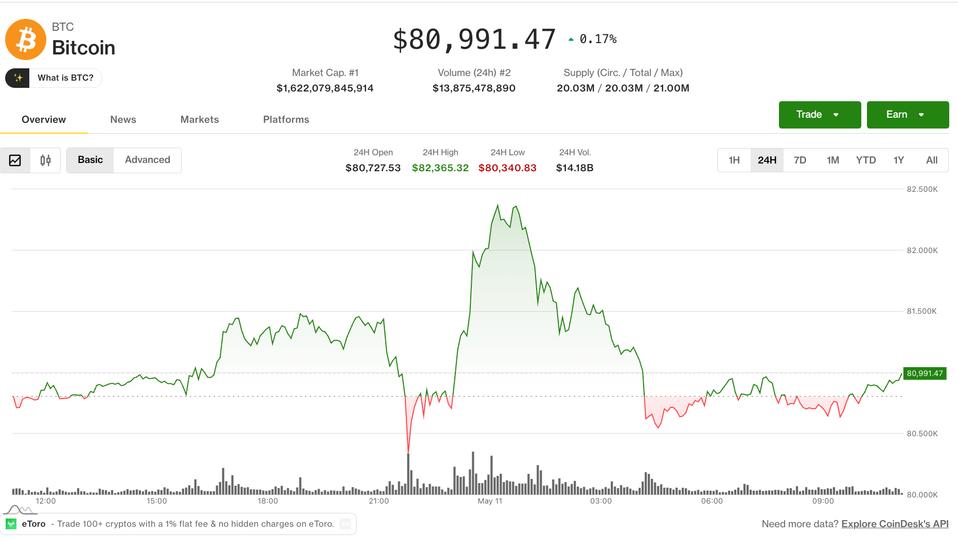
Bitcoin surged from $80,670 at 23:00 UTC Sunday to $82,400 within an hour on May 11, 2026, before trading narrowly beneath $81,000 as futures reopened. The move coincided with geopolitical tensions after President Donald Trump called Iran's response to a peace proposal 'totally unacceptable.' Venice's VVV token more than doubled in the past month amid emissions cuts and new AI partnerships.
May 11, 6:28 AM·2m read1 source
 CoinDesk
Audio version
Tap play to generate a narrated version.
Developing·Limited corroboration so far. This page will refresh as more sources emerge.
U.S. equity futures reopened. The cryptocurrency rose from $80,670 at 23:00 UTC on May 10, 2026, before topping at $82,400 roughly one hour later.
01 according to CoinDesk Data. The move coincided with the weekly open of bitcoin futures on the CME on May 11, 2026. U.S. Geopolitical developments added pressure. U.S. President Donald Trump said Iran's response to a peace proposal was "totally unacceptable" on or before May 11, 2026.
U.S. dollar while weighing on risk assets including crypto. All major crypto benchmarks declined. 5 percent on May 11, 2026. 6 percent the same day.
Crypto market-wide futures open interest remained just above $130 billion for the fourth straight day as of May 11, 2026. Centralized exchanges liquidated over $400 million in leveraged futures bets, with shorts accounting for most of that amount. Individual token open interest diverged.
SUI's open interest surged by 29 percent as of May 11, 2026. OI in futures tied to the ZEC token declined by 6 percent the same day.
U.S. CPI and PPI releases due later this week from May 11, 2026. On Deribit, bitcoin calls at strikes ranging from $81,000 to $86,000 dominate the volume rankings as of May 11, 2026. Block flows featured bitcoin long call condors.
Separately, Venice’s VVV token more than doubled in the past month as of May 11, 2026. Venice doubled its subscription-linked burn rate in late April 2026. Pro, Pro+ and Max subscriptions on Venice now trigger $2, $5 and $10 VVV burns respectively.