Brain-Controlled System Decodes Auditory Attention With Up to 90% Accuracy in Small Lab Study
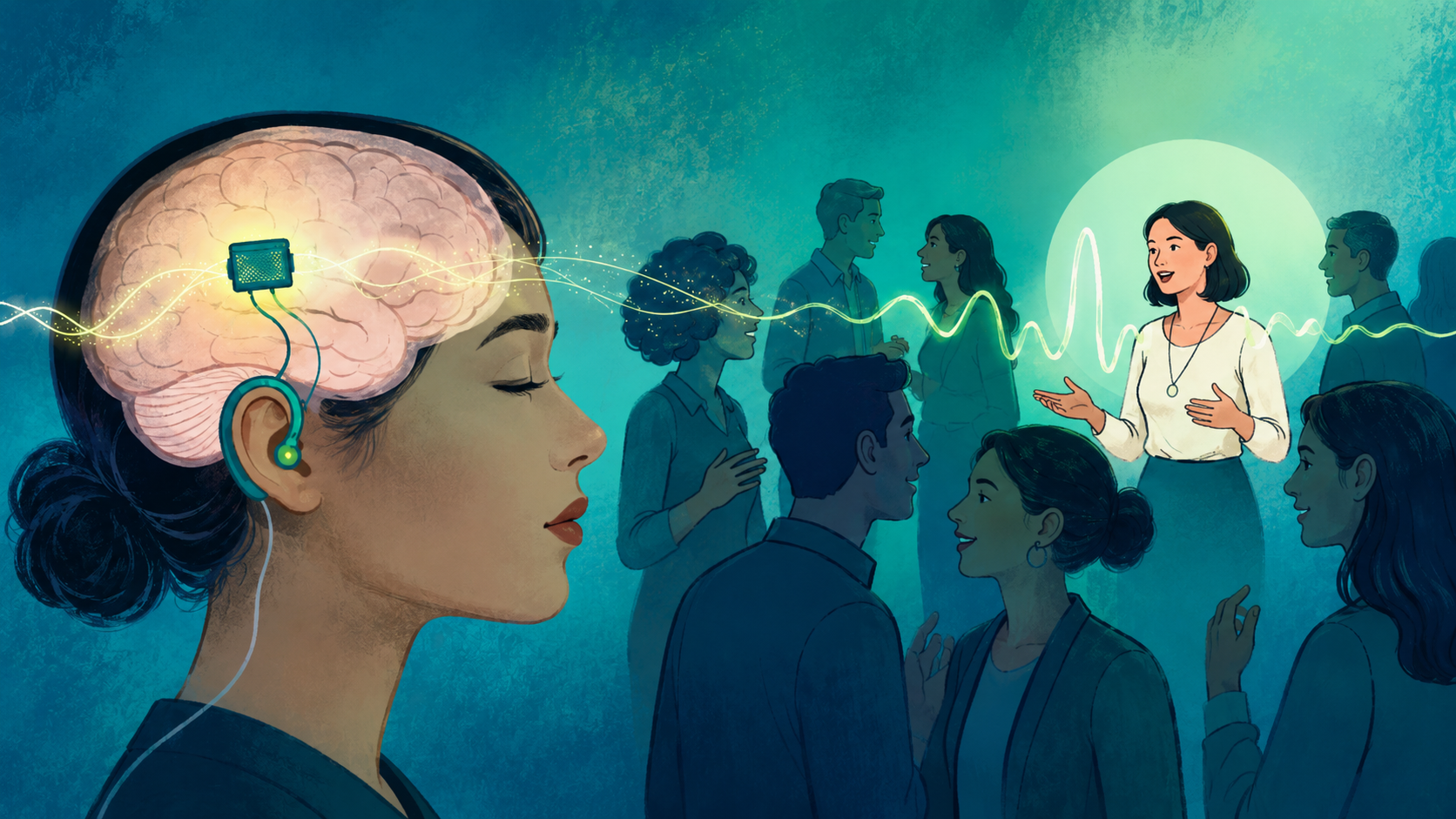
A real-time brain-controlled system decoded which voice a listener wanted to hear and amplified it, improving comprehension up to 90 percent of the time in tests. The study, published in Nature Neuroscience on or before May 13 2026, builds on a 2012 discovery about auditory cortex brain waves.
news-medical.netA real-time brain-controlled hearing system correctly detected which conversation a person wanted to hear up to 90 percent of the time and increased comprehension while decreasing listening effort when activated, according to a study published in the journal Nature Neuroscience on or before May 13 2026.
Nima Mesgarani, an associate professor at Columbia University who runs the Neural Acoustic Processing Lab, is an author of the paper. The effort was led by Vishal Choudhari, who was a graduate student in Mesgarani's lab at the time of the research and is currently a research scientist at a startup working on next-generation hearing technologies.
The discovery that brain waves in the auditory cortex show a distinct pattern when focusing on one voice was made in 2012 by Mesgarani and Dr. Eddie Chang, a neurosurgeon at the University of California, San Francisco. "The pattern of activity gives us a signature," Mesgarani says.
The experiment was conducted on four people with typical hearing who were hospitalized for epilepsy treatment and already had electrodes implanted in their brains. The system used intracranial electroencephalography (iEEG) electrodes to record brain activity from speech and sound-processing regions.
Participants listened to two competing conversations played from two loudspeakers in front of them.
Competing conversations were initially played at the same volume, leaving the participants struggling to comprehend either one. "They have two loudspeakers in front of them," Mesgarani says. " The brain-controlled system was tested in realistic multi-talker and noise conditions including similar voices of the same gender and background sounds such as street noise and crowd chatter.
Participants verified attention by pressing a button upon hearing repeated words in the target conversation. Npr reported that when the system was switched on, "their comprehension went up and their listening effort [went] down," Mesgarani says. A separate group of listeners with hearing loss preferred and better understood the system-enhanced audio.
The study tested auditory attention decoding (AAD) technology that detects the voice an individual is listening to based on brain activity signals. Josh McDermott runs the Laboratory for Computational Audition at MIT and was not involved in the study. He said the system might be less accurate when reading the brain waves of people with hearing loss because the signal is weaker.
"They have some pretty good algorithms for reducing background noise," McDermott says of current hearing aids. " More than half of people 75 and older are living with disabling hearing loss. The new approach could lead to better hearing technology, including hearing aids, assistive listening devices and cochlear implants.
Whether the system will work as well for people with hearing loss remains an "open question," McDermott says. The findings open avenues for the development of brain-guided hearing aids to improve voice recognition and hearing in busy environments like restaurants or parties.
Key Facts
Story Timeline
3 events- 2012
Nima Mesgarani and Dr. Eddie Chang discover distinct brain wave patterns in the auditory cortex for focusing on one voice
1 sourceNpr - 2026-05-13
Study on real-time brain-controlled hearing system published in Nature Neuroscience
2 sourcesnews-medical.net · Npr - 2026-05-14
Npr reports details of the Columbia University-led experiment and expert reactions
1 sourceNpr
Potential Impact
- 01
Advances in real-time auditory attention decoding (AAD) technology for cochlear implants and assistive devices
- 02
Potential development of brain-guided hearing aids that amplify specific voices rather than all sounds
- 03
Improved speech perception for more than half of people aged 75 and older with disabling hearing loss
Transparency Panel
Related Stories
NprWHO Director Visits Congo as Ebola Outbreak Spreads
The head of the World Health Organization arrived in Kinshasa to support efforts against a rare Ebola strain. Health workers face equipment shortages, community distrust, and armed conflict in affected provinces.
medpagetoday.comFDA Panel Recommends XFG Variant for Fall Covid Shots
Replimune will submit an application to the FDA for the third time. Pfizer and Innovent Biologics reached a collaboration agreement valued at up to $10.5 billion.
Benzinga Publishes Article on Biotech Stocks During Pandemic Recovery
Benzinga published an article titled 'Best Biotech Stocks Right Now' that addresses the sector's position during global recovery from the pandemic. The piece notes government institutions and professional traders are focusing on biotech companies for vaccine and booster developme…