Bumblebees Demonstrate Spontaneous Object Manipulation in Controlled Experiments
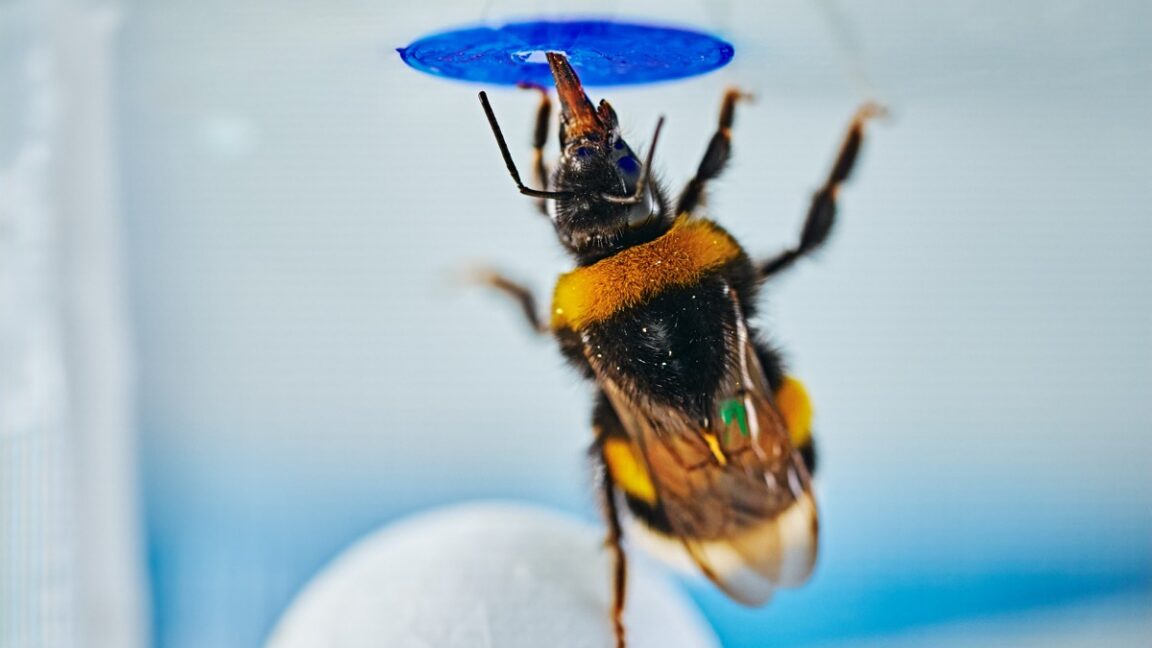
A study published in Science shows bumblebees can spontaneously use a ball as a ladder to reach a flower, marking the first demonstration of this type of problem-solving in an insect.
 Ars Technica
Bumblebees solved an object-manipulation task without prior training by rolling a small ball into a pit and climbing on it to reach an artificial flower placed above, according to a study published in the journal Science in 2026. ady1618, was led by researchers including Olli Loukola of the University of Oulu in Finland.
It is the first time spontaneous problem-solving of this kind has been demonstrated in an insect.
Loukola previously co-authored a 2024 study in which pairs of bees were trained to push a Lego block to the middle of a mini-arena or push against a door at the end of a tunnel to obtain a reward. In the first experiment of the new study, one group of bees learned that the flower provided a sugary reward and that the ball could be moved into the pit, but received no instruction on completing the full task.
A second group learned only that the flower was a reward source, and a third group received no training.
Bees in the first group solved the problem at a much higher rate than those in the other two groups. A second version of the experiment used a barrier with a small opening that blocked the bees’ view of the flower. Sixteen of 22 bees succeeded in rolling the ball through the opening to reach the flower.
When the experiment was repeated with three openings in the barrier, performance showed no significant differences between trained and untrained bees. In a final test, a rectangular arena contained two compartments invisible to the bees. Thirty bees participated.
Twenty-three moved the ball into the correct compartment, and 16 of those 23 did so without first moving the ball into the incorrect compartment. The experimental setups had no way to track the bees’ gaze, posture, or other behavioral cues. “This is an insect version of the classic ‘box-and-banana’ problem,” Loukola stated.
The authors wrote that the present design provides the clearest evidence to date that bumblebees are capable of generating novel, goal-directed solutions.
Transparency
Story details
Related Stories
Frontier AI Labs Report Rapid Capability Gains and AI-Written Code; Anthropic Calls for Coordinated Slowdown
Anthropic called for a slowdown or pause among labs developing the most advanced AI systems. The request appeared in a Thursday blog post from its research institute.
 Euronews
Small Phase 1 Safety Trial Tests First AI-Designed Coronavirus Vaccine Candidate
A Phase 1 safety study of an AI-designed protein vaccine against multiple coronaviruses enrolled 39 volunteers and reported no significant safety issues. A Phase 2 trial is now planned.
 TechCrunch
Cash App Releases $25 NFC Star-Shaped Tap-to-Pay Wand
Cash App will begin selling a star-shaped wand on Thursday that links to its debit card and works at any Visa contactless terminal. The $25 device is the first in a planned line of NFC tags aimed at younger users.