Chinese Researchers Document 485 Whale Skeletons Across 1,200 km of Deep Indian Ocean Seafloor
Researchers catalogued the remains along a 1,200-kilometer corridor at depths reaching 7,000 meters. The site includes both recent whale falls and fossils dating back 5.3 million years.
 earther.gizmodo.com
Chinese scientists have documented 485 whale skeletons along a 1,200-kilometer corridor on the seafloor west of Australia, establishing the largest, deepest and oldest known whale graveyard on Earth. The remains lie in the Diamantina Zone of the southeastern Indian Ocean at depths up to 7,000 meters. 3 million years ago, while others represent recent whale falls.
A previously unknown extinct species of beaked whale was identified among the bones. The research was published Wednesday in the journal Nature. Most of the catalogued fossils belong to various species of beaked whales.
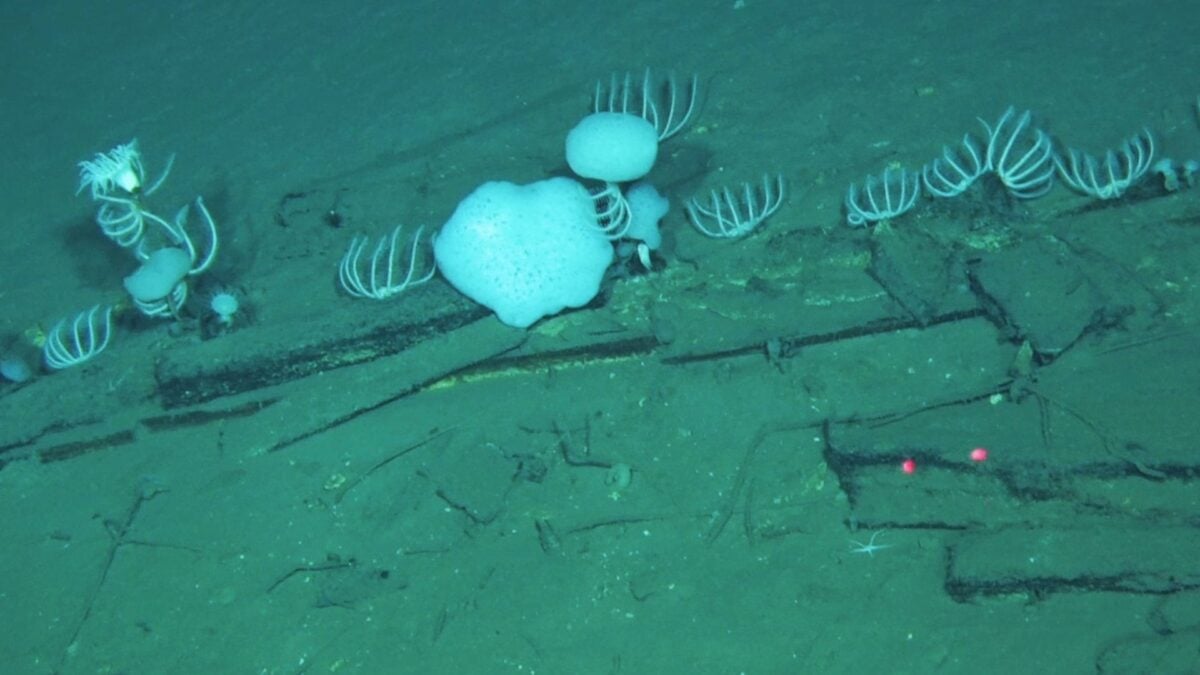
The site also supports diverse communities of deep-sea organisms, including jellyfish, brittle stars, bone-boring worms and bivalves, many believed to be new to science. The Fendouzhe submersible carried out 32 dives in 2023 to locate and sample the remains. The vessel carried up to three people and used robotic arms to collect fossil material.
Lead author Xiaotong Peng of the Chinese Academy of Sciences said the team was astonished when the scale of the discovery became clear. "Discovering a necropolis of this scale was completely unexpected: the size of distribution, the depth and the age range were far beyond anything we had imagined," Xiaotong Peng told AFP.
The area is a known foraging habitat for whales, and its V-shaped trench funnels carcasses to the seafloor.
Extrapolating from sampled bones, Xiaotong Peng estimated more than 10 million carcasses may exist across the Diamantina Zone. 7 million tonnes of sequestered carbon, he said. " He said the vibrant ecosystems offered a completely different perspective on the otherwise dark and cold ocean floor.
Xikun Song, a biologist with the Chinese Academy of Sciences' Institute of Deep-sea Science and Engineering, told The Associated Press that a whale's size and the unique chemistry of its bones are the keys to forming these underwater neighborhoods. Craig Smith, who discovered the first whale fall in 1987, told AFP the documentation of so many fossil whale falls, including a new species of beaked whale, is of major importance to understanding whale evolution and distributions over geologic time.