Substrate
world

Chinese Scientists Develop Self-Degrading Plastic Material

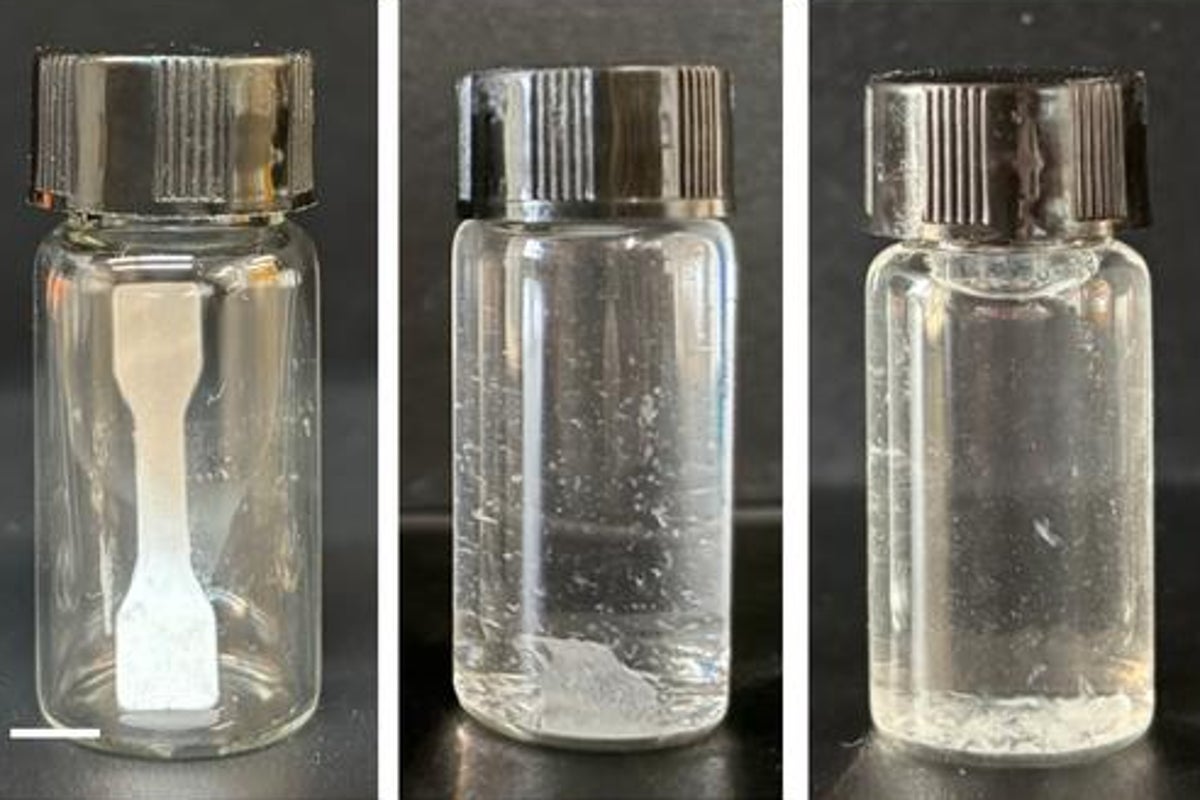
Researchers incorporated two strains of Bacillus subtilis bacteria into polycaprolactone to create a material that breaks down completely in six days when activated. The bacteria produce complementary enzymes that degrade the polymer into its base building blocks without forming microplastics. The study was published in ACS Applied Polymer Materials.

The Independent
1 source·May 12, 8:29 AM(17 days ago)·1m read
Chinese Scientists Develop Self-Degrading Plastic MaterialThe Independent
Audio version
Tap play to generate a narrated version.
Developing·Limited corroboration so far. This page will refresh as more sources emerge.

Chinese scientists have created a plastic material containing living bacteria that can be triggered to break down completely without leaving microplastics. The material uses two strains of the common bacterium Bacillus subtilis that work together to degrade polycaprolactone, a polymer used in 3D printing and some medical sutures.

The bacteria remain dormant as spores until placed in a nutrient broth and heated to 50 degrees Celsius. Once activated, the strains produce different enzymes that degrade the plastic. One enzyme cuts long polymer chains at random points while the other breaks the resulting fragments down from the ends into their smallest molecular building blocks.

The process completely degrades the material within six days. The study, published in the journal ACS Applied Polymer Materials, states that the cooperative enzymatic activity within the microbial consortia outperforms that of a single-strain system.

Previous efforts to create living plastics relied on a single enzyme. The Chinese researchers engineered two Bacillus subtilis strains, each producing a different polymer-degrading enzyme, to improve efficiency. The microbes were incorporated into the plastic in spore form to protect them until degradation was required.

The resulting material maintains stable mechanical properties suitable for its intended uses. Scientists protected the bacteria in their dormant spore form during the manufacturing process.

Researchers plan to develop a trigger mechanism that activates the bacterial spores in water, where much plastic waste accumulates. They also intend to adapt the approach for other common plastics, including those used in single-use products. Current conventional plastics are designed for single use but can persist in the environment for years.

The new material addresses the challenge of non-biodegradable waste by enabling on-command degradation down to base building blocks.

Key Facts

Two Bacillus subtilis strains
produce complementary polymer-degrading enzymes
Complete degradation
occurs within six days at 50C in nutrient broth
Polycaprolactone base
used in 3D printing and surgical sutures
No microplastics
material breaks down to base building blocks

Story Timeline

3 events
  1. 2026

    Chinese researchers published study on bacteria-enhanced self-degrading plastic.

    1 sourceThe Independent
  2. During testing

    Activated bacteria fully degraded polycaprolactone material in six days.

    1 sourceThe Independent
  3. Next phase

    Scientists plan to develop water-based activation trigger for spores.

    1 sourceThe Independent

Potential Impact

  1. 01

    The material could reduce persistence of certain plastics in the environment if commercialized.

  2. 02

    Approach may be extended to other common single-use plastics beyond polycaprolactone.

  3. 03

    Water-based activation would allow degradation of the material in typical waste environments.

Transparency Panel

Sources cross-referenced1
Confidence score65%
Synthesized bySubstrate AI
Word count285 words
PublishedMay 12, 2026, 8:29 AM
Bias signals removed3 across 2 outlets
Signal Breakdown
Loaded 1Editorializing 1Framing 1

Related Stories

WHO Chief Visits DRC as Ebola Death Rate Reaches 30-50%The Guardian
world26 min ago

WHO Chief Visits DRC as Ebola Death Rate Reaches 30-50%

World Health Organization director-general Tedros Adhanom Ghebreyesus arrived in the Democratic Republic of the Congo to support containment of a new Ebola outbreak. The agency revised the death rate to 30-50% based on confirmed cases and recorded 10 confirmed and 223 suspected d…

SK
The Guardian
2 sources
Greek National Charged in UK With Aiding Iran-Linked Intelligence Servicewesternjournal.com
world26 min ago

Greek National Charged in UK With Aiding Iran-Linked Intelligence Service

A 46-year-old Greek man living in Germany was charged under the UK National Security Act with assisting an intelligence service believed to be Iran by targeting a journalist at Iran International.

Reuters
BBC News
2 sources
Journalists in Gaza to Receive 2026 Golden Pen of Freedom Awardstraitstimes.com
world2 hrs ago

Journalists in Gaza to Receive 2026 Golden Pen of Freedom Award

Three international news agencies will accept the award on behalf of their local staff still reporting from the territory. The World Association of News Publishers cited the journalists' continued coverage under extreme conditions.

Al-Monitor
AF
2 sources