CMS Tightens Medical Frailty Exemption Process in Medicaid Work Requirement Rule
The Centers for Medicare and Medicaid Services issued an interim final rule on Monday that narrows the medical frailty exemption and adds new attestation requirements for patients seeking to avoid work reporting rules under the One Big Beautiful Bill Act.
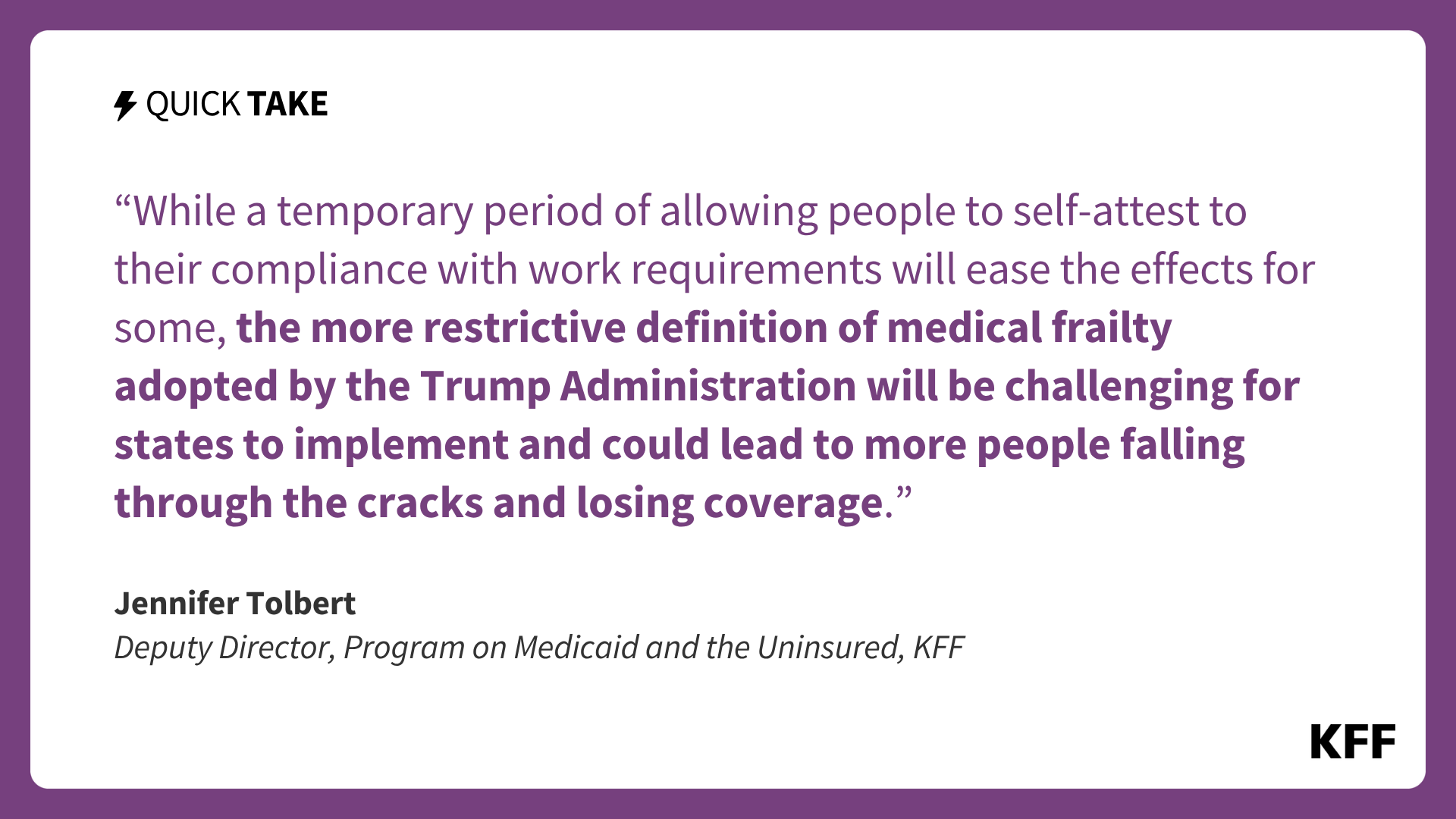 kff.org
The Centers for Medicare and Medicaid Services issued an interim final rule on Monday that narrows the medical frailty exemption under the One Big Beautiful Bill Act and requires patients to complete additional steps to qualify for it. The rule takes effect July 31, 2026.
Starting nationwide in 2028, patients must navigate new red tape to attest they qualify for the exemption rather than simply certifying their condition.
Gwen Nichols, chief medical officer of Blood Cancer United, said the interim final rule is in direct conflict with the One Big Beautiful Bill Act. She stated that Congress chose to exempt people with serious medical needs like cancer patients from the work reporting requirements.
The One Big Beautiful Bill Act became law a few weeks after May 2025 and included Medicaid work reporting requirements.
The legislation mandated that states verify Medicaid enrollees’ monthly work status at least every six months and required a minimum of 80 hours per month of community service, educational activities, and/or work. Medicaid is a state and federal program that covers more than 75 million Americans including older adults, children, veterans, people with disabilities, pregnant people, and adults with low incomes.
In May 2025, Gwen Nichols joined more than 160 blood cancer advocates on Capitol Hill while Congress was considering changes to Medicaid.
The advocates met with congressional staff and lawmakers to oppose work reporting requirements. Weeks before the final One Big Beautiful Bill Act passed, Brett Guthrie, chair of the House Energy and Commerce Committee, wrote in the New York Post that the policy applied only to able-bodied, unemployed adults and included exemptions for people who are medically frail, including those living with a serious and complex medical condition like cancer.
The interim final rule limits patients’ ability to attest that they qualify for their exemption.
Nichols said one small misstep by a patient, provider, contractor, or state employee could mean the difference between having health coverage and losing it. Research shows that continuous access to Medicaid is critical to the survival of children and young adults with cancer. Nichols said the rule forces states to go far beyond what Congress included in its legislative text.
Arkansas implemented Medicaid work requirements during the first Trump administration. Implementation led to significant coverage losses and no increase in employment.
The state saw small coverage gains but at a prohibitively expensive operating cost. Brian Becker, a 32-year-old father and leukemia patient from Texas, died while he was waiting to qualify for Medicaid coverage. His family received a denial letter stating he didn’t qualify for disability while mourning his death.
Amanda Brunson, a Florida-based volunteer with Blood Cancer United, was diagnosed with acute lymphoblastic leukemia at 21 years old and again at 25. She weighed 88 pounds at her lowest point during treatment and credits Medicaid for saving her life.
Nichols said there is still time before the July 31, 2026 effective date for the administration to correct the rule and for Congress to ensure that their promises of exemptions were not hollow.
Transparency
Story details
Related Stories
 France 24
Marjane Satrapi, Author of 'Persepolis,' Dies at 56 a Year After Husband
The French-Iranian graphic novelist died Thursday in a statement from people close to her. She had refused France's highest civilian honor last year over its Iran policy.
 spacenews.com
NASA Loses Contact with MAVEN Mars Orbiter, Begins Decommissioning After Battery-Draining Anomaly
The agency announced Wednesday that the MAVEN orbiter is unrecoverable following an anomaly that drained its batteries. The mission produced more than 800 publications on Mars’ atmosphere over twelve years.