Democratic senators seek AI limits in defense bill
Senators plan amendments to the annual defense policy bill that would restrict military AI use for nuclear launches, domestic surveillance, and autonomous weapons. The Senate is scheduled to begin markup next week.
 The Hill
Democratic senators are seeking to add restrictions on military artificial intelligence use to the annual defense authorization bill. The House Armed Services Committee is set to debate the legislation on Thursday. Sen. Kirsten Gillibrand introduced a bill Tuesday that would limit AI applications for launching nuclear weapons, surveilling Americans, and developing or deploying autonomous weapons.
A congressional aide said she intends to offer parts of the measure as an amendment to the Senate version of the National Defense Authorization Act. The Senate is expected to begin markup of the bill next week. The proposed Secure and Accountable Military AI Act would require human involvement in decisions involving use of force, detention, or high-consequence actions.
Amendment details High-consequence actions are defined in the bill as those involving nuclear command and control, lethal targeting, domestic surveillance, and cyber operations. These actions would also require approval from a senior-level official.
Gillibrand stated that critical national security decisions must remain with humans rather than machines. She added that the Pentagon is moving toward deploying powerful AI technology without guardrails. Sen. Elissa Slotkin plans to offer her own AI Guardrails Act as an amendment, according to NOTUS.
That measure, introduced in mid-March, would bar the Pentagon from using AI to fire autonomous weapons without human oversight, launch nuclear weapons, or conduct surveillance on Americans.
Background The amendment push follows a dispute between the Pentagon and Anthropic over contract language for AI systems. Anthropic sought limits on mass domestic surveillance and autonomous lethal weapons, while the Defense Department sought broader lawful-use provisions.
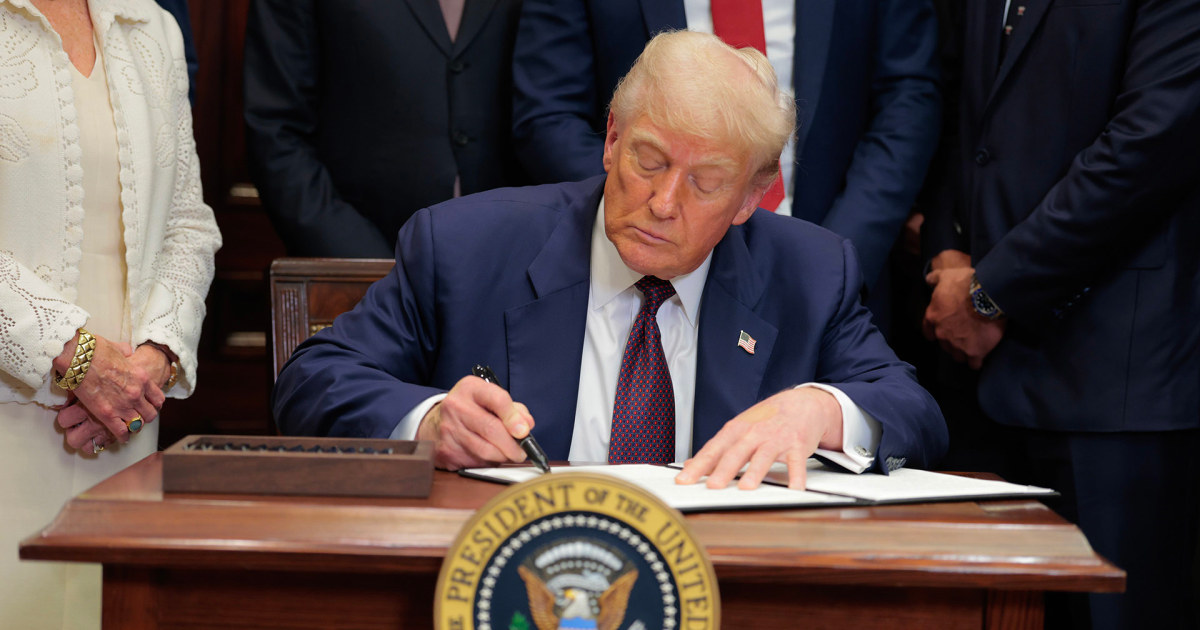
The disagreement led to the Pentagon designating Anthropic a supply chain risk, prompting the company to challenge the designation in court. President Trump signed an executive order Tuesday directing agencies to strengthen defenses against advanced AI and create a voluntary framework for early government access to company models.
Defense Secretary Pete Hegseth has advocated for AI use in classified military networks. The Pentagon announced in early May that eight major AI companies agreed to deploy systems in those networks. Last week, Vice President Vance expressed concern about AI changing warfare and stated that decisions over life and death must be made by humans.
Transparency
Reported by a single outlet. This score reflects source tier and factual specificity — corroboration is limited with one source.
Story details
Related Stories
 abcnews.go.com
Trump Signs Executive Order Prioritizing AI for Cybersecurity Innovation
President Donald J. Trump signed an executive order on June 2 directing federal agencies to accelerate artificial intelligence development for protecting critical infrastructure. The order reverses earlier emphasis on slower deployment and risk reviews.
 The Hill
Trump administration proposes expanding 401(k) alternative asset options; Democrats urge withdrawal
Top Democratic lawmakers sent a letter Monday asking the Department of Labor to drop a rule that would allow cryptocurrency, private equity and private credit in retirement plans. They said the change would expose an estimated $14.2 trillion in savings to greater risk and higher…
 nbcnews.com
Trump Issues Executive Order for Voluntary 30-Day AI Model Sharing to Boost Innovation and Cybersecurity
President Trump signed an executive order on artificial intelligence and cybersecurity on June 2, 2026, establishing a voluntary 30-day pre-release window for frontier models and an industry collaboration on vulnerability scanning.