Substrate
world

New Details Emerge on Russia's S-71K Air-Launched Missile from Ukrainian Intelligence Report

Ukraine's intelligence agency disclosed technical specifications and a 3D model of Russia's S-71K Kovyor missile, which has been deployed since late last year. The missile, developed for the Su-57 fighter, features a low-observable design and foreign components. It represents Russia's push for cost-effective alternatives to legacy cruise missiles.

The War Zone
1 source·Apr 27, 9:50 PM(31 days ago)·3m read
New Details Emerge on Russia's S-71K Air-Launched Missile from Ukrainian Intelligence ReportThe War Zone
Audio version
Tap play to generate a narrated version.
Developing·Limited corroboration so far. This page will refresh as more sources emerge.

Ukraine has released additional details on Russia's S-71K Kovyor air-launched missile, which has been used in combat since late last year. The Ukrainian Ministry of Defense’s Main Directorate of Intelligence (GUR) publicly shared new information, including an interactive 3D model of the missile.

The War Zone reported that this disclosure highlights Russia's efforts to develop alternatives to more established and costly legacy air-launched cruise missiles, with current production levels struggling to meet wartime needs.

The S-71K missile was specifically developed for the Su-57 Felon fighter, according to the GUR. It represents the United Aircraft Corporation’s (UAC) initial venture into missile manufacturing. The GUR stated that the new missile was first deployed by Russia late last year.

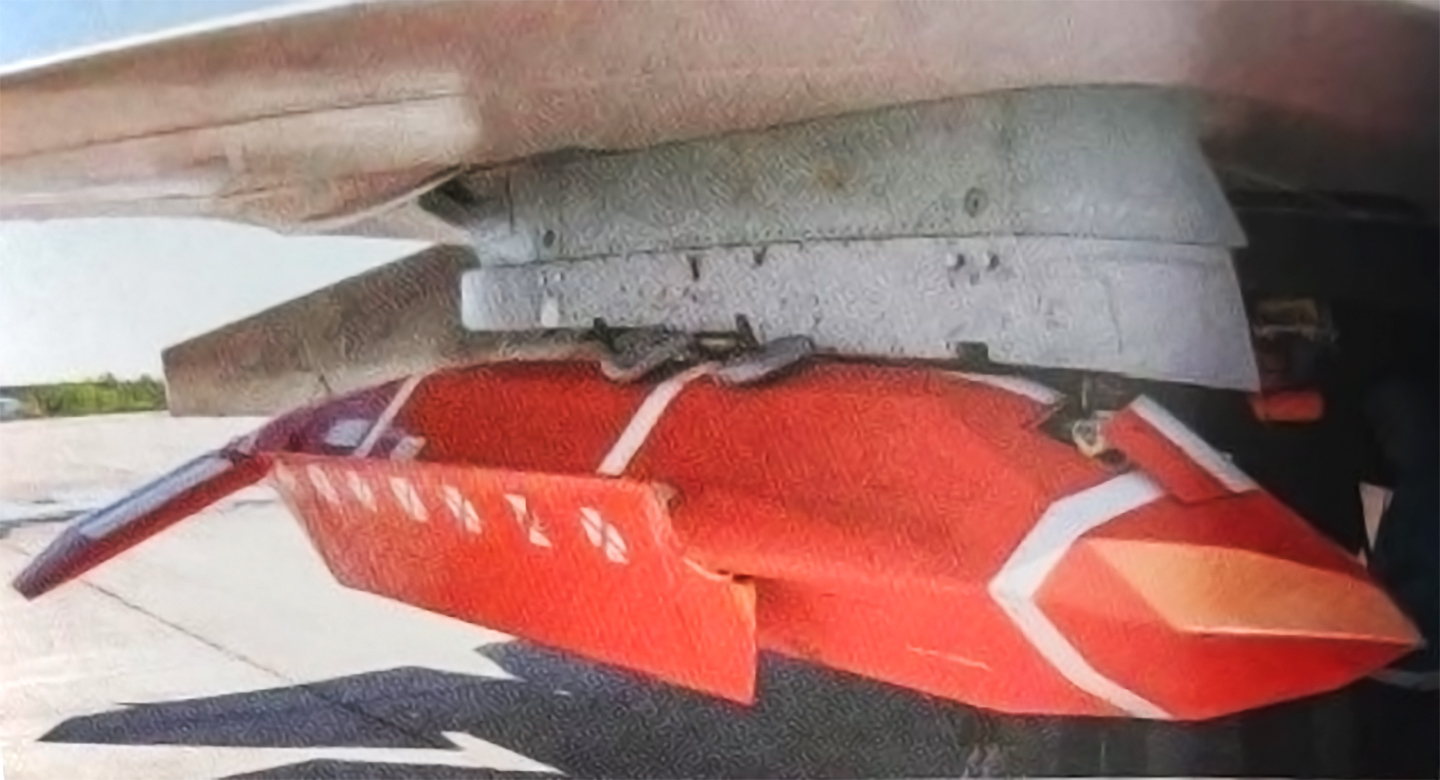
The warhead of the S-71K utilizes a 551-pound OFAB-250-270 high-explosive fragmentation bomb, the GUR said. This bomb was developed in the Cold War as a free-fall air-launched weapon. The S-71K airframe features a low-observable shape with a trapezoidal cross section, chined nose, pop-out swept wings, and an inverted V-tail.

The airframe is made from a multi-layer fiberglass material with additional reinforcement, while other internal elements are made of aluminum alloys, according to the GUR. Available imagery of the S-71K wreckage reveals a top-mounted conformal engine intake feeding a pentagon-shaped intake duct.

The vast majority of the S-71K’s electronic components are of foreign origin, including items manufactured in China, Germany, Ireland, Japan, Switzerland, Taiwan, and the United States.

The S-71K is powered by a compact R500 turbojet engine produced by UAC, the GUR reported. It features an inertial navigation system based on simple sensors. The missile has three separate internal fuel tanks.

Ukraine assesses that the S-71K has an operational range of up to 186 miles and at altitudes of up to 27,000 feet. Earlier reports suggest that the missile flies at a speed of Mach 0.6. It was reported that approval had been received to begin producing the S-71 after significant design changes based on lessons from the Ukraine conflict.

The S-71K has been tested on the Su-57 aircraft with captive-carry trials in April 2024 at the Russian flight research center in Zhukovsky. Imagery shared on X shows a T-50 with S-71K smart cruise missile taking off from Zhukovsky this summer.

The S-71K is expected to be integrated with the S-70 Okhotnik UCAV. Unconfirmed reports from Russia suggested that the S-71M Monokhrom may have been used in an attack on a Ukrainian HIMARS launcher in the Chernihiv region earlier this year. The Russian military stressed that the target in the Chernihiv region was destroyed by a Geran loitering munition.

The War Zone reported that the S-71M is described as a kamikaze drone with human-in-the-loop capability for dynamic targeting. In March of this year, the GUR revealed details of the Izdeliye 30 air-launched cruise missile, including an interactive 3D model and data on 20 enterprises involved in its production.

The Izdeliye 30 has a range of at least 930 miles, according to the Defence Intelligence of Ukraine.

The Kh-69 air-launched cruise missile has a maximum range of 290 km, cruise speed of 700-1,000 km/h, and warhead of 300-310 kg. The War Zone noted that the S-71K appears tailored for tactical crewed and uncrewed aircraft, with its limited range compensated by low-observable features.

It offers a cheaper alternative to the Kh-69, which is associated with the Su-57 but can also be launched by other Russian tactical aircraft.

The deployment of the S-71K poses an additional challenge for Ukraine’s air defense forces, given the scarcity of Western-supplied ground-based systems. The GUR emphasized that continued access to foreign technologies allows Russia to develop and scale new weapons in the war against Ukraine.

Iran, Taiwan, and other nations, while a downed S-70 Okhotnik-B UCAV also had multiple foreign components.

Key Facts

S-71K deployment
The missile has been used in combat since late last year and was developed for the Su-57 fighter.
Technical specifications
Features 551-pound warhead from OFAB-250-270 bomb, range up to 186 miles, speed Mach 0.6, altitude up to 27,000 feet.
Components
Vast majority of electronic components from foreign sources including China, Germany, Ireland, Japan, Switzerland, Taiwan, and the United States.
Related missiles
Izdeliye 30 has range of at least 930 miles; Kh-69 has 290 km range, 700-1,000 km/h speed, 300-310 kg warhead.
Integration and testing
Tested on Su-57 in 2024, expected integration with S-70 Okhotnik UCAV.

Story Timeline

6 events
  1. 2026-03

    GUR revealed details of the Izdeliye 30 air-launched cruise missile, including 3D model and production data.

    1 sourceGUR
  2. 2026 earlier this year

    Unconfirmed reports of S-71M Monokhrom used in attack on Ukrainian HIMARS in Chernihiv; Russian military attributed to Geran munition.

    1 sourceunattributed
  3. 2025 summer

    T-50 with S-71K took off from Zhukovsky.

    1 sourceGeorge N. via X
  4. 2024-04

    Captive-carry trials of S-71K on Su-57 at Zhukovsky.

    1 sourceunattributed
  5. 2024

    Sukhoi approved to produce S-71 after design changes from Ukraine conflict lessons.

    1 sourceunattributed
  6. late 2025

    First deployment of S-71K by Russia.

    2 sourcesKyiv · GUR

Potential Impact

  1. 01

    Increased challenges for Ukrainian air defenses due to new missile deployments.

  2. 02

    Broader reliance on foreign tech enabling Russian weapon development.

  3. 03

    Russia's scaling of cost-effective weapons production using foreign components.

  4. 04

    Potential adaptation of S-71K for drone-launched use on S-70 Okhotnik.

  5. 05

    Comparison to U.S. munitions challenges in potential conflicts.

Transparency Panel

Sources cross-referenced1
Framing risk28/100 (low)
Confidence score75%
Synthesized bySubstrate AI
Word count620 words
PublishedApr 27, 2026, 9:50 PM
Bias signals removed4 across 4 outlets
Signal Breakdown
Loaded 2Speculative 2

Related Stories

WHO Chief Visits DRC as Ebola Death Rate Reaches 30-50%The Guardian
world46 min ago

WHO Chief Visits DRC as Ebola Death Rate Reaches 30-50%

World Health Organization director-general Tedros Adhanom Ghebreyesus arrived in the Democratic Republic of the Congo to support containment of a new Ebola outbreak. The agency revised the death rate to 30-50% based on confirmed cases and recorded 10 confirmed and 223 suspected d…

SK
The Guardian
2 sources
Greek National Charged in UK With Aiding Iran-Linked Intelligence Servicewesternjournal.com
world46 min ago

Greek National Charged in UK With Aiding Iran-Linked Intelligence Service

A 46-year-old Greek man living in Germany was charged under the UK National Security Act with assisting an intelligence service believed to be Iran by targeting a journalist at Iran International.

Reuters
BBC News
2 sources
Supreme Court Revives Havana Docks Lawsuit Over Confiscated Cuban Propertyupi.com
world2 hrs ago

Supreme Court Revives Havana Docks Lawsuit Over Confiscated Cuban Property

The U.S. Supreme Court sent a Helms-Burton Act case back to lower courts for further argument. The suit seeks damages from cruise lines that used docks seized by Cuba in 1959.

FO
1 source