Substrate
finance

Duke University Researchers Develop Omnidirectional Robot Named Argus

Duke University engineers built a 20-legged robot that moves and senses equally in any direction. The design uses dynamic isotropy to achieve uniform acceleration without a defined front or back.

Fortune
1 source·May 28, 11:20 AM(1 day ago)·1m read
Duke University Researchers Develop Omnidirectional Robot Named ArgusFortune
Audio version
Tap play to generate a narrated version.
Developing·Limited corroboration so far. This page will refresh as more sources emerge.

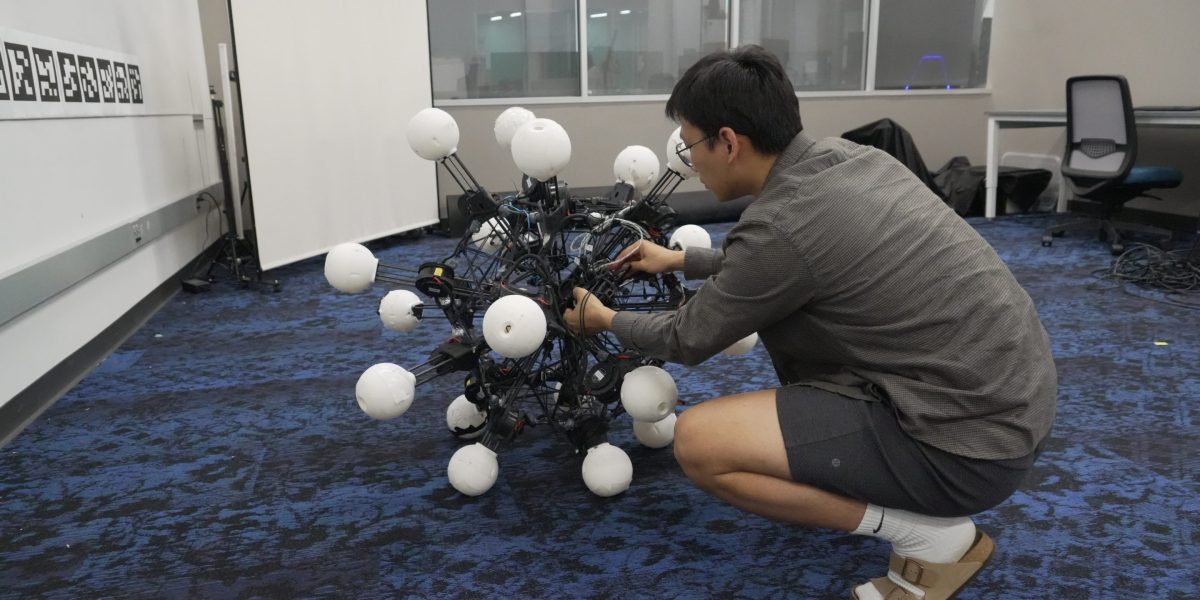
Duke University researchers have developed a robot called Argus that can move and sense equally in any direction. The machine has 20 telescoping legs extending from a central core, each fitted with a depth-sensing camera. Engineering professor Boyuan Chen led the project.

His team replaced conventional body symmetry with what they call dynamic symmetry, allowing the robot to accelerate uniformly without needing to face a particular way. In field tests, Argus navigated sandy beaches and forest undergrowth. It rolled over obstacles, stabilized after collisions, and climbed between parallel brick walls using alternating leg motions.

The researchers introduced a design principle called dynamic isotropy. It scores robots from 0 to 1 on how evenly they can accelerate in every direction. 6. Graduate student Jiaxun Liu, a co-author of the study, said the robot continued to function even when motors failed or legs broke.

The study was published online Wednesday in the journal Science Robotics. Chen said the same principle could apply to search-and-rescue robots, underwater vehicles, aerial drones, or grippers that manipulate objects without a fixed orientation.

Key Facts

20 legs
telescoping legs with depth-sensing cameras
Dynamic isotropy score
Argus scored 0.91 on 0-1 scale
No fixed orientation
moves and senses equally in any direction

Story Timeline

2 events
  1. Wednesday

    Study on Argus published online in Science Robotics.

    1 sourceFortune
  2. Recent

    Argus completed navigation tests on beaches and forest terrain.

    1 sourceFortune

Potential Impact

  1. 01

    Search-and-rescue teams could gain robots that operate after partial damage.

  2. 02

    Underwater and aerial vehicle designs may adopt uniform-acceleration principles.

Transparency Panel

Sources cross-referenced1
Confidence score75%
Synthesized bySubstrate AI
Word count179 words
PublishedMay 28, 2026, 11:20 AM

Related Stories

Romania Expels Russian Consul General After Drone StrikeFinancial Times
finance4 hrs agoDeveloping

Romania Expels Russian Consul General After Drone Strike

Romania ordered the expulsion of Russia's Consul General in Constanta and closed the consulate after a drone struck an apartment building in Galati, injuring two people. NATO and Romanian officials condemned the incident as reckless escalation.

MA
Financial Times
2 sources
House Republicans stall on immigration enforcement funding billfortune.com
finance4 hrs agoDeveloping

House Republicans stall on immigration enforcement funding bill

A roughly $70 billion measure to fund immigration enforcement through the end of President Donald Trump's term stalled in the House. Progress halted over White House ballroom security funding and a proposed $1.8 billion fund for government-mistreatment claims.

fortune.com
1 source
Canada Seeks 50 Percent Rise in Exports to China by 2030techjuice.pk
finance2 hrs agoDeveloping

Canada Seeks 50 Percent Rise in Exports to China by 2030

Foreign Minister Anita Anand stated the export target during a visit by her Chinese counterpart to Ottawa. The announcement comes amid U.S. tariffs that have altered trade patterns.

Bloomberg
1 source