world
Duke University Robot Uses 20 Telescoping Legs for Omnidirectional Movement
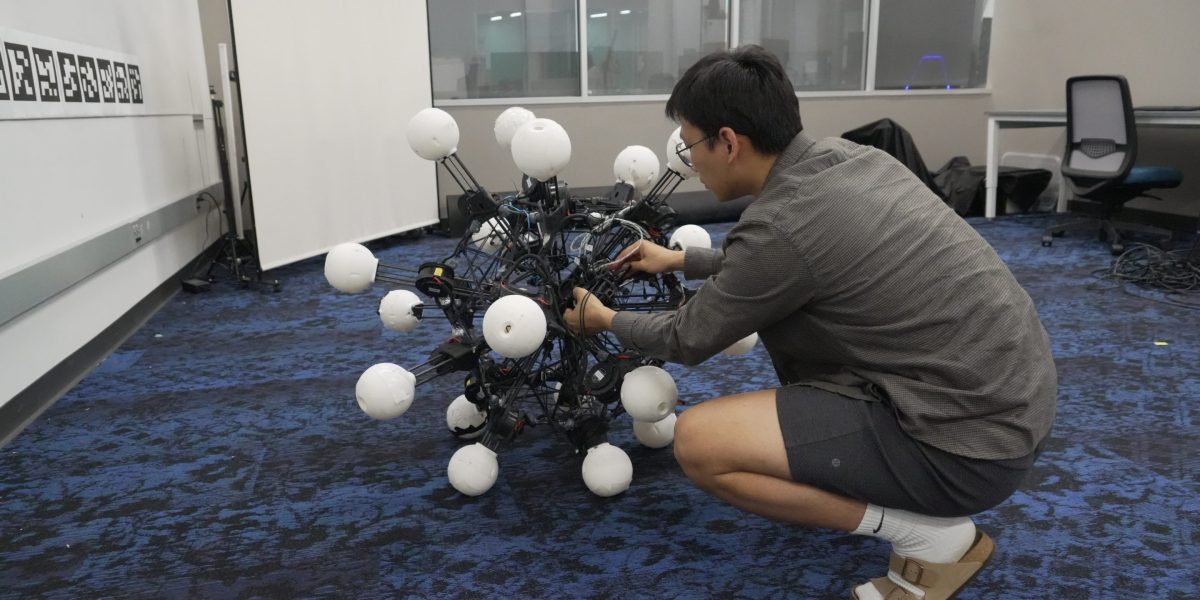
A prototype robot developed at Duke University features depth-sensing cameras on 20 legs radiating from a central core. The design allows the robot to move and perceive its surroundings equally in any direction without a designated front or back.
May 28, 4:00 PM·1m read1 source
FO
 fortune.com
Audio version
Tap play to generate a narrated version.
Developing·Limited corroboration so far. This page will refresh as more sources emerge.
A robot under development at Duke University uses 20 telescoping legs fitted with depth-sensing cameras to move and observe its environment in any direction without a fixed orientation. Engineering professor Boyuan Chen and his team designed the robot, named Argus, around a principle they call dynamic symmetry.
The spherical body has legs extending outward from a central core, eliminating any designated front, back, top, or bottom. Chen said the approach measures how quickly the robot can move in any direction rather than how its legs are arranged around a body.
In tests, Argus has rolled across sandy beaches and forest undergrowth, climbed between parallel brick walls, and continued operating after individual motors failed or legs broke.
Researchers introduced a measurement called dynamic isotropy that scores how uniformly a robot can accelerate in every direction on a scale from 0 to 1. 6. Graduate student Jiaxun Liu, a co-author of the study published online Wednesday in Science Robotics, said the robot's movement differs from any other system the team has tested.
The researchers said the same design principle could apply to search-and-rescue robots, underwater or aerial vehicles, and robotic grippers. Chen said one possibility is to use the robot itself as a manipulator that can handle objects from any angle rather than copying the shape of a human hand.