world
Armenia Hosts European Summits
European leaders gathered in Armenia for two summits focused on security, trade, and regional ties. The events highlight Armenia's pivot toward the EU following conflicts with Azerbaijan and tensions with Russia. Discussions addressed energy dependence, peace processes, and countermeasures against disinformation.
AB
+1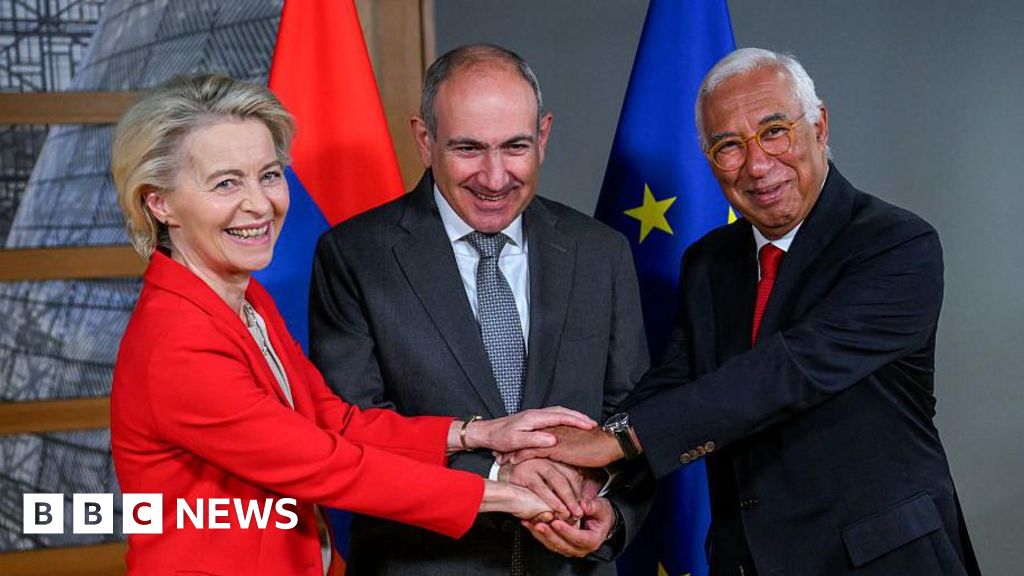 BBC News
Audio version
Tap play to generate a narrated version.
European leaders gathered in Armenia for two summits, including the European Political Community meeting on Monday and a bilateral EU-Armenia summit on Tuesday. The events took place in Yerevan, according to reports from BBC News, Al Jazeera, France 24, Le Monde, ABC News, and The Guardian.
The European Political Community summit involved more than 30 leaders from Europe, plus Canada's Prime Minister Justin Trudeau, as noted in The Guardian. This was the first such summit in Armenia, a country that maintains membership in the Russia-led Eurasian Economic Union and hosts a Russian military base.
Armenia's Prime Minister Nikol Pashinyan met with Russian President Vladimir Putin in Moscow on April 1, 2026, where Putin stated that Armenia receives gas at $177.50 per 1,000 cubic meters, compared to $600 in Europe. Putin also said during the meeting that pursuing EU membership would be "incompatible" with Eurasian Economic Union participation.
The bilateral EU-Armenia summit on Tuesday included European Commission President Ursula von der Leyen and European Council President António Costa. Discussions covered security, trade, and the war in Ukraine, per ABC News and Al Jazeera. French President Emmanuel Macron stated in Le Monde that "Armenia has chosen the path towards Europe," while noting the shift away from Russia.
Armenia's parliament passed a law in March 2026 to begin the EU accession process, according to France 24.
Russia banned imports of Armenian mineral water days before the summits, as reported by BBC News. Azerbaijan's parliament suspended ties with the European Parliament last week following a resolution calling for the return of displaced Armenians and release of prisoners, per Al Jazeera.
No publicly released statements from Russia's foreign ministry directly addressed the summits as of May 4, 2026, based on the source bundle.


