FIRE Brief Challenges Defense Secretary's Authority to Censure Retired Officer Sen. Mark Kelly
The Foundation for Individual Rights and Expression filed a brief arguing against extending speech restrictions to military retirees in a case involving Sen. Mark Kelly. The dispute arises from Kelly's public statements criticizing military actions under President Donald Trump. A court injunction currently prevents disciplinary action against Kelly.
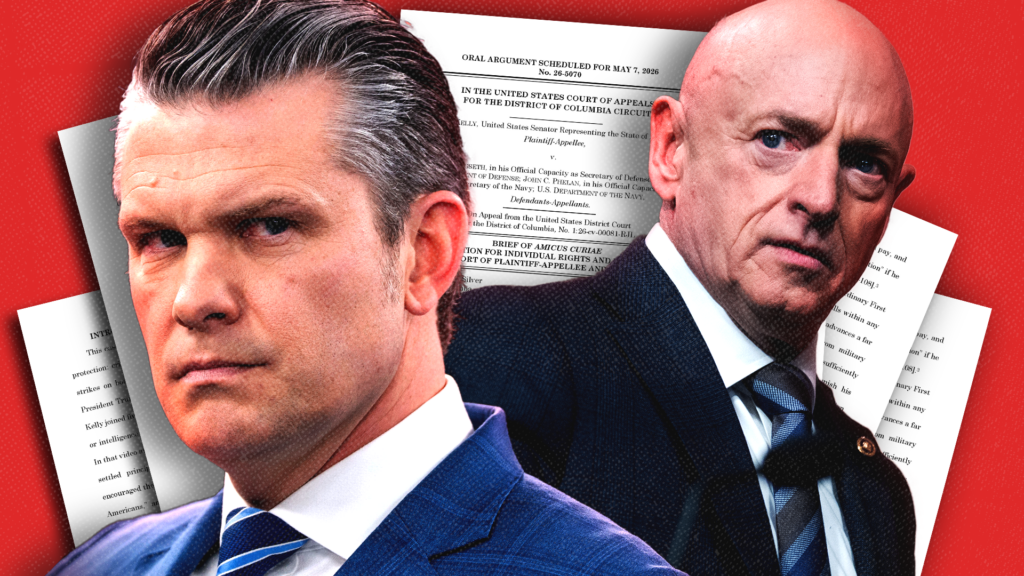
SSgt Tyler Placie / Wikimedia (Public domain)The Foundation for Individual Rights and Expression (FIRE) filed a brief with the U.S. Court of Appeals for the D.C. Circuit in the case Kelly v. Hegseth. The brief supports upholding a preliminary injunction that bars Defense Secretary Pete Hegseth from disciplining Sen.
Mark Kelly, a retired Navy captain, for his public statements. FIRE argues that applying the Supreme Court's 1974 decision in Parker v. Levy to retirees would create an exception to First Amendment protections. Hegseth cited Kelly's participation in a November 18 video where Kelly and five other Democratic legislators reminded military personnel of their duty to refuse illegal orders.
The video did not reference specific orders but occurred during President Donald Trump's domestic military deployments and operations against suspected cocaine smugglers. Hegseth sent Kelly a letter of censure on January 5, referencing the video and other comments, including Kelly's defense of the video, his description of the principle as legally uncontroversial, his pledge to defend the Constitution, and his statement that intimidation would not silence him.
Hegseth also noted Kelly's criticism of Pentagon missile strikes on suspected drug boats and Hegseth's decisions to fire admirals and generals while surrounding himself with yes men. Hegseth stated these remarks were prejudicial to good order and discipline in the armed forces and threatened to reduce Kelly's retirement rank and pension if such conduct continued.
The letter warned of potential criminal prosecution or further administrative action. FIRE's brief states that the government does not defend these actions under standard First Amendment rules and instead claims Kelly's retired status allows for punishment of his speech.
The brief argues this extends Parker v. Levy beyond its context, which involved an active-duty Army captain, Howard Levy, who urged soldiers to defy deployment orders during the Vietnam War. The Supreme Court upheld Levy's punishment, citing the military as a specialized society requiring obedience.
FIRE notes there is no historical precedent for restricting speech of military retirees based on their status. The brief cites retired Marine Major Gen. Smedley Butler, who after retiring in 1931, gave speeches and published a 1935 book criticizing American military intervention.
A separate brief filed by 73 former admirals, generals, and service secretaries states that the threat of censure has deterred military retirees from speaking on public issues. FIRE argues that retirees' experience provides valuable insights on topics like war powers, military law, and operations.
The brief states that allowing punishment for speech deemed disruptive would chill criticism while permitting praise of military leadership. The case remains pending in the appeals court.
Key Facts
Story Timeline
5 events- January 5
Defense Secretary Pete Hegseth sent a letter of censure to Sen. Mark Kelly, citing his public statements.
1 sourceReason - November 18
Sen. Mark Kelly participated in a video reminding military personnel of their duty to refuse illegal orders.
1 sourceReason - 1974
The Supreme Court decided Parker v. Levy, upholding speech restrictions for an active-duty officer.
1 sourceReason - 1935
Retired Marine Major Gen. Smedley Butler published his book War Is a Racket criticizing military intervention.
1 sourceReason - 1931
Marine Major Gen. Smedley Butler retired from the military.
1 sourceReason
Potential Impact
- 01
The appeals court decision may set precedent on First Amendment rights for retirees.
- 02
Military retirees may reduce public criticism of defense policies to avoid potential censure.
- 03
Public debate on military issues could see less input from experienced former officers.
- 04
Other former government employees might face similar speech restriction claims.
Transparency Panel
Related Stories
North Korea Updates Constitution, Omits Korean Unification References Amid International Trade Fair
North Korea has revised its constitution to eliminate references to unification with South Korea. The country also opened the Pyongyang Spring International Trade Fair on Monday, showcasing domestic products like the Jindallae smartphone. More than 290 enterprises from several na…
Trump Signs Memorandum to Revive Presidential Physical Fitness Award at White House Event
President Donald Trump signed a memorandum on May 5, 2026, restoring the Presidential Physical Fitness Award and reintroducing a competitive fitness test in U.S. schools. The event featured student athletes on the White House South Lawn, where Trump demonstrated his signature dan…
EuronewsEU and US Negotiators Meet on Tariff Threats to European Cars
EU and US trade officials are convening for discussions aimed at resolving tensions after President Trump threatened to increase tariffs on EU-made cars. The threats stem from allegations of EU non-compliance with a bilateral trade agreement signed last year. European leaders exp…