Substrate
world

Five US Military Bases Selected for Anti-Drone Pilot Program

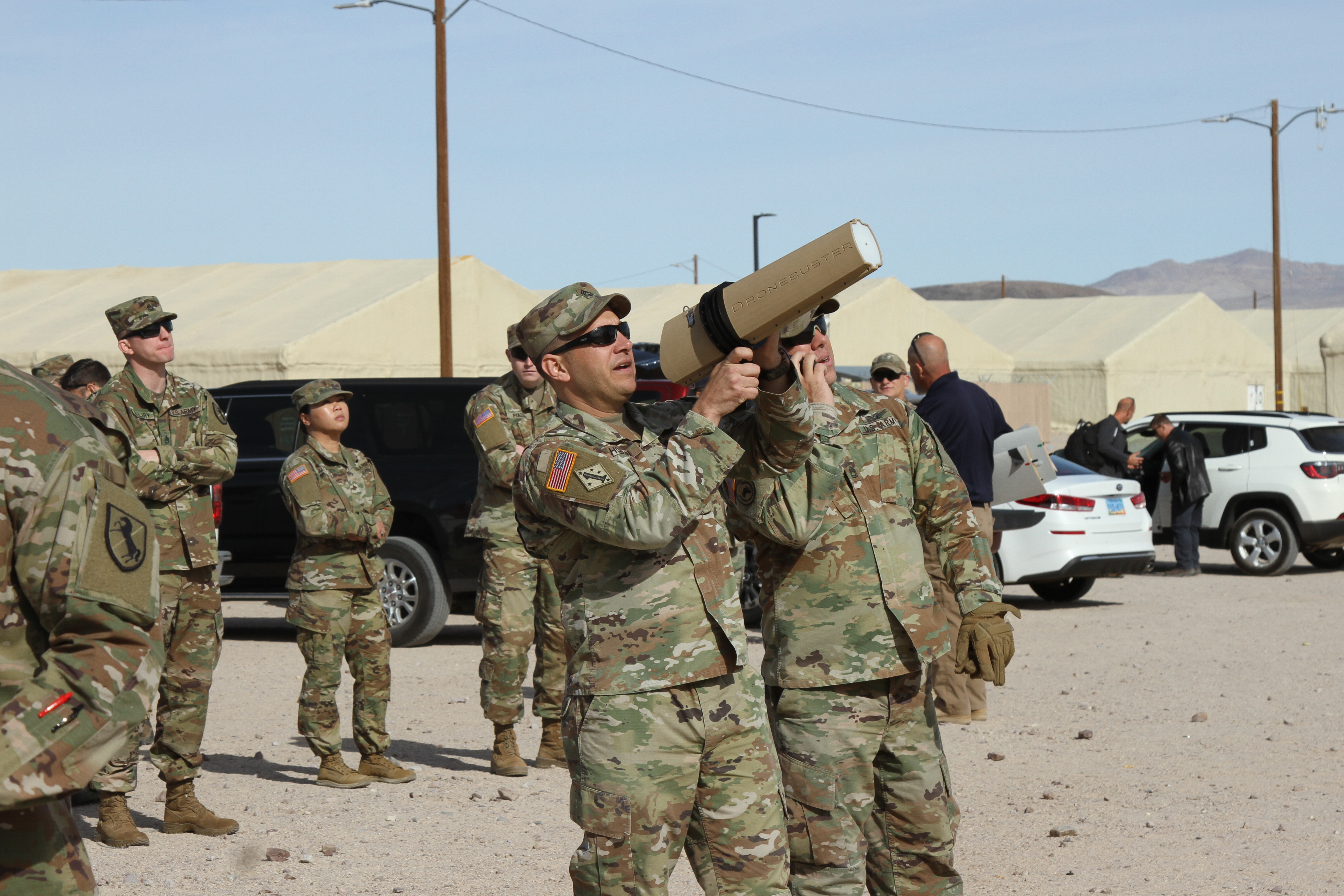
The Joint Interagency Task Force 401 has chosen five military installations, including two along the southern border, to test directed energy systems against small unmanned aircraft. The program follows earlier tests conducted with the Federal Aviation Administration. Operations are scheduled to begin later this year after deployment plans are completed within 180 days.

Defense News
1 source·May 11, 5:25 PM(18 days ago)·2m read
Five US Military Bases Selected for Anti-Drone Pilot ProgramDefense News
Audio version
Tap play to generate a narrated version.
Developing·Limited corroboration so far. This page will refresh as more sources emerge.

The U.S. task force responsible for countering small unmanned aircraft has selected five military installations to participate in an anti-drone pilot program. The U.S. Army-led Joint Interagency Task Force 401, which was established in August 2025 and included in the fiscal 2026 National Defense Authorization Act, picked the sites to test advanced directed energy capabilities.

Two of the installations are along the southern border, according to a May 6 Department of Defense release. “Countering unlawful and adversarial drone activity is a homeland defense imperative,” the task force director said in the release. ” The five chosen installations are Fort Huachuca in Arizona and Fort Bliss in Texas, both near the U.S.-Mexico border, as well as Naval Base Kitsap in Washington, Grand Forks Air Force Base in North Dakota, and Whiteman Air Force Base in Missouri.

Officials selected the locations to support testing and operational assessments across a variety of mission goals and environments.

The release did not specify which systems each base will test. It highlighted high-energy lasers and high-powered microwave systems that can counteract adversarial or unlawful drone activity while reducing risk to nearby personnel and infrastructure.

The announcement follows anti-drone laser tests conducted by the Pentagon and the Federal Aviation Administration in New Mexico in March. Those tests addressed safety concerns that arose after the Pentagon permitted U.S. Customs and Border Protection to use anti-drone lasers in February, which led the Federal Aviation Administration to close El Paso, Texas, airspace twice in one month.

In April the Defense Department and the Federal Aviation Administration issued a joint statement indicating that a safety assessment showed the technology does not pose a risk to passenger aircraft. The agencies said they would work together to implement a safety agreement.

“Our collaboration with the FAA and the successful demonstration at White Sands were pivotal steps forward in our counter-UAS efforts,” the task force deputy director said in the release. “We showed that directed-energy systems can counter drone threats while preserving the safety of air travelers.

Operations at the five sites are scheduled to begin this year.

Key Facts

Five installations
selected for anti-drone pilot program
Fort Huachuca and Fort Bliss
southern border sites in program
JITF 401
stood up August 2025, leads effort
High-energy lasers and microwaves
highlighted counter-drone tools
Within 180 days
deployment plans to be completed

Story Timeline

5 events
  1. August 2025

    Joint Interagency Task Force 401 was established.

    1 sourceDefense News
  2. February 2026

    Pentagon allowed Customs and Border Protection to use anti-drone lasers.

    1 sourceDefense News
  3. March 2026

    Pentagon and FAA conducted anti-drone laser tests in New Mexico.

    1 sourceDefense News
  4. April 2026

    DoD and FAA released joint statement on safety assessment and agreement.

    1 sourceDefense News
  5. May 6 2026

    Defense Department announced selection of five bases for pilot program.

    1 sourceDefense News

Potential Impact

  1. 01

    Five bases will begin testing directed energy systems against drones later in 2026.

  2. 02

    Program expands collaboration between Defense Department and Federal Aviation Administration on counter-drone safety.

  3. 03

    Results from varied environments may inform broader military counter-drone operations.

  4. 04

    Deployment plans will be developed with commanders at each of the five installations.

Transparency Panel

Sources cross-referenced1
Confidence score75%
Synthesized bySubstrate AI
Word count370 words
PublishedMay 11, 2026, 5:25 PM
Bias signals removed4 across 2 outlets
Signal Breakdown
Framing 1Loaded 1Amplifying 1Editorializing 1

Related Stories

WHO Chief Visits DRC as Ebola Death Rate Reaches 30-50%The Guardian
world34 min ago

WHO Chief Visits DRC as Ebola Death Rate Reaches 30-50%

World Health Organization director-general Tedros Adhanom Ghebreyesus arrived in the Democratic Republic of the Congo to support containment of a new Ebola outbreak. The agency revised the death rate to 30-50% based on confirmed cases and recorded 10 confirmed and 223 suspected d…

SK
The Guardian
2 sources
Greek National Charged in UK With Aiding Iran-Linked Intelligence Servicewesternjournal.com
world34 min ago

Greek National Charged in UK With Aiding Iran-Linked Intelligence Service

A 46-year-old Greek man living in Germany was charged under the UK National Security Act with assisting an intelligence service believed to be Iran by targeting a journalist at Iran International.

Reuters
BBC News
2 sources
Supreme Court Revives Havana Docks Lawsuit Over Confiscated Cuban Propertyupi.com
world2 hrs ago

Supreme Court Revives Havana Docks Lawsuit Over Confiscated Cuban Property

The U.S. Supreme Court sent a Helms-Burton Act case back to lower courts for further argument. The suit seeks damages from cruise lines that used docks seized by Cuba in 1959.

FO
1 source