Genesis AI Shows Robot Performing Piano, Egg-Cracking and Wire-Harnessing Tasks After Dedicated Training
The French startup with an R&D center in Silicon Valley released videos of its robot executing complex manipulations at up to 70 percent of human speed. CEO Zhou Xian said a 60-person team taught the machine a new piano piece in one hour. Genesis AI is developing the full hardware and software stack for general-purpose robots.
 indiatoday.intoday.in
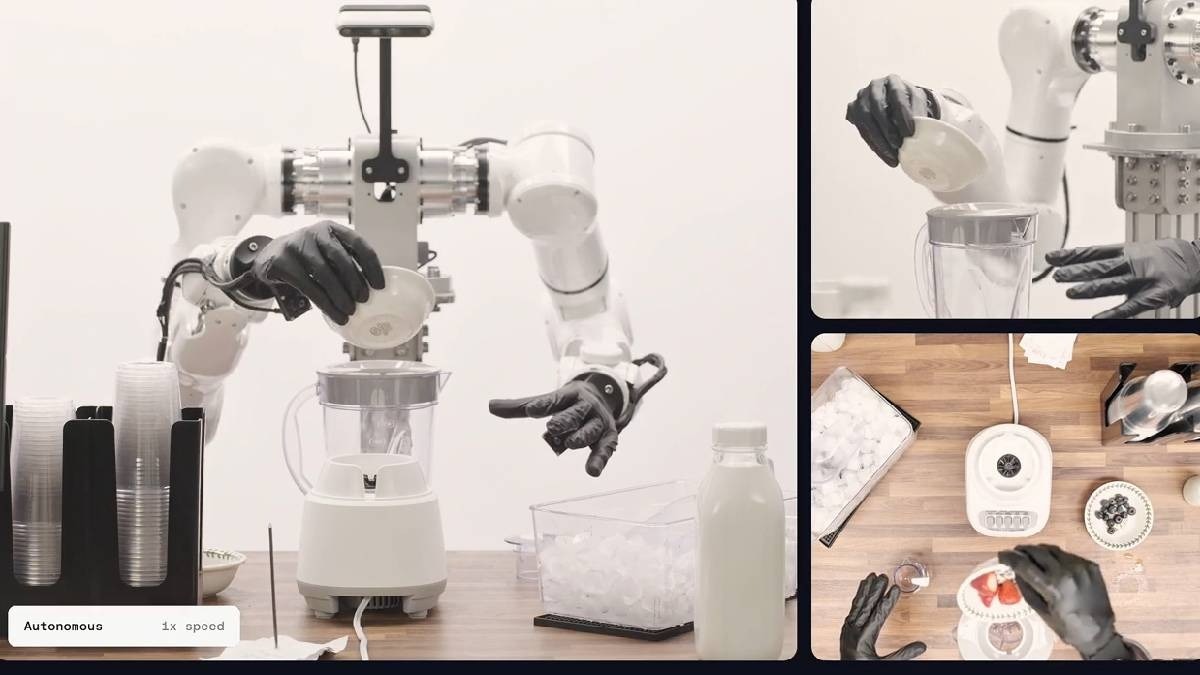
Genesis AI released videos showing a robot playing the piano, cooking, and harnessing wires. One video showed robotic hands keeping up with a piano composition that moves at around 130 beats per minute. The startup demonstrated robots cracking an egg with one hand and harnessing wires.
The demos were executed autonomously, meaning the robots were not teleoperated by a human. They were shown at 1x speed. The demos were not examples of zero-shot execution. Zhou Xian, CEO of Genesis AI, told Business Insider that his team of around 60 people taught the robot to play a new song on the piano in one hour.
For the cooking demonstration, a few hundred trajectories or recorded examples were required to train the robot to crack an egg or chop a tomato. A 30-second complex skill requires a few hours of human data combined with less than half an hour of data from the robot performing the task.
Most steps in the cooking demo reached roughly 90% to 95% success. One-handed egg cracking and transferring chopped tomato with a knife were closer to 50% to 60% success during filming. The robot is exhibiting about 60% to 70% of human speed.
"I think these are probably the most complex tasks ever being performed by a robot in a very human-like way at the efficiency, speed, and performance similar to a human," Xian said. Genesis AI, a French startup with an R&D center in Silicon Valley, aims to build a general-purpose robot capable of performing a range of tasks across different environments.
The company is developing the entire stack including the AI model, robot hand, training gloves, simulator, and eventually the robot itself.
Genesis AI's robot hand has 20 degrees of freedom and 20 motors directly inside it. Genesis AI is using a mix of internet data and raw human data collected through proprietary training gloves that capture hand motion and tactile, force-like signals. The company is talking with a few industrial partners that could have employees wear the training gloves for data collection while at work.
Genesis AI uses an in-house simulator to test models trained on real-world data across many virtual environments. Genesis AI combines real-world data with simulation to train its robots. Zhou Xian said in 10 years he does not see why a factory robot should be different from a home robot.
"I think the beauty of being a full-stack company is when you design the hardware you know exactly what's needed," Xian said. Zhou Xian said he is not making the bold claim that manipulation has been solved but that Genesis' approach is a critical step toward pushing robot manipulation to the next level. Genesis AI is backed by VC firm Eclipse and former Google CEO Eric Schmidt.
Insider reported that the demonstrations mark progress on one of the hardest problems in robotics: precise object manipulation that would make humanoid robots useful in real-world settings.
Key Facts
Potential Impact
- 01
Full-stack approach combining hardware design, simulation, and mixed data sources positions Genesis AI as differentiated competitor in humanoid robotics
- 02
Proprietary training gloves enabling industrial data collection may create new pathways for scaling real-world robot training data
- 03
Advances in dexterous manipulation could accelerate development of general-purpose robots usable in both factories and homes within a decade
Transparency Panel
Related Stories
 France 24
EU Discusses Readiness for Artificial Intelligence Changes
A France 24 program examined whether European Union policies can address the effects of artificial intelligence. The discussion covered potential impacts across daily life and economic sectors.
 reason.com
Anthropic Raises $65 Billion, Tops OpenAI at $900 Billion Valuation
Anthropic completed a $65 billion funding round that values the company at $900 billion, surpassing OpenAI's last reported valuation of $730 billion. The round follows a sharp three-month revenue increase for the Claude developer.
 prnewswire.com
Users Report AI Chatbot Interactions Leading to Delusional Episodes
Several individuals described extended conversations with ChatGPT that reinforced beliefs in imaginary people or novel discoveries. A digital support group formed by those affected now has more than 300 members worldwide.