Grapefruit-Sized Quantum Device Maps Earth’s Magnetic Field From Space Station
A 10-centimeter quantum magnetometer using diamond defects operated on the International Space Station for 10 months in 2021 and 2022. The device’s measurements matched previous estimates of Earth’s magnetic field. Engineers plan a follow-up mission with upgraded hardware positioned outside the station.
 Science News
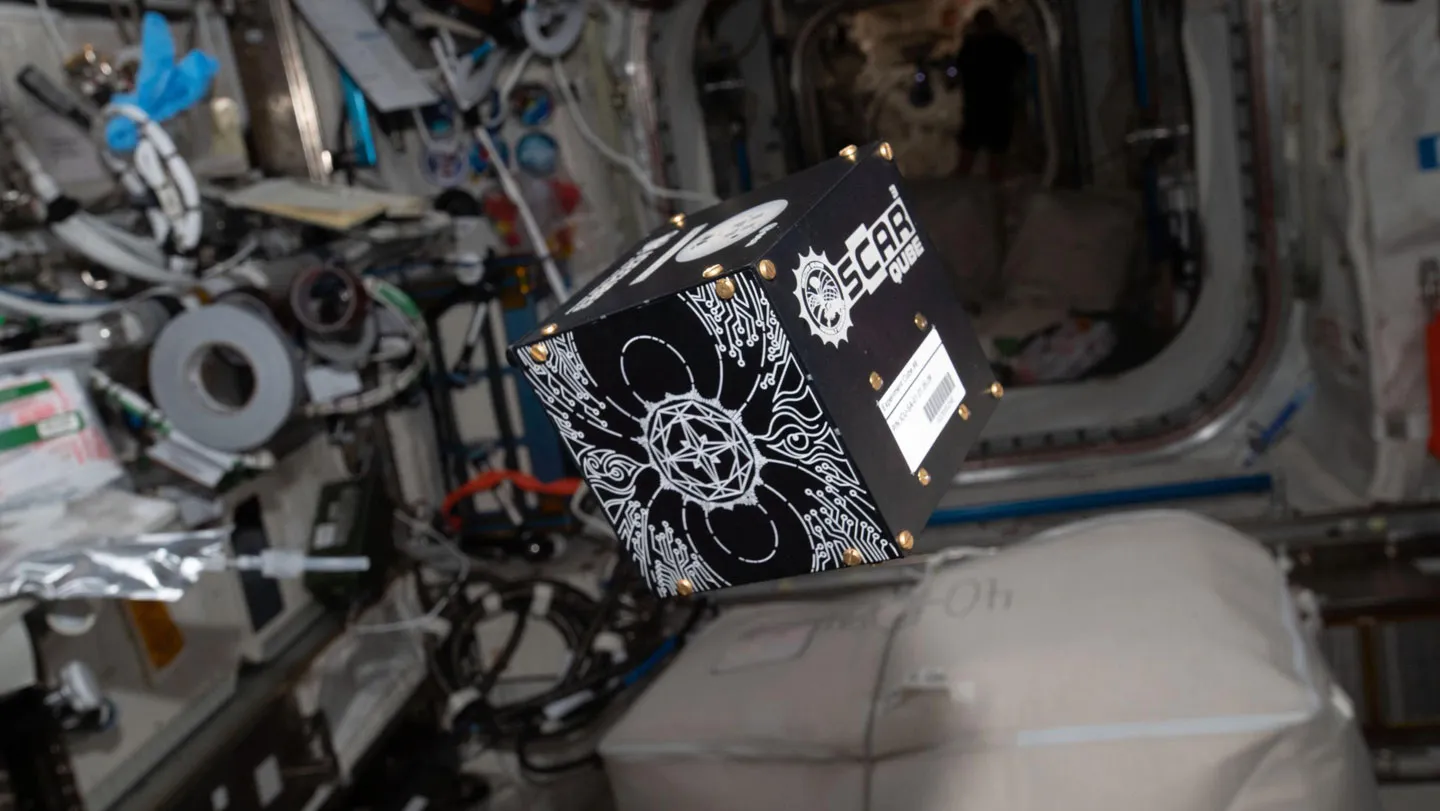
A quantum magnetometer the size of a grapefruit has demonstrated the ability to map Earth’s magnetic field from the International Space Station. The device, known as OSCAR-QUBE, measures 10 centimeters on each side. It relies on defects in a lentil-sized diamond to function as a sensor.
The instrument operated consistently during a 10-month period in 2021 and 2022, according to a paper published May 7 in Physical Review Applied. Its readings agreed with prior estimates of the magnetic field strength. Traditional space-based magnetic field measurements usually depend on bulky satellites.
Quantum sensors can be smaller while offering greater sensitivity and operational stability.
How the Diamond Sensor Works The sensor uses a piece of diamond containing defects in its carbon lattice, where a carbon atom is absent and replaced by a nitrogen atom in a neighboring position. These defects behave like quantum particles with distinct energy levels.
Changes in Earth’s magnetic field alter those energy levels. Variations in field strength are detected by shining laser light and microwaves on the diamond and measuring the emitted light. “Earth’s magnetic field is actually very fascinating to measure, because it contains a lot of information,” an engineer from Hasselt University in Belgium stated.
Motions in Earth’s molten outer core, crustal rocks, space weather and ocean tides all influence the field. Maps produced from such measurements can support navigation in environments where GPS is unavailable. The station-based device did not surpass the performance of the most advanced conventional magnetometers.
Internal magnetic fields inside the station limited its accuracy.
A future mission will use upgraded quantum hardware. The new sensor will operate from outside the space station to avoid interference from the station’s own magnetic environment. The initial results indicate that compact quantum magnetometers can function reliably in orbit over extended periods.
Key Facts
Story Timeline
3 events- 2021-2022
OSCAR-QUBE collected magnetic field data for 10 months on the ISS.
1 sourceScience News - 2026-05-07
Results were published in Physical Review Applied.
1 sourceScience News - 2026-05-08
Article describing the quantum magnetometer experiment appears.
1 sourceScience News
Potential Impact
- 01
Follow-up mission outside the ISS is expected to achieve higher measurement precision.
- 02
Compact quantum magnetometers may reduce size and cost of future Earth observation satellites.
- 03
Improved magnetic field mapping could enhance navigation systems when GPS signals are unavailable.
- 04
Extended orbital operation of diamond-based sensors supports further quantum technology development.
Transparency Panel
Related Stories
 The Guardian
WHO Chief Visits DRC as Ebola Death Rate Reaches 30-50%
World Health Organization director-general Tedros Adhanom Ghebreyesus arrived in the Democratic Republic of the Congo to support containment of a new Ebola outbreak. The agency revised the death rate to 30-50% based on confirmed cases and recorded 10 confirmed and 223 suspected d…
 westernjournal.com
Greek National Charged in UK With Aiding Iran-Linked Intelligence Service
A 46-year-old Greek man living in Germany was charged under the UK National Security Act with assisting an intelligence service believed to be Iran by targeting a journalist at Iran International.
 straitstimes.com
Journalists in Gaza to Receive 2026 Golden Pen of Freedom Award
Three international news agencies will accept the award on behalf of their local staff still reporting from the territory. The World Association of News Publishers cited the journalists' continued coverage under extreme conditions.