Substrate
politics

Hungary’s Tisza Party Wins Parliamentary Majority as Orban’s Fidesz Loses Power After 16 Years

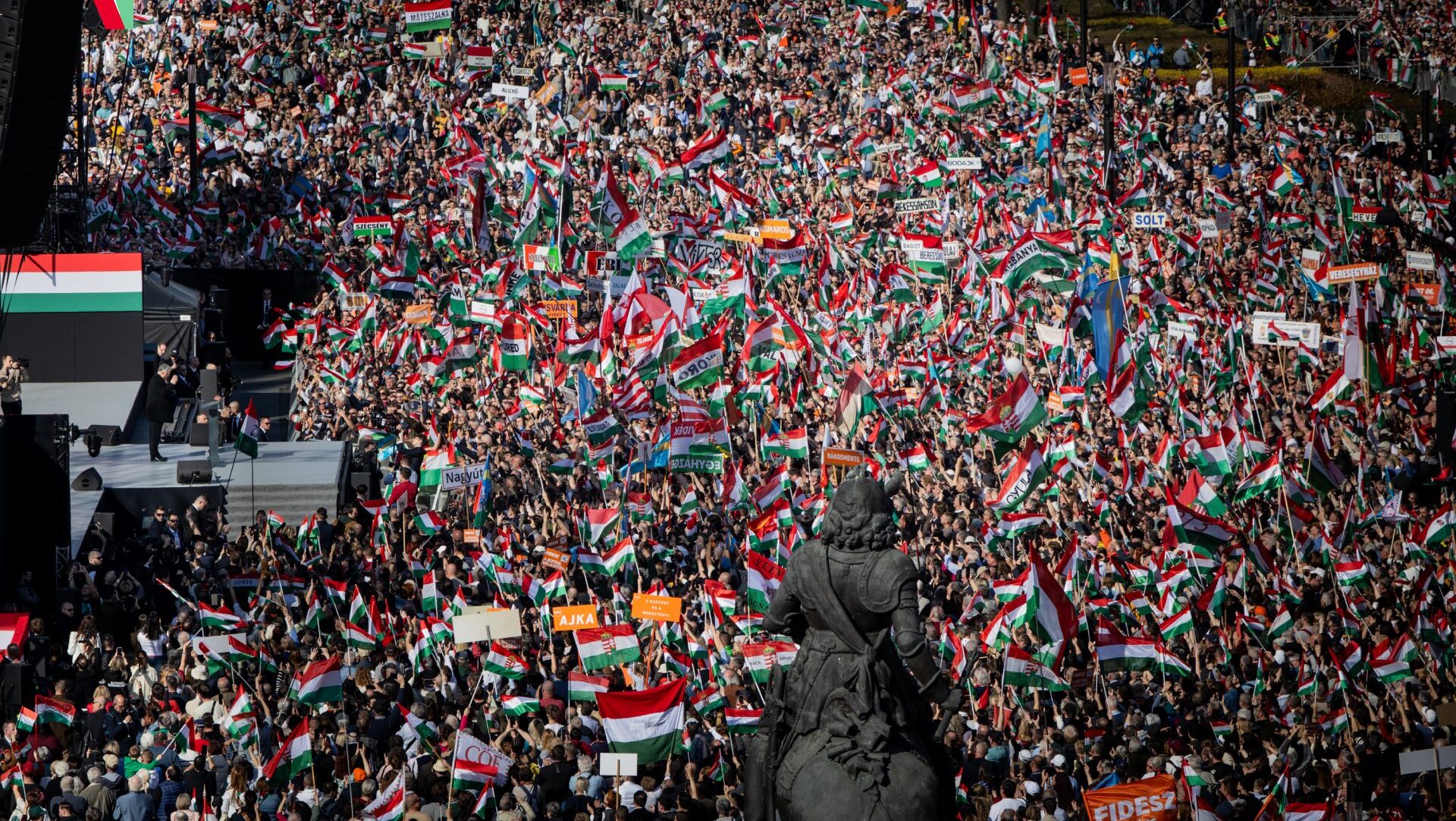
Peter Magyar’s center-right Tisza party secured 53 percent of the vote on Sunday in April 2026, ending Viktor Orban’s 16-year rule. Orban’s Fidesz received 39 percent as the opposition united behind a former insider who campaigned on corruption and failing public services. The outcome gives Tisza the supermajority tools Orban once used to entrench power.

FO
1 source·May 8, 7:11 PM(2 hrs ago)·3m read
Hungary’s Tisza Party Wins Parliamentary Majority as Orban’s Fidesz Loses Power After 16 Yearsrevolver.news
Audio version
Tap play to generate a narrated version.
Developing·Limited corroboration so far. This page will refresh as more sources emerge.

Voters ousted Hungarian Prime Minister Viktor Orban’s government on Sunday in April 2026. Peter Magyar’s Tisza party won 53 percent of the vote while Orban’s Fidesz party received 39 percent. The result handed Tisza a two-thirds majority in parliament.

Orban had been in power for 16 years as of April 2026 and remained the longest-serving prime minister in Europe. In all of post–World War II European history, only former German chancellors Helmut Kohl and Angela Merkel served as many consecutive years in office as Orban. He had governed with a supermajority in parliament for his entire 16 years in power.

The scale of the defeat reversed the pattern Fidesz established in earlier elections. In 2010, Fidesz received 53 percent of the vote and earned a two-thirds majority in parliament. In 2014, after electoral changes, Fidesz received 45 percent of the vote but maintained its supermajority.

Those changes, engineered by Fidesz, included gerrymandered districts, extending the franchise to Hungarians living abroad, and a mixed voting system that allocated a disproportionately large number of parliamentary seats to the party with the highest share of the vote.

The same system now delivers Tisza a two-thirds majority, enabling it to undo laws Orban had placed beyond regular majorities. Magyar, a former Fidesz member turned critic, had not held any high-profile political position in the Orban government.

He represented a center-right, conservative, nationalist ideology. Tisza emerged as more popular than Fidesz and consolidated pro-democracy forces so effectively that the total votes cast for all pro-democracy parties besides Tisza amounted to less than two percent of the total vote on Sunday in April 2026.

The Tisza Party campaigned on corruption, failure to fix deteriorating public services, and high inflation.

Orban attempted to blame the European Union and Ukraine for Hungary’s domestic problems including high inflation and deteriorating public services. That message failed to resonate with enough voters after 16 years of uninterrupted Fidesz rule. @ForeignAffairs reported that Orban’s regime lasted as long as it did because it was extremely adept at rigging the electoral system and stoking polarization in society.

Yet those very strengths proved to be its undoing. The stark polarization made a united opposition easier to forge while the long tenure made it impossible for Orban to escape responsibility for governance failures. Orban spoke to reporters in Budapest in April 2026.

Investigative journalists had reported on the construction of lavish residences for Orban’s family and close friends. Magyar capitalized on scandals involving the pardoning of Endre Konya, the deputy director of a state-run orphanage who had been convicted of helping cover up a pedophilia ring.

Fidesz appointed party propagandists to state TV and radio and used economic pressure to consolidate most private news outlets in the hands of government-friendly oligarchs.

Orban’s System of National Cooperation involved exercising economic influence by way of regime-friendly oligarchs and control over social, cultural, and media institutions via appointed party loyalists. These structures shaped Hungary’s economic, political, judicial and cultural institutions without effective checks.

Lorinc Redei, Associate Professor of Instruction at the Lyndon B. Johnson School of Public Affairs at the University of Texas at Austin, published the article "How Orban Defeated Himself" on April 15, 2026. Redei wrote that Magyar and the Tisza Party used Orban’s own record against him, uniting pro-democracy forces and turning the division Fidesz had manufactured against Orban himself.

The Hungarian election offers lessons for opposition parties in competitive authoritarian systems, according to the same analysis.

Pro-democracy forces must close ranks behind a single person and party, temporarily setting aside ideological differences to restore a pluralist system. Magyar’s profile as a former insider without high-profile baggage allowed him to appeal across ideological lines while resisting smears that he was a stooge of the European Union.

Once united, such forces can turn polarization against those in power by painting the government as being on the wrong side of a clear binary divide.

Issues that transcend ideology, such as corruption and the abuse of children, helped unify movements. The Tisza Party kept pressure on the government’s governance record, exposing state corruption and campaigning on pocketbook issues that crossed political boundaries.

Key Facts

Tisza party victory ends Orban era
Peter Magyar’s Tisza won 53 percent and a two-thirds parliamentary majority on Sunday in April 2026 while Fidesz took 39 percent after Orban’s 16 years in power
Electoral system reversal
The supermajority rules Orban engineered in 2010 and 2014, when Fidesz converted 53 percent and then 45 percent into two-thirds control, have now delivered equi
Opposition consolidation
All pro-democracy parties besides Tisza received less than two percent combined as voters united behind former Fidesz insider Magyar
Campaign focus on governance
Tisza campaigned on corruption, deteriorating public services and high inflation; Orban blamed the EU and Ukraine without success

Story Timeline

5 events
  1. 2010

    Fidesz received 53 percent of the vote and earned a two-thirds majority in parliament

    1 sourceForeignAffairs
  2. 2014

    After electoral changes, Fidesz received 45 percent of the vote but maintained its supermajority

    1 sourceForeignAffairs
  3. April 15, 2026

    Lorinc Redei published 'How Orban Defeated Himself' in Foreign Affairs

    1 sourceForeignAffairs
  4. April 2026

    Viktor Orban spoke to reporters in Budapest

    1 sourceForeignAffairs
  5. Sunday April 2026

    Voters ousted Orban’s government; Tisza won 53 percent, Fidesz 39 percent, securing two-thirds majority

    2 sourcesForeignAffairs · unattributed

Potential Impact

  1. 01

    Tisza gains ability to repeal Orban-era laws that required supermajorities

  2. 02

    Pressure on new government to restore institutional checks and pluralism

  3. 03

    Potential rollback of Fidesz control over media, judiciary and state institutions

  4. 04

    Model for opposition unity in other competitive authoritarian systems

Transparency Panel

Sources cross-referenced1
Confidence score75%
Synthesized bySubstrate AI
Word count684 words
PublishedMay 8, 2026, 7:11 PM
Bias signals removed4 across 4 outlets
Signal Breakdown
Loaded 4

Related Stories

White House Correspondents Dinner Shooting Suspect Moves to Disqualify ProsecutorsSubstrate placeholder — needs review
politics37 min agoFraming65Framing risk65/100Rewrite heavily inherits defense-driven lede and selective sourcing that foregrounds conflict-of-interest claims and Pirro's statements over the assassination attempt itself.Click to jump to full framing analysis

White House Correspondents Dinner Shooting Suspect Moves to Disqualify Prosecutors

Cole Allen, charged with attempting to assassinate President Trump at the April 25 White House Correspondents' Dinner, filed a motion to remove Acting Attorney General Todd Blanche and U.S. Attorney Jeanine Pirro from the case. Allen's lawyers argue the officials were present dur…

New York Post
The Guardian
CBS News
3 sources
Rubio Meets Vatican and Italian Officials on Middle East Peace ProposalSubstrate placeholder — needs review
politics37 min agoFraming65Framing risk65/100Rewrite inherits heavy consensus framing and lede misdirection by centering Rubio's meetings and Trump-Vatican tensions instead of the substantive Middle East peace proposal and Iranian response.Click to jump to full framing analysis

Rubio Meets Vatican and Italian Officials on Middle East Peace Proposal

Secretary of State Marco Rubio held talks with Pope Leo XIV at the Vatican on Thursday and Italian Prime Minister Giorgia Meloni on Friday amid strained relations with both. The U.S. is expecting a response from Iran today on a proposal to end the Middle East war. Rubio presented…

Cnbc
JA
The New York Times
The Guardian
Semafor
+4
9 sources
Southern Poverty Law Center Indicted on Federal Wire Fraud and Money Laundering ChargesSubstrate placeholder — needs review
politics37 min agoFraming68Framing risk68/100Rewrite inherits heavy consensus framing from right-leaning sources by leading with indictment while burying exculpatory context that SPLC's informant payments were known to and used by DOJ/FBI.Click to jump to full framing analysis

Southern Poverty Law Center Indicted on Federal Wire Fraud and Money Laundering Charges

A federal grand jury indicted the Southern Poverty Law Center in April 2026 for allegedly funneling millions in donations to pay informants inside violent extremist groups including the KKK while publicly denouncing those same organizations. Acting Attorney General Todd Blanche s…

The Federalist
RealClearPolitics
2 sources