IFS Deaton Review Finds Large Geographic and Income Gaps in UK Health, Earnings and Wealth
A six-year study published in late April found Britain remains one of the most unequal countries among G7 nations. The IFS Deaton Review detailed stark differences in healthy life expectancy, income and wealth concentration, with the top 1% capturing significant shares of both.
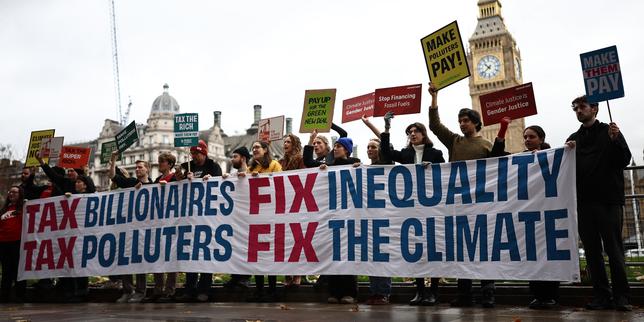
Le MondeA protest against inequality, polluters and climate change took place outside the Houses of Parliament in London on November 24, 2025. The demonstration reflected public concern over findings contained in a major study released months earlier. In 2025 a man born in Blackpool had a healthy life expectancy of 51 years while his counterpart born in Richmond could expect 69 years of good health.
These figures formed part of the IFS Deaton Review published in late April after six years of research by economists, sociologists and public health experts for the Nuffield Foundation and the Institute for Fiscal Studies. The bottom 10% of British people earned no more than £11,800 per year compared with £69,500 for the top 10%.
Richard Blundell, a professor of political economy at University College London who participated in the study, said the aim was to examine inequality in the UK across several indicators.
"We realized the UK is one of the most unequal countries in the world," Blundell stated. The UK's Gini coefficient is the worst among all G7 countries except the US. Compared with the European Union, only Lithuania and Latvia have a worse Gini coefficient than the UK.
"Inequality is particularly pronounced at the top of the income pyramid," Blundell said. The top 1% of earners captured 15% of all taxable income in the 2018-2019 financial year, more than the bottom 55% of earners combined. The top 1% also owned 20% of all household wealth in the UK.
7 trillion according to the Office for National Statistics and was the lowest share among G7 countries. "This mostly relates to housing," Blundell said, noting a growth in intergenerational inequality with young people unable to get on the property ladder while their parents' generation benefited from rising housing prices. More than £100 billion is allocated to welfare every year.
Blundell said households with modest incomes benefit from a relatively generous system of government support, progressive taxation and several consecutive increases in the minimum wage. This has allowed them to partially catch up with their wealthier peers, he added.
"London and the southeast of England are home to the highest-paying jobs in technology, finance, and high-value services," Blundell said.
In contrast, central and northern regions have seen industrial jobs lost in the 1970s and 1980s replaced by poorly paid positions in logistics, catering or construction. Life expectancy is lower in those areas while rates of obesity, diabetes and poor mental health are higher.
The IFS Deaton Review authors proposed taxing capital gains and inheritances more heavily along with a one-off wealth tax rather than a recurring one.
"This would improve wealth redistribution," Blundell said. To reduce regional inequalities they called for new innovation clusters outside London, particularly in the north of England, through improved skills training, expanded transport networks and development of local start-up and venture capital ecosystems.
"the aim is to create good jobs, with a decent salary, but also career progression opportunities and a good work-life balance," Blundell said.
Le Monde reported on the full findings and recommendations of the IFS Deaton Review.
Key Facts
Story Timeline
4 events- 2018-2019
Top 1% captured 15% of taxable income, more than bottom 55% combined
1 sourceLe Monde - Late April 2026
IFS Deaton Review published after six years of research
1 sourceLe Monde - November 24, 2025
Protest against inequality held outside Houses of Parliament in London
1 sourceLe Monde - 2025
Healthy life expectancy recorded at 51 years in Blackpool and 69 years in Richmond
1 sourceLe Monde
Potential Impact
- 01
Intergenerational housing wealth divide likely to persist without policy changes on property ladder access
- 02
Proposal to increase taxes on capital gains, inheritances and introduce one-off wealth tax could improve redistribution but faces political hurdles
- 03
Creation of innovation clusters in northern England may narrow regional pay and health gaps over time
Transparency Panel
Related Stories
tass.comEight Hantavirus Cases Confirmed on MV Hondius Cruise, Three Fatal
Health officials have confirmed eight cases of Andes hantavirus tied to an expedition cruise aboard the MV Hondius, with three deaths reported. The World Health Organization assesses the broader public health risk as low. An epidemiologist highlighted rapid spread of misinformati…
thedrinksbusiness.comLVMH's Arnault Visits Seoul Stores as US Treasury Secretary Travels to Asia
LVMH Chairman and CEO Bernard Arnault is expected to visit South Korea next week for the first time in three years, touring newly opened Louis Vuitton outlets in major department stores. Separately, U.S. Treasury Secretary Scott Bessent plans a one-day stop in Seoul en route to C…
Substrate placeholder — needs reviewCDC Classifies Hantavirus Outbreak as Level 3 Emergency
The Centers for Disease Control and Prevention activated its Emergency Operations Center on Friday after classifying the ongoing hantavirus outbreak as level 3, the lowest of its emergency activation levels. Two new suspected cases were reported the same day linked to a cruise sh…