India and Pakistan Mark One Year Since Four-Day Conflict With Military Celebrations
Both countries held events and issued statements on the anniversary of the May 2025 aerial conflict that lasted four days. India reported striking Pakistani airfields and destroying aircraft while Pakistan said it downed Indian jets including Rafales. Officials in both nations outlined subsequent military enhancements and diplomatic moves.
 citizen.co.za
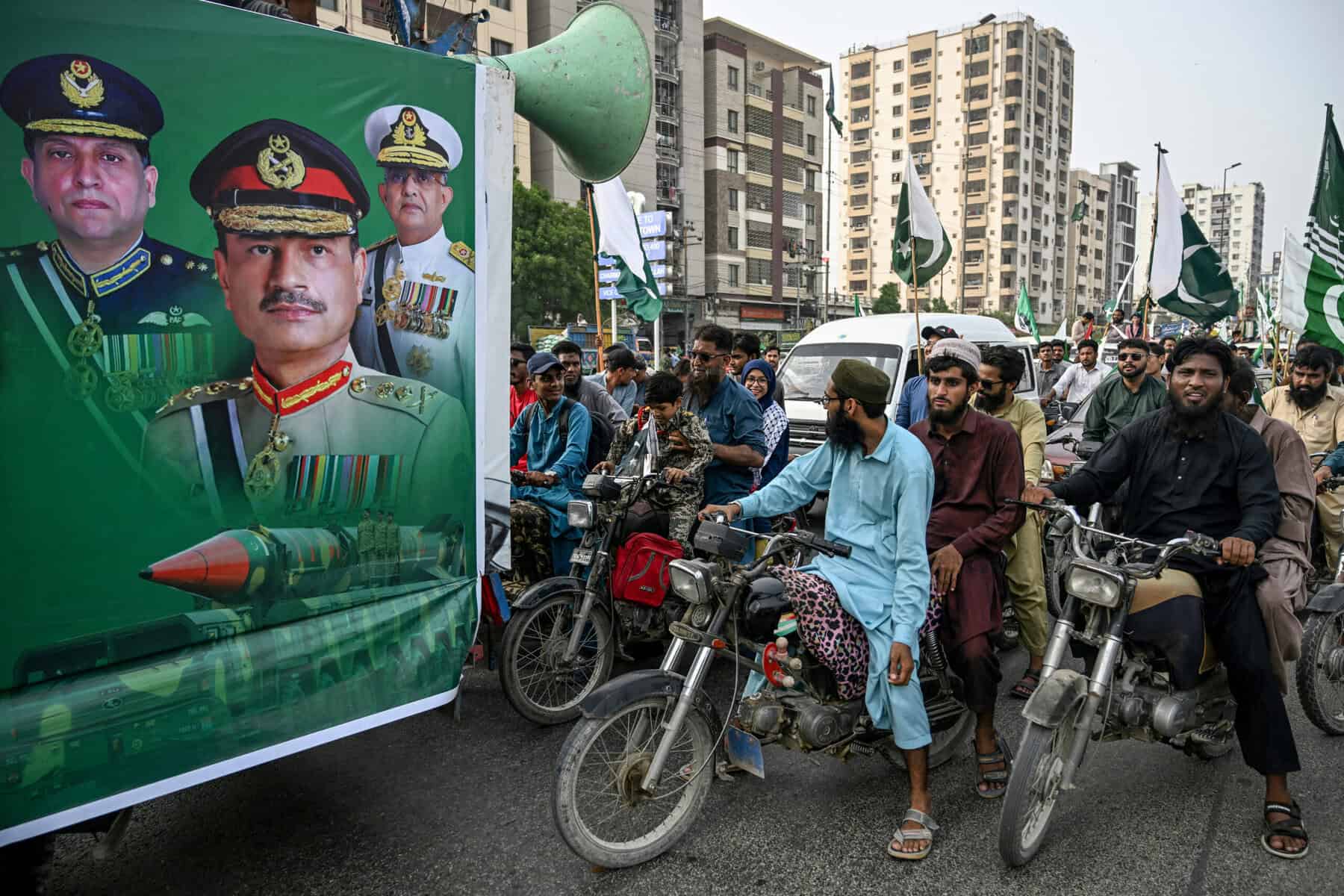
Pakistan began May 2026 with banners and posters in major cities honouring its military leadership for what officials described as guiding the country's defences to victory in the four-day aerial war with India in 2025. The Pakistan Air Force held a ceremony at the Nur Khan Auditorium in Rawalpindi on May 8 marking its achievements in downing Indian jets.
A government-organised concert took place in Lahore on May 9 at Liberty Chowk to mark what Pakistan calls the Day of the Battle of Truth. India also marked the anniversary with public statements and military briefings. On May 7, Prime Minister Narendra Modi changed his profile picture on X to the official logo of Operation Sindoor, India's name for the May 2025 military operation against Pakistan, and urged others to do the same.
"A year ago, our armed forces displayed unparalleled courage, precision and resolve," Modi wrote on X. " At a news conference in New Delhi, Air Marshal Awadhesh Kumar Bharti said India had destroyed 13 Pakistani aircraft and struck 11 airfields. In Rawalpindi, Lieutenant General Ahmed Sharif Chaudhry, director general of Inter-Services Public Relations, told reporters that Pakistan had defeated an enemy five times larger than itself and had shown only 10 percent of its military potential.
"We are prepared," he said.
the Conflict The fighting began after gunmen attacked tourists in Indian-administered Kashmir’s Pahalgam on April 22, 2025, killing 26 civilians. India blamed the attack on Pakistan, an accusation that Islamabad rejected. India launched Operation Sindoor on May 7, 2025, striking multiple sites deep inside Pakistan and Pakistan-administered Kashmir.
It said the strikes targeted terrorist infrastructure while Pakistani officials said civilians bore the brunt of the assault. Pakistan responded with Operation Bunyan al-Marsoos. The four-day conflict ended with a ceasefire on May 10, 2025. Pakistan accepted then-U.S. President Donald Trump’s assertion that he had brought about the ceasefire, nominated him for a Nobel Peace Prize, and has since acted as a mediator in the U.S. war on Iran.
India suspended the Indus Waters Treaty on April 23, 2025, the pact that governs river-water sharing between the two countries.
Pakistan said its Chinese-built J-10C jets shot down Indian aircraft, including Rafales, during the opening phase of the conflict. India’s second chief of defence staff, General Anil Chauhan, later acknowledged jet losses on the first day. Air Marshal Bharti stated that losses are a part of combat.
India’s BrahMos long-range missiles struck Pakistani airbases including Nur Khan in Rawalpindi and Bholari in Sindh province. India also used Israeli-made drones that reached as far as Karachi and Lahore. Commercial satellite imagery from Western companies documented damage at Pakistani military sites.
The same companies released no imagery of Indian military sites that Pakistan said it struck. Pakistani losses received open-source scrutiny while Indian losses did not. At the May 8 news conference in Rawalpindi, Pakistan’s military announced the formal operationalisation of the Army Rocket Force Command equipped with modern technology for high-precision targeting.
It unveiled newly inducted systems including the Fatah-III supersonic cruise missile, the Fatah-IV with a stated range of 750 kilometres and the Fatah-V described as a 1,000-kilometre deep-strike rocket system. Pakistan raised its military budget by 20 percent last year, allocating 2.55 trillion Pakistani rupees, equivalent to $9 billion, according to budget documents presented by Minister of Finance Muhammad Aurangzeb.
That included 704 billion rupees, or $2.5 billion, for equipment.
“The Rocket Force was not created specifically to ‘solve’ the BrahMos problem. Its purpose was institutional and doctrinal: to streamline and accelerate conventional missile decision-making while maintaining a clear separation from Pakistan’s nuclear deterrent architecture.”
Defence analysts contacted by Al Jazeera described the rocket force as providing Pakistan with credible conventional strike options, though they noted it remains a work in progress. Pakistan continues to review lessons from the conflict while both countries maintain public narratives of success.
Key Facts
Story Timeline
5 events- April 22, 2025
Gunmen killed 26 civilians in Pahalgam, Indian-administered Kashmir.
1 source@AJEnglish - May 7, 2025
India launched Operation Sindoor striking sites in Pakistan and Pakistan-administered Kashmir.
1 source@AJEnglish - May 10, 2025
Ceasefire ended the four-day conflict after U.S. President Trump intervention.
1 source@AJEnglish - May 7, 2026
Prime Minister Narendra Modi changed his X profile picture to Operation Sindoor logo.
1 source@AJEnglish - May 8-9, 2026
Pakistan held military ceremony and concert marking anniversary of the conflict.
1 source@AJEnglish
Potential Impact
- 01
India suspended the Indus Waters Treaty that governs shared river resources.
- 02
Pakistan established Army Rocket Force Command with new long-range conventional missiles.
- 03
Pakistan has served as mediator in the U.S. war on Iran since the conflict.
- 04
Both nations continue public military commemorations one year after ceasefire.
Transparency Panel
Related Stories
 Defense News
Zelenskyy Says Ukraine Expects Russian Drone and Missile Assault
Ukrainian President Volodymyr Zelenskyy told CBS News that intelligence indicates Russia will launch attacks involving drones and missiles as soon as Friday or Saturday night. He requested additional U.S. defensive systems and cited a recent Russian strike that killed two and wou…
 koreatimes.co.kr
Hungarian Election Shifts Right-Wing Focus to Moderate Conservatism
Peter Magyar won Hungary's parliamentary elections on April 12 and was sworn in as prime minister on May 9. His campaign retained emphasis on national sovereignty and immigration control while criticizing former Prime Minister Viktor Orban's centralization of power and ties to Ru…
 theyeshivaworld.com
U.S. Travel Group Estimates Newark Airport International Closure Would Cost $8 Billion a Year
A U.S. travel industry group has calculated that ending international service at Newark airport would reduce annual economic activity by $8 billion. The estimate covers lost spending by foreign visitors and related sectors.