Israel, Iran trade fire for first time since truce
<p>Israel and Iran exchanged attacks on Monday for the first time since a ceasefire in the Middle East war took effect two months ago, despite US President Donald Trump calling for restraint.</p><p>Israel's strikes came after Iran targeted Israel to avenge an airstrike on Beir
Jun 7, 8:50 PM(27 days ago)·15m read10 sources
MA+6
Nbc News
Audio version
Tap play to generate a narrated version.
m. m. June 8 Latest Iran and Israel traded waves of attacks on Monday as an uneasy two-month truce that had suspended the U.S.-Israeli war against Iran appeared to have broken down. Iranian ballistic missiles sent sirens wailing in central and southern Israel and booms from air defenses could be heard overhead.
Post via X — linked by one of this story's sources.
Israel’s air force bombarded sites in western and southern Iran, including a petrochemical factory, the Israeli military said. This was the first exchange of strikes between Israel and Iran since April, when President Trump called a halt to the American-Israeli campaign that began in late February to allow for negotiations on a peace deal with Tehran.
Weeks of talks have failed to end the war, and the renewed fighting has again brought the Middle East to the edge of a wider, full-blown conflict. Mr. Trump has publicly called for calm, but for now the conflict has no clear off-ramp. Iranians and Israelis alike had braced for yet another round of fighting after events put the two countries on a collision course.
On Sunday afternoon, Israel struck the southern outskirts of Beirut, the Lebanese capital, as part of its war with Hezbollah, the Iran-backed militia. Iran had pledged to retaliate against such strikes. Hours later, Iran acted on its threats, launching a wave of ballistic missiles at Israel.
The Israeli military said it intercepted at least some and vowed that it was ready to respond. Mr. Trump had earlier appeared keen to avoid an escalation, telling the Axios news site on Sunday that he planned to call Prime Minister Benjamin Netanyahu of Israel to tell him not to respond to the first barrage of Iranian missiles.
The president also told the Financial Times that Mr. Netanyahu had no choice but to accept a deal with Iran. “I call all the shots,” the newspaper quoted Mr. Trump as saying. ” Early Monday, the Israeli military said it had hit military sites in Iran.
It later added that the Israeli air force had attacked a major petrochemical complex in southern Iran. The Israeli strikes were followed by two more waves of Iranian missile launches, the Israeli military said. Here’s what else to know: Energy markets: The price of oil jumped after the exchange of strikes between Israel and Iran.
Brent crude, the global benchmark for oil, rose nearly 5 percent to about $98 a barrel. Read more › Diplomacy: Canada and Britain both expressed concern about the conflict resuming, and called for de-escalation. The prime minister of Qatar, which has mediated between the United States and Iran, spoke with Abbas Araghchi, the Iranian foreign minister, on Monday to discuss mediation efforts.
Yemen: The Iran-backed Houthis in Yemen on Monday announced a naval blockade against Israel in the Red Sea. It was unclear what that threat will mean in practice. But earlier Houthi attacks in the Red Sea snarled global shipping and prompted a bombing campaign by the United States and its allies.
Iran launched another volley of ballistic missiles at central Israel on Monday morning, the Israeli military said, the latest in the tit-for-tat strikes between the two countries. There were no immediate reports of casualties. The Houthis in Yemen on Monday announced a naval blockade against Israel in the Red Sea.
The Iran-backed militia has targeted vessels passing near parts of Yemen that are under their control since the war in Gaza began in 2023, including some with no clear connection to Israel. Earlier Houthi attacks in the Red Sea ensnarled global shipping, forcing vessels to sail thousands of additional miles around Africa and prompting a bombing campaign by the United States and its allies against them.
It is unclear how the Houthis might carry out their threat this time, but the U.S.-Israeli war with Iran has already rattled global markets. Iran’s blockade of the Strait of Hormuz, a critical waterway for oil and gas, has caused energy prices to rise worldwide.
Diplomatic contacts were ongoing as concerns about the U.S.-Iran cease-fire mounted. Sheikh Mohammad bin Abdulrahman Al Thani, who is Qatar’s prime minister and foreign minister, spoke with Foreign Minister Abbas Araghchi of Iran on Monday, the Qatari foreign ministry said.
The two discussed mediation efforts between the United States and Iran, and the developments in Lebanon, according to the statement, which did not mention the latest fighting between Iran and Israel. Iran’s state news agency IRNA said all the workers of Mahshahr’s vast petrochemical complex, which employee tens of thousands of workers, were being evacuated under emergency provisions.
Israel attacked a petrochemical plant earlier in the morning. Iran’s Islamic Revolutionary Guards Corps said it had launched strikes on two Israeli air bases, Nevatim and Tel Nof. The attack was in retaliation for Israeli strikes on Iranian radar sites in three regions, it said in a statement carried by Iran’s state news agency, IRNA.
The Israeli military said it had attacked several targets at a petrochemical complex in Mahshahr, southern Iran, on Monday morning. The governor of Khuzestan province, where Mahshahr is located, told Iranian state media that Israel had struck the Karun petrochemical plant.
Israel previously targeted the industrial facilities in Mahshahr in April. The area’s vast petrochemical complex is one of Iran’s key oil and gas production centers. Israel’s air defense systems are working to intercept a missile launched from Yemen, the Israeli military said on social media.
The Houthis — an Iran-backed militia in Yemen — have launched strikes at Israel since the war in Gaza began in 2023, but those attacks had stopped following the cease-fire between the United States and Iran in April. Tehran’s fire department said two non-residential locations in the western part of the Iranian capital had been struck, according to state television.
Isfahan’s deputy governor said on the broadcast that Najafabad — a city close to Isfahan, in central Iran — had been attacked, but no casualties had been reported so far. Iran’s official broadcaster reported early Monday local time that explosions were heard in Tehran, the capital, and the cities of Tabriz and Isfahan.
Israel’s air force struck military targets in western and central Iran early Monday, the Israel Defense Forces said on social media, without providing more details. The attack came hours after Iran fired ballistic missiles at Israel. Oil prices jumped after Iran and Israel exchanged strikes, casting fresh doubt on the future of a fragile cease-fire in the Middle East and stoking fears of an escalation in violence.
The strikes came after Israel attacked the outskirts of Beirut, targeting Hezbollah, the Iranian-backed militant group. Iran retaliated by firing a barrage of ballistic missiles, which prompted a counterattack from Israel. The attack and counterattack are the first such hostilities since a cease-fire paused the war with Iran two months ago.
Stocks in Asia fell sharply as investors retreated from artificial intelligence-related shares that had fueled blistering gains in recent months. South Korea’s benchmark KOSPI index, the world’s best-performing major stock market this year, fell 8 percent before trading was temporarily halted.
Oil prices surge. The price of Brent crude, the global benchmark for oil, rose nearly 5 percent to about $98 a barrel. West Texas Intermediate crude, the U.S. benchmark, was up around 5 percent to about $95 a barrel. Investors and analysts are focused on the continued disruption to shipping in the Strait of Hormuz, the narrow waterway between Iran and Oman that is a vital trading route for oil and natural gas that normally carries as much as one-fifth of the world’s oil supply.
Stocks in Asia tumble. Stocks in Asia, where countries import vast quantities of oil and gas, were broadly lower. After a sharp decline at the open of trade and a temporary halt in trading, South Korean shares clawed back some of the losses, with the index down 7 percent by the afternoon.
Japan’s Nikkei 225 fell more than 4 percent. Futures on the S&P 500 pointed to a modest decrease when stocks resume trading in the United States on Monday. Gasoline prices pull back. Gas prices fell again on Sunday, dropping to a national average of $4.17 a gallon, according to the AAA motor club.
Still, gasoline prices have risen 40 percent since the war began. Gas prices don’t move in lock step with crude, usually trailing increases or drops by a few days. The average price of diesel fell two cents to $5.34 on Sunday, up 42 percent since the start of the war.
When Israel and the United States attacked Iran in late February, some Iranian opponents of the Islamic Republic hoped that it would bring an end to decades of theocratic rule they saw as oppressive. Now, after devastating strikes and amid a teetering cease-fire, those hopes have been snuffed out.
Feelings of disillusionment and despair have taken their place, driven by a reported death toll of 1,700 civilians, vast destruction and an economic implosion that has made daily life a struggle. The cease-fire has provided some relief from bombs, but on Sunday, it was looking even shakier after Iran launched a new barrage of ballistic missiles against Israel.
Iranian officials cited Israel attacks in Lebanon, but the strikes raised the specter of Israeli retaliation on Iran. Beyond the military skirmishes, an economic war has sent the prices of basic goods skyrocketing. The crippling of critical industries and the effective closure of the Strait of Hormuz — a key trading route for Iran’s most precious export, oil — have tipped the already troubled economy into free fall.
The on-again, off-again peace talks, along with U.S. proclamations that the war is over when it’s not, has left both supporters and opponents of the government confused and anxious, according to interviews using voice apps with more than 20 Iranians in Tehran, Isfahan, Ahvaz and Mashhad in the days before Sunday’s strikes.
“I’m angry. I feel alone,” Kimia, a 25-year-old designer, said in an interview from Tehran. ” For some of those desperate for regime change, learning that Israel and the United States had initially planned to install a former hard-line president, Mahmoud Ahmadinejad, as the country’s new ruler was a painful indignity.
In interviews and in social media posts, several said that the disclosure of the plan by The New York Times left them feeling like bystanders in a geopolitical game with direct impact on their lives. Ayatollah Ali Khamenei, the country’s longtime supreme leader, was killed in strikes on the first day of the war in February and has since been replaced by his son.
” asked Amirali, a 62-year-old engineer in Tehran, in an interview. “They bombed and destroyed our country, our airports, roads and factories in the name of regime change so they could bring Ahmadinejad? ” Like all the Iranians interviewed, Kimia and Amirali asked to be identified only by their first names to avoid any possible retaliation.
It has been a tumultuous year for Iranians. The United States and Israel struck Iran first in June 2025 in a short war and then attacked again starting in late February, hitting factories, airports, seaports, bridges, universities and densely populated residential neighborhoods.
President Trump said this latest war was meant to create conditions to displace the regime and to ensure Iran could never get a nuclear weapon. Negotiations to end the conflict appear to be at a standstill, with one of the main sticking points being the Strait of Hormuz.
Iran shut down internet service to the general public from the start of the war until late May, saying it was for national security reasons. Now that more people are back on social media, many of them are able to communicate with the world and with one another.
Their messages paint a dire picture. A retired professor in Tehran who was critical of the government said in an interview that people had simply given up on political change and were focused on surviving day to day. A manager of a plastic bottle factory near Mashhad said production was shut down and all employees furloughed because it lacked raw materials after Israeli airstrikes on Iran’s petrochemical industry.
A doctor in Isfahan said pharmacies were rationing medicine, and that the health ministry had advised doctors to prescribe only essential medications because of shortages. Amin Afshar, the head of Iran’s hemophilia association, recently told Iranian media that the country had no reserves of the medicine that people with the bleeding disorder needed, and that importing medication had become very challenging.
Social media in Iran is awash with tragedy. One story that has spread widely is that of Hamed Mirzaei, who posted that he lost 12 members of his family in an Israeli airstrike in March on Resalat Square, a densely populated residential area in Tehran.
Mr. Mirzaei wrote that he is the sole survivor of the attack that killed his wife of one year, his parents, grandparents, uncle, cousins and other relatives, according to his Instagram posts and Iranian media reports. “Until the last day I’m alive, I will not let your names be forgotten, I will speak of each and every one of you.
I will not let you die in vain,” Mr. Mirzaei wrote in a post where he shared his wedding photographs. Many Iranians — even those who have opposed the theocratic regime — say they oppose the war and have suffered enough. They are increasingly looking at diplomatic negotiations as a means for stabilizing the country and the economy.
“I am definitely in favor of negotiations right now given the circumstances,” said Lida, a 44-year-old environmental expert in Tehran who has been opposed to the government. “We lost a lot of lives and lost a lot of our infrastructure. ” Analysts say that the huge airstrikes led many Iranians who initially supported the war to change their minds.
“This is a moment of Iranians taking stock of the reality and calculating things that have worked and have not worked,” said Ellie Geranmayeh, a senior fellow at the European Council on Foreign Relations. “Accepting the resilience of the regime despite all your hopes is a very bitter moment for those opposing the regime to digest.
” Mr. Trump’s contradictory remarks about Iran have further inflamed confusion and fury, analysts and several people interviewed said. He initially said help was on the way to Iranian protesters, then threatened to annihilate Iran’s ancient civilization.
On Thursday in comments to the media, Mr. Trump said that he would “be honored” to meet Iran’s new supreme leader, Ayatollah Mojtaba Khamenei, if a deal was reached with Tehran. That comment became an instant news headline in Iran, and people flooded social media with commentary and jokes, some referring to the fact that the ayatollah has not been seen in public since the war started.
“Well, 90 million people in Iran want to see him too, but it’s a shame they don’t have that fortune. ” Ahmad Mosaddegh wrote on social media. But as the war drags on, some government supporters are also losing patience with their leaders. Mehdi, a 52-year-old government employee, said in an interview that he had attended pro-government rallies with his wife and children.
But he said his salary runs out by the middle of the month, and he cannot afford to buy beef or chicken to feed his family. “I bought some groceries on loan from a shop in our neighborhood; he told me to pay when I get my paycheck,” Mehdi said. When he returned to pay, “the bill had doubled because the prices of everything had gone up.
” Iran’s official statistics center announced last week that inflation had spiked compared with this period last year. The report said the price of cooking oil had increased by 430 percent, eggs by 345 percent, rice by 287 percent and milk by 139 percent.
“Nobody is thinking of them or taking their opinions into consideration,” Sanam Vakil, the Middle East and North Africa director for Chatham House, said, adding that Iranians she reached inside the country kept asking her what would happen to them. ” Sanam Mahoozi, Rozhin Razavi and Shirin Hekmat contributed reporting.
---
[@MarioNawfal] 🇮🇷🇮🇱 Iran has released footage of missiles launched at Israel in retaliation for the strikes ... 🇮🇷🇮🇱 Iran has released footage of missiles launched at Israel in retaliation for the strikes on the Mahshahr petrochemical complex. Since last night, approximately 31 missiles have been fired at Israel, 30 from Iran and one from Yemen. Source: RN Intel Telegram / Writer: Julie
---
[@NBCNews] BREAKING: Israel strikes Iranian military targets hours after Tehran launched its own attacks. BREAKING: Israel strikes Iranian military targets hours after Tehran launched its own attacks. Follow live updates.
---
[@AP] BREAKING: Israel says Iran has launched missiles at it in the first such bombardment since a ceas... BREAKING: Israel says Iran has launched missiles at it in the first such bombardment since a ceasefire in April.
---
[@AFP] BREAKING Israel's military says it has struck several targets at a petrochemical complex in Mahsh... BREAKING Israel's military says it has struck several targets at a petrochemical complex in Mahshahr in southwestern Iran
---
[CBS News] Iran strikes Israel for first time since April ceasefire in retaliation for Israeli attack on Beirut For the first time since the ceasefire went into effect in April, Iran launched missiles toward Israel Sunday, largely contained to the north of the country.
The Iranian retaliation came after Israeli forces bombed suspected Hezbollah strongholds in southern Beirut. Charlie D'Agata reports.
---
[Al-Monitor] Israel, Iran trade fire for first time since truce <p>Israel and Iran exchanged attacks on Monday for the first time since a ceasefire in the Middle East war took effect two months ago, despite US President Donald Trump calling for restraint.</p><p>Israel's strikes came after Iran targeted Israel to avenge an airstrike on Beirut's southern suburbs, where the Islamic republic's proxy Hezbollah holds sway.</p><p>The exchange followed weeks of fruitless negotiations seeking to bring about a definitive end to the regional war sparked by US and Israeli strikes on Iran on February 28.</p><p>No casualties have been reported so far.</p>
---
[France 24] Hostilities escalate between Iran and Israel in blow to truce Iran and Israel have exchanged strikes in the first time since the start of a truce on April 8, in a blow to the ceasefire and amid stalled talks between the US and Iran. US President Donald Trump has called for restraint, and has asked Iran to go back to the negotiating table FRANCE 24's.
Noga Tarnopolsky has more from Jerusalem.
---
[The New York Times] Mideast Live Updates: Iran and Israel Trade Strikes for the First Time Since April Tehran11:03 a.m. June 8 Tel Aviv10:33 a.m. June 8 Latest Iran and Israel traded waves of attacks on Monday as an uneasy
The New York TimesMideast Live Updates: Iran and Israel Trade Strikes for the First Time Since AprilMA@MarioNawfal🇮🇷🇮🇱 Iran has released footage of missiles launched at Israel in retaliation for the strikes ...Nbc NewsBREAKING: Israel said it intercepted multiple missiles launched by Iran in retaliation for Israel...+6
The New York TimesMideast Live Updates: Iran and Israel Trade Strikes for the First Time Since AprilMA@MarioNawfal🇮🇷🇮🇱 Iran has released footage of missiles launched at Israel in retaliation for the strikes ...Nbc NewsBREAKING: Israel said it intercepted multiple missiles launched by Iran in retaliation for Israel...+6
These outlets didn't split into competing frames — coverage was uniform.
Retired pilot Chesley Sullenberger said on July 14, 2026, that he has early-stage Alzheimer’s disease. He described initial symptoms and expressed resolve to face the condition with his family.
 MA
MA +6
+6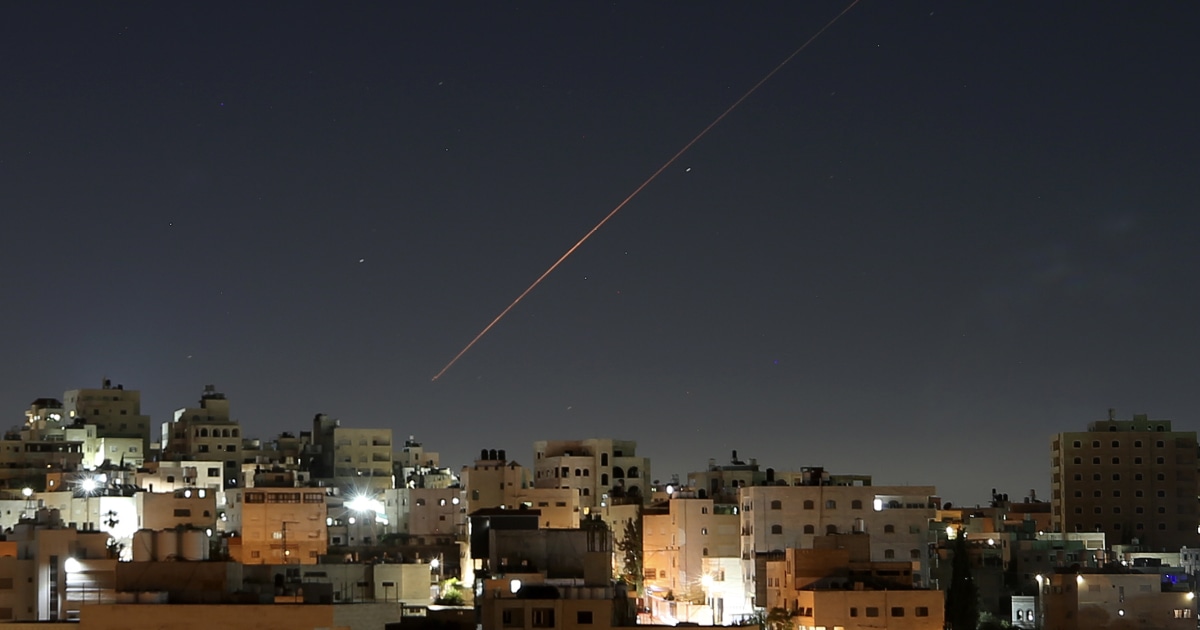 Nbc News