world
JWST Spectrum Shows Hot Atmosphere on Planet Orbiting White Dwarf
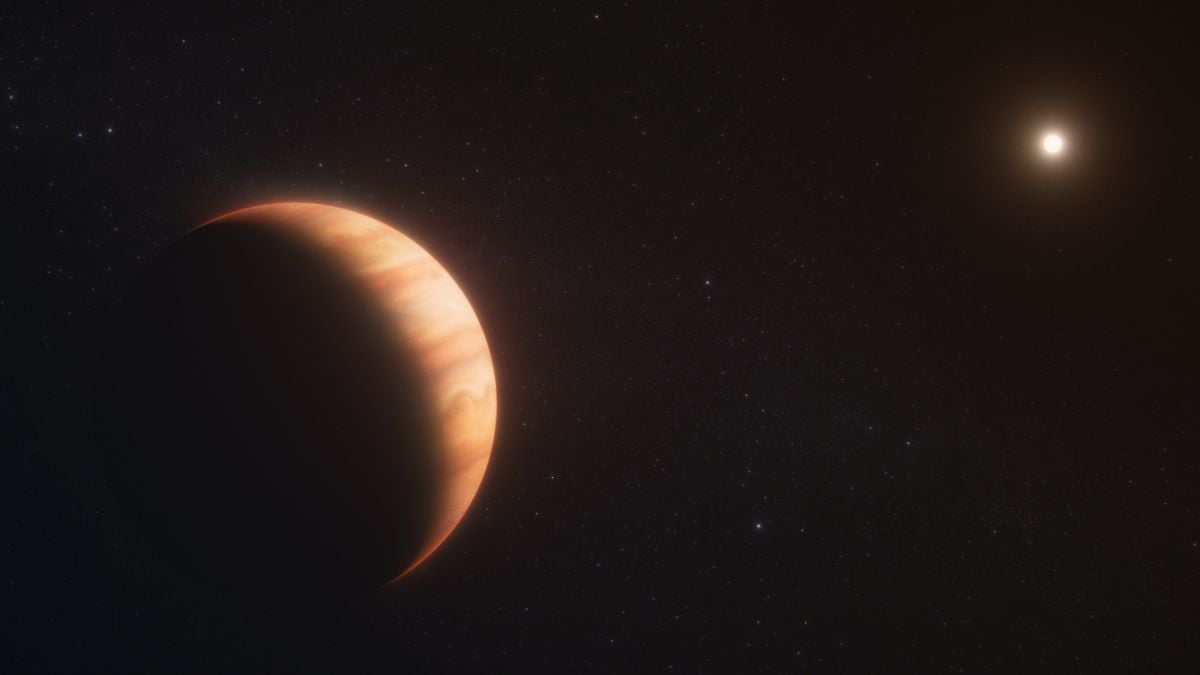
Astronomers published observations July 1 of WD 1856 b, a Jupiter-sized planet circling a white dwarf 80 light-years away. The data revealed a temperature 240 degrees Fahrenheit above expectations and traces of methane. Cnn reported the Nature journal study based on an eight-minute transit captured by the James Webb Space Telescope.
 sciencealert.com
Audio version
Tap play to generate a narrated version.
Astronomers using the James Webb Space Telescope obtained the first transmission spectrum of WD 1856 b during an eight-minute transit on or before July 1. The planet, discovered in 2020, orbits the white dwarf WD 1856+534 every 34 hours at a distance less than 2 million miles. Cnn reported that the spectrum indicated small cloud particles and hydrocarbons, most likely methane.
The planet’s mass lies between four and eleven times that of Jupiter, and its temperature reaches approximately 260 degrees Fahrenheit. This value exceeds by 240 degrees the temperature expected from heating by the host star alone. The white dwarf itself is Earth-sized, making the planet seven times larger than its star.
The study, published July 1 in the journal Nature, combined the new measurements with cooling models for giant planets. The results indicate the planet originally orbited at a much greater distance and migrated inward roughly one billion years ago after the star became a white dwarf.
Lead author Ryan MacDonald, a lecturer at the University of St Andrews, noted the methane abundance supports migration without engulfment during the red giant phase.
Co-author Christopher O’Connor of Northwestern University stated the data favor the gravitational interaction model over the engulfment model. Four additional transits observed after the initial spectrum will allow further analysis of atmospheric chemistry.
Victoria Boehm, a Cornell graduate student and study co-author, said the short transit duration required precise timing only Webb can achieve.
The host star WD 1856+534 lies 80 light-years from Earth. The planet’s current orbit is 50 times closer than Earth is to the Sun. The findings provide a reference point for how gas giants might respond when the Sun expands into a red giant in approximately five billion years.