Lebanese First Responders Report 110 Deaths From Israeli Strikes Since March
Lebanese paramedics and rescue teams have recorded 110 deaths from Israeli airstrikes and drone attacks since fighting between Israel and Hezbollah resumed on March 2, 2026. The Lebanon Ministry of Public Health says strikes have also damaged 131 emergency vehicles and affected multiple hospitals.
 csmonitor.com
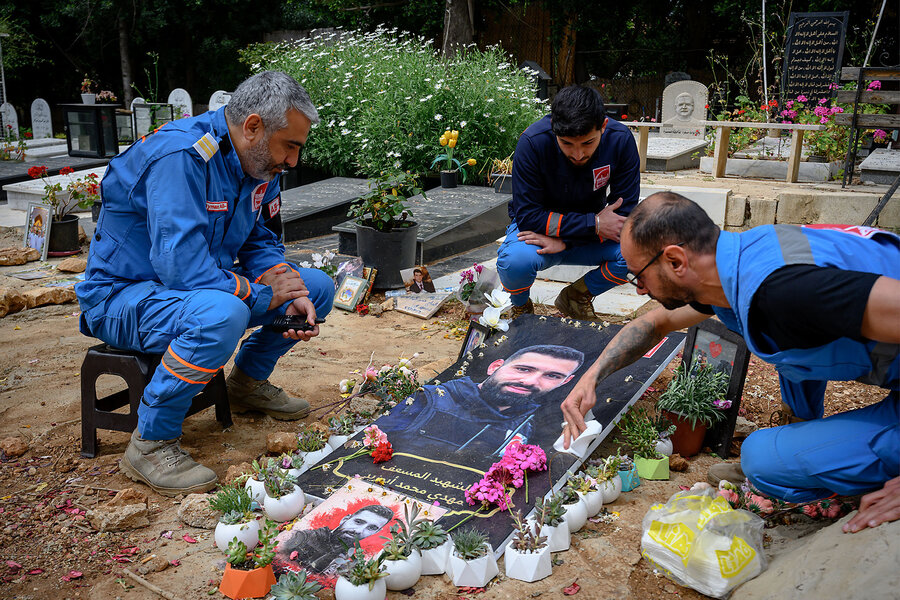
Lebanese first responders have faced a record toll since fighting resumed between Israel and Hezbollah on March 2, 2026. The deaths represent the highest number of emergency responder casualties in the decades of conflict between the two sides. Mohammed Suleiman, director of the Nabatiyeh Ambulance Service, visits the graves of three team members daily when security conditions allow.
His 16-year-old son Joud, an assistant rescuer, was killed March 24 along with volunteer paramedic Ali Jaber while riding a motorcycle minutes after leaving their base near Nabatiyeh Hospital. A third team member, Mohammed Abu Zaid, died April 15 in a strike that killed four paramedics in the town of Mayfadoun.
The health ministry said two Lebanese Civil Defense paramedics died Tuesday in Nabatiyeh while tending to the wounded. The day before, one medic was killed and five others wounded in a strike on a volunteer medical center in Srifa, in the Sidon district.
A separate strike in Toul killed one medic from the Hezbollah-affiliated Islamic Health Committee who was assisting victims.
The ministry stated that the toll among paramedics forms part of a deliberate attempt to undermine health infrastructure in Shiite communities of south Lebanon and the southern suburbs of Beirut. The Israel Defense Forces said in a statement that it struck only military objectives.
The IDF added that medical teams receive special protection so long as they do not carry out actions outside their humanitarian role. The IDF described specific strikes that killed Nabatiyeh Ambulance Service members as directed at Hezbollah infrastructure rather than at ambulances or rescue teams.
It did not provide evidence for those assertions.
Teams have adopted additional precautions to document the humanitarian nature of their work. Paramedics with the Nabatiyeh Ambulance Service wear GoPro body cameras at strike sites and inside vehicles. They also wait 15 minutes before approaching attack locations to ensure any military activity has ended.
"Medical personnel, whether military or civilian, and other civilians, including journalists, are protected under international humanitarian law. com) Mahdi Sadek, co-founder and coordinator of the Nabatiyeh Ambulance Service, said body camera footage from the April 15 strikes in Mayfadoun showed successive attacks on three separate ambulance teams within 30 minutes, with no visible military activity.
Mr. Sadek compared his organization's neutral status to that of the Red Cross. He said the losses have strengthened the team's resolve. "In our job ... we understand there is a lot of risk, but we’ve got to continue working," Mr. Sadek said. " The service was co-founded in 2002 and had not lost any members until the current round of fighting.