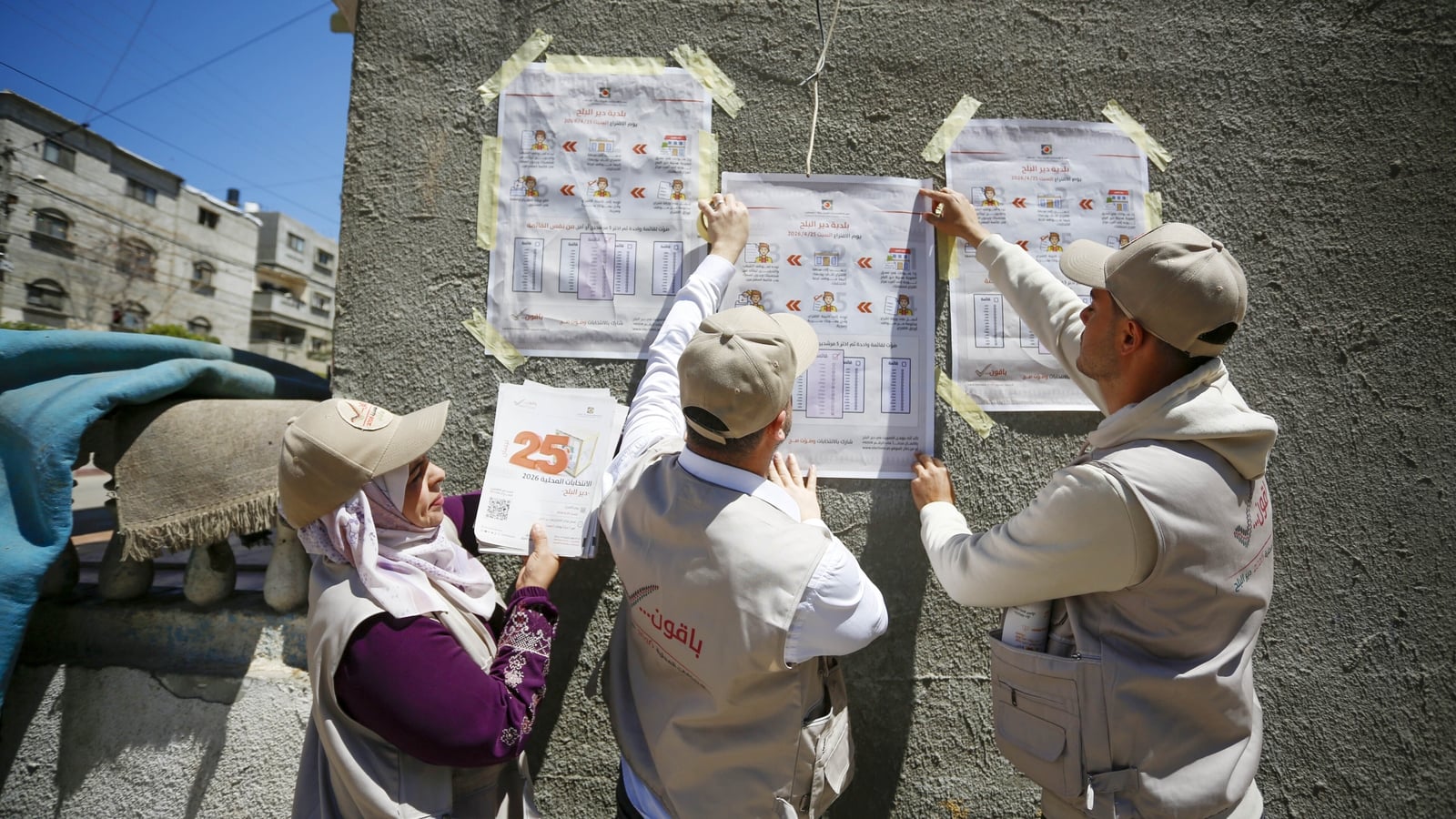
Local Elections Held in West Bank and Deir al-Balah, Gaza, for First Time in Over 20 Years
Palestinians participated in municipal elections in the West Bank and Deir al Balah in central Gaza on April 25, 2026, marking the first such vote in part of Gaza in over two decades. Turnout reached 24.5% by early afternoon, with voters emphasizing needs for services and justice. The elections follow reforms by the Palestinian Authority amid ongoing regional challenges.
Illustration: Substrate (Quartr-Edge style, Grok)Palestinians voted in local elections in the West Bank and part of Gaza on April 25, 2026, the first such polls held in portions of the Gaza Strip in more than two decades. More than 70,000 people were eligible to vote for municipal government posts in Deir al Balah, a central Gaza city damaged by airstrikes but spared an Israeli ground invasion.
Post by @AFP on X
5 million voters in the occupied West Bank were also eligible to cast ballots, according to the Central Election Commission.
Associated Press video showed security officers keeping order outside polling stations in Deir al Balah. Ashraf Abu Dan voted in Deir al Balah on April 25, 2026.
“I came to vote because I have a right to elect members to municipal council so they can provide us with services,” Ashraf Abu Dan said outside his Deir al Balah polling place. Voters spoke about the near-total absence of public services and the devastation in Gaza as reasons for participating.
Khalid al-Qawasmeh voted in Beitunia, West Bank, on April 25, 2026, where his finger was inked blue to mark having voted.
“Municipal laws need to be enforced so people feel there’s justice,” Khalid al-Qawasmeh said outside his polling place in Beitunia. Throughout the West Bank and Deir al Balah, the voting aimed to determine the makeup of local councils overseeing water, roads and electricity. The Palestinian Authority enacted reforms last year in response to demands from international backers.
Ninety-year-old President Mahmoud Abbas signed a decree last year reforming elections to allow voting for individuals rather than slates. In January 2026, Mahmoud Abbas signed a decree requiring candidates to accept the program of the Palestine Liberation Organization. The Palestinian Authority has not held presidential or legislative elections since 2006.
Hamas won parliamentary elections in 2006 and seized control of Gaza by militarily defeating Fatah in 2007. S. plan. The elections are part of an effort to politically link Gaza and the occupied West Bank, which Palestinians see as integral to any future path to statehood.
“We’re talking about geographically linking the West Bank and Gaza Strip,” Rami Hamdallah said. Rami Hamdallah is the chairman of the Ramallah-based Central Election Commission. Israel blocked the entry of materials such as ballot paper, ballot boxes or ink into Gaza, Rami Hamdallah said.
The Central Election Commission used wooden ballot boxes and blue ink left over from a vaccination drive last year. The Central Election Commission did not coordinate directly with Israel or Hamas ahead of the vote. Palestinian voter turnout in past local elections averaged between 50% and 60%.
By comparison, turnout in recent local elections in Lebanon was less than 40%, and in Tunisia it was 12%. Some polling places in the West Bank and Deir al Balah were busy on April 25, though others were more empty. Under the slogan “We Stay,” the Ramallah-based Central Election Commission campaigned to encourage participation, reflecting how Palestinians living amid war and occupation want a say in governance.
The single-city vote in Deir al Balah is a largely symbolic pilot, election officials said. The commission chose Deir al Balah because it was one of the few areas in Gaza where a large number of residents were not displaced during the two-year war. Campaign posters have been plastered across cities, though many, including Ramallah and Nablus, do not have contested elections.
Slates in major cities are dominated by Fatah, the faction that leads the Palestinian Authority, and independents, some with ties to other factions. It is the first time in six local elections that no faction besides Fatah has put forward its own slate. In Qalqilya, a city where no slates registered to participate, the Palestinian Authority will appoint councils.
The Palestinian Authority’s power has withered amid years without peace negotiations and Israel tightening its grip on the West Bank. Local councils have taken on greater importance, overseeing local health centers and schools that residents once accessed elsewhere. The authority sees local elections as a low-risk way to demonstrate progress on reforms.
Progress toward further phases, including disarming Hamas, reconstruction and transferring power, is stalled. A private security company secured the vote in the areas in Gaza where it took place.
Voters who turned out said they wanted a say over decision-making in their cities. For many Palestinians, this is more than just a municipal vote, reflecting a deep public desire to be heard and to participate.
Key Facts
Story Timeline
6 events- 2026-04-25
Palestinians voted in local elections in the West Bank and part of Gaza; turnout reported at 24.5% by 1 p.m.
3 sourcesLos Angeles Times · AFP · Jerusalem Post - 2026-01
Mahmoud Abbas signed a decree requiring candidates to accept the program of the Palestine Liberation Organization.
1 sourceLos Angeles Times - 2025
Palestinian Authority enacted reforms; Abbas signed decree reforming elections to allow voting for individuals.
1 sourceLos Angeles Times - 2025
Israel withdrew from half of Gaza.
1 sourceLos Angeles Times - 2007
Hamas seized control of Gaza by militarily defeating Fatah.
2 sourcesLos Angeles Times · Jerusalem Post - 2006
Hamas won parliamentary elections; last presidential or legislative elections held.
2 sourcesLos Angeles Times · Jerusalem Post
Potential Impact
- 01
Appointed councils in uncontested cities, maintaining Fatah dominance in local governance.
- 02
Highlighting ongoing challenges like material blockades, affecting governance transitions in Gaza.
- 03
Potential boost to Palestinian Authority reforms and international backing if turnout remains high.
- 04
Increased political linkage between West Bank and Gaza, advancing statehood efforts.
- 05
Demonstration of public participation amid disillusionment, possibly influencing future national elections.
Transparency Panel
Related Stories
Illustration: Substrate (Quartr-Edge style, Grok)Iran Rations Electricity Despite Large Gas Reserves Due to War Damage
Iran is implementing electricity rationing amid damage to its energy infrastructure from war. The country's president suggested using fewer lights as a response. Iran holds the world's second-largest gas reserves.
Illustration: Substrate (Quartr-Edge style, Grok)Hungary's Orban Opts Out of Parliamentary Seat Following Fidesz's Election Defeat
Viktor Orban announced he will not take his seat in Hungary's parliament following his party's defeat in the April 12, 2026, election. The Tisza party, led by Péter Magyar, secured a two-thirds majority with 141 seats. Orban plans to focus on reorganizing his political camp and m…
Illustration: Substrate (Quartr-Edge style, Grok)Blue Jays Pitcher Max Scherzer Struggles as Injured Starters Near Return
Toronto Blue Jays pitcher Max Scherzer faced questions about his rotation spot after a poor performance against Cleveland. With several injured pitchers set to return soon, the team made roster adjustments. Scherzer's high ERA highlights his early-season difficulties.