Substrate
business

Malaysia Says It Has Limited Ability to Halt Iranian Oil Transfers Near Its Waters

Malaysia’s maritime agency reported limited jurisdiction over ship-to-ship oil transfers conducted in international waters off its southern coast. The agency said vessels often evade detection through various tactics while operating about 70 kilometers from Johor state. The activity has persisted since late February amid regional conflict and sanctions.

Abc News
1 source·May 13, 1:16 PM(3 hrs ago)·2m read
|
Malaysia Says It Has Limited Ability to Halt Iranian Oil Transfers Near Its WatersAbc News
Audio version
Tap play to generate a narrated version.
Developing·Limited corroboration so far. This page will refresh as more sources emerge.

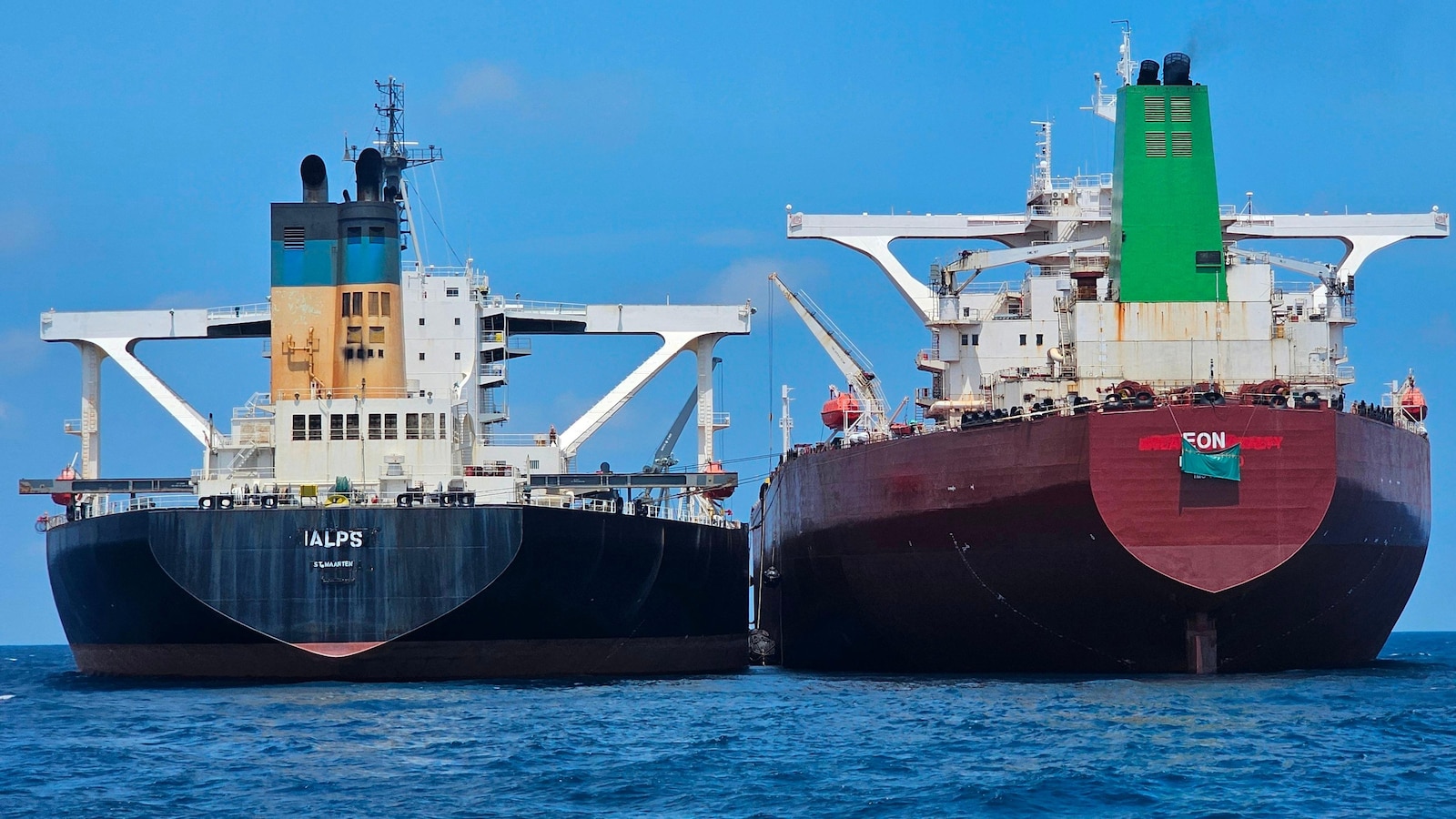
Malaysia’s maritime agency has stated it possesses limited ability to stop Iranian-linked tankers from conducting ship-to-ship oil transfers off its coast. The transfers occur in international waters roughly 70 kilometers from Malaysia’s southern Johor state, allowing Iran to continue oil exports while evading sanctions.

Malaysian Maritime Enforcement Agency Director-General Mohamad Rosli Abdullah said the operations often take place beyond Malaysia’s jurisdiction. Vessels involved, commonly referred to as the shadow fleet, frequently switch off tracking systems, use false identities, operate at night and employ complex ownership structures to avoid detection.

“The issues raised do not align with the actual situation on the ground and do not reflect the operational realities of maritime enforcement conducted by the MMEA,” Mohamad Rosli told The Associated Press. The area lies along a major maritime trade route in the South China Sea between Iran and China, which purchases about 90 percent of Iranian oil.

The transfers have continued even after a U.S. blockade of Iranian ports began in mid-April. As of Tuesday, two dozen Iranian-linked tankers tracked by an advocacy group remained anchored or loitering near the Eastern Outer Port Limits used for the transfers, though it was unclear how many had arrived before the blockade.

The practice has persisted for years, providing buyers with plausible deniability about the oil’s origin.

Malaysia discourages unsanctioned ship-to-ship transfers outside designated areas where they can be supervised. Such operations increase spill risks because they involve aging vessels and occur far from ports where accidents could be contained more easily.

The location borders the Riau Archipelago, which belongs to Indonesian territory. Indonesia’s Foreign Ministry said authorities were reviewing the situation to determine the legality of the activity. “Indonesia does not permit its territory or maritime zones to be used for unlawful activities,” said Foreign Ministry spokesperson Yvonne Mewengkang.

Malaysian authorities earlier this year seized two vessels involved in the unauthorized transfer of 2 million barrels of crude oil in Malaysian territorial waters. Those vessels were later released on bond. Mohamad Rosli noted that one of the seized vessels was observed this month conducting another ship-to-ship transfer of suspected Iranian oil off Johor.

Malaysian authorities said they will continue to strengthen monitoring and enhance cooperation with relevant agencies to safeguard the nation’s maritime domain. Neither the Iranian Embassy in Kuala Lumpur nor the U.S. State Department responded immediately to requests for comment.

Key Facts

42 transfers
Iranian oil ship-to-ship transfers near Johor since Feb 28
70 kilometers
Distance off Malaysia's southern Johor state
90%
Share of Iranian oil bought by China
2 million barrels
Crude oil transferred by two seized vessels
Two dozen tankers
Iranian-linked vessels near transfer area as of Tuesday

Story Timeline

4 events
  1. 2026-05-13

    Malaysian agency states limited ability to stop transfers in international waters.

    1 sourceAbc News
  2. April 2026

    U.S. blockade of Iranian ports begins while transfers continue.

    1 sourceAbc News
  3. February 28, 2026

    U.S. and Israel attack Iran, starting regional war as transfers begin near Malaysia.

    1 sourceAbc News
  4. Early 2026

    Malaysia seizes two vessels for unauthorized oil transfer of 2 million barrels.

    1 sourceAbc News

Potential Impact

  1. 01

    Iran maintains oil export revenue through transfers to China despite sanctions.

  2. 02

    Indonesia reviews legality of activity near its Riau Archipelago territory.

  3. 03

    Malaysia faces continued pressure from shipping organizations over enforcement.

  4. 04

    Risk of oil spills rises from unsupervised transfers using aging vessels.

Transparency Panel

Sources cross-referenced1
Confidence score65%
Synthesized bySubstrate AI
Word count394 words
PublishedMay 13, 2026, 1:16 PM
Bias signals removed4 across 2 outlets
Signal Breakdown
Loaded 1Amplifying 1Editorializing 1Framing 1

Related Stories

Global Supply Chains Disrupted After Iran Blocks Strait of Hormuzecns.cn
business3 hrs agoDeveloping

Global Supply Chains Disrupted After Iran Blocks Strait of Hormuz

Japan's largest snack maker will switch to black-and-white labels by the end of May 2026 because of a naphtha shortage caused by the closure of the Strait of Hormuz. The February 2026 U.S.-Israeli attacks on Iran have triggered worldwide shortages of fuel, metals, fertilizer ingr…

Forbes
1 source
Cyprus, Bulgaria and Spain Lead Eurozone Growth in First Quarter of 2026riotimesonline.com
business5 hrs ago

Cyprus, Bulgaria and Spain Lead Eurozone Growth in First Quarter of 2026

The eurozone expanded 0.8 percent year-on-year in the first quarter of 2026 while Cyprus grew 3.0 percent, Bulgaria 2.9 percent and Spain 2.7 percent. Eurostat reported the wider European Union grew 1.0 percent annually, trailing the United States at 2.7 percent.

Euronews
riotimesonline.com
benzinga.com
3 sources
U.S. Government Energy Spending More Than Doubled Since 2019 to Exceed $405 Billion in 2025foxnews.com
business7 hrs ago

U.S. Government Energy Spending More Than Doubled Since 2019 to Exceed $405 Billion in 2025

Government spending on energy exceeded $405 billion in 2025, more than double the level in 2019. The majority of the funds supported investments in energy infrastructure, manufacturing, renewables, efficiency programs and incentives for fuel switching. The International Energy Ag…

IE
opindia.com
uctoday.com
3 sources