world
MQ-9 Reaper Successfully Test-Fires Laser-Guided APKWS Rockets in Air-to-Air and Air-to-Ground Roles
General Atomics Aeronautical Systems conducted recent flight tests of an Air Force MQ-9A at the Nevada Test and Training Range, successfully employing APKWS in both its original air-to-ground role and against aerial targets. The trials responded to urgent demand for counter-unmanned aircraft systems capabilities.
May 11, 5:59 PM·2m read3 sources
THOS
 The War Zone
Audio version
Tap play to generate a narrated version.
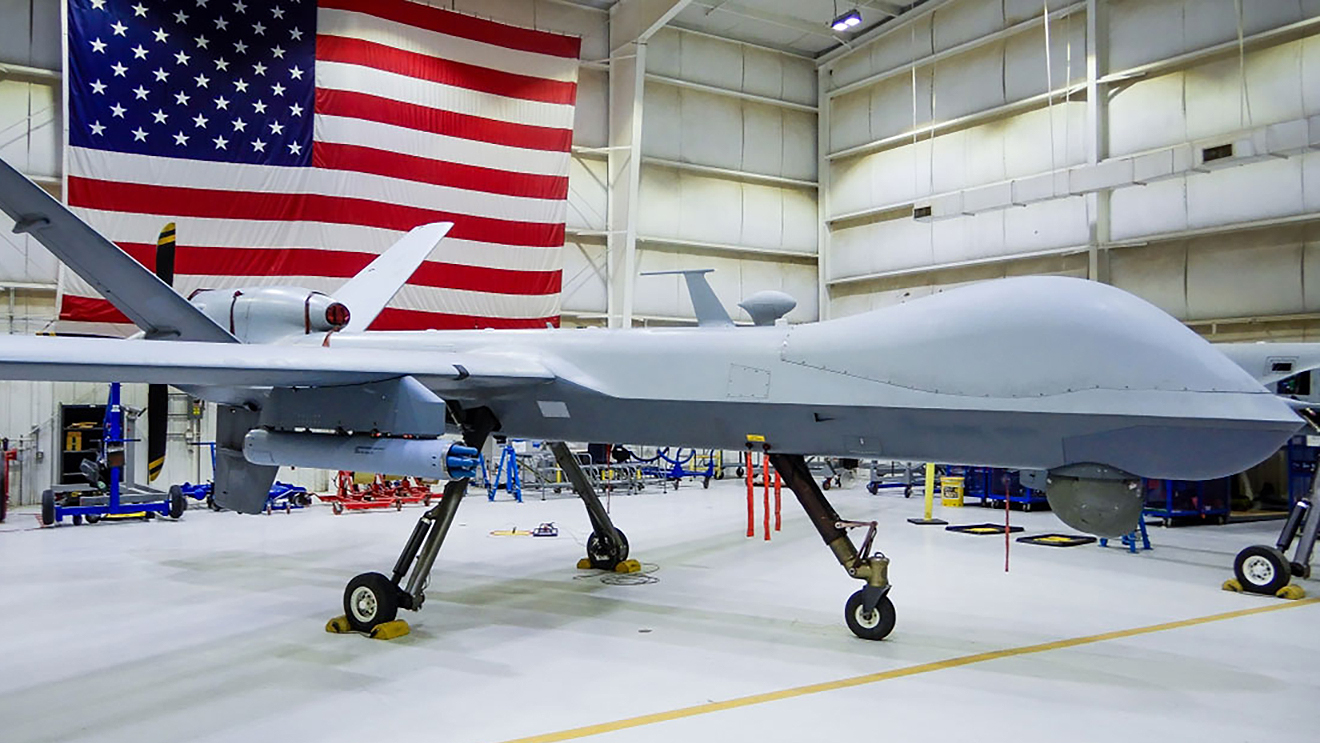
An Air Force MQ-9A successfully test-fired laser-guided 70mm Advanced Precision Kill Weapon System rockets against both air and ground targets during recent flight tests at the Nevada Test and Training Range. The MQ-9 Reaper employed the APKWS in its original air-to-ground capacity as well as against aerial targets.
All shots were executed flawlessly by the MQ-9A crews using laser-guided rockets and a specialized launcher.
The demonstration featured multiple types and variations of shot profiles, including aerial targets. U.S. Air Force. The test campaign was a response to real-time technological adaptation requirements, with the urgent need for C-UAS capabilities accelerating the trials and reducing the time between planning, integration, and flight test.
"We recognize the value that a system like APKWS brings to the MQ-9 aircraft as a tool to counter one-way attack drones," said GA-ASI President David R. Alexander. " Standard pods used for APKWS are loaded with seven rounds, while 19-round rocket pods are also a possibility.
The MQ-9 in its standard configuration has seven hardpoints, with six main underwing pylons usually utilized for weapons. Exactly how many APKWS a single MQ-9 can carry remains unclear. U.S. military service, the laser-guided air-to-air rocket is known as AGR-20F, a variant of the APKWS II also known as Fixed Wing, Air Launched, Counter-Unmanned Aircraft Systems Ordnance, or FALCO.
FALCO includes a modified laser-guidance and control section and a proximity fuze. FALCO-equipped rockets can be used against soft ground targets like standard vehicles and fast boats. GA-ASI brought up the potential of the MQ-9 or MQ-9 variants to carry APKWS for the C-UAS role last month.
The Mojave short takeoff and landing drone was earmarked for C-UAS as part of a broader mission scope. U.S. Army shows where Mojave STOL was present," General Atomics spokesperson C. Mark Brinkley said. Brinkley described integrating new weapons as a multi-part process including fit tests, weight considerations, captive carry for airworthiness, software, and actual live-fire.