Substrate
science

NASA Releases First Photos from Artemis II Moon Flyby Mission Captured by Astronauts

NASA has released photographs taken by the four Artemis II astronauts during their lunar flyby, showing a setting Earth and a solar eclipse. The mission marked the farthest distance from Earth traveled by humans since Apollo. The crew shared observations with mission control and the public upon their return.
The Bbc
The New York Times
4 sources·Apr 7, 8:10 PM(27 days ago)·1m read
NASA Releases First Photos from Artemis II Moon Flyby Mission Captured by Astronautsrte.ie
Audio version
Tap play to generate a narrated version.

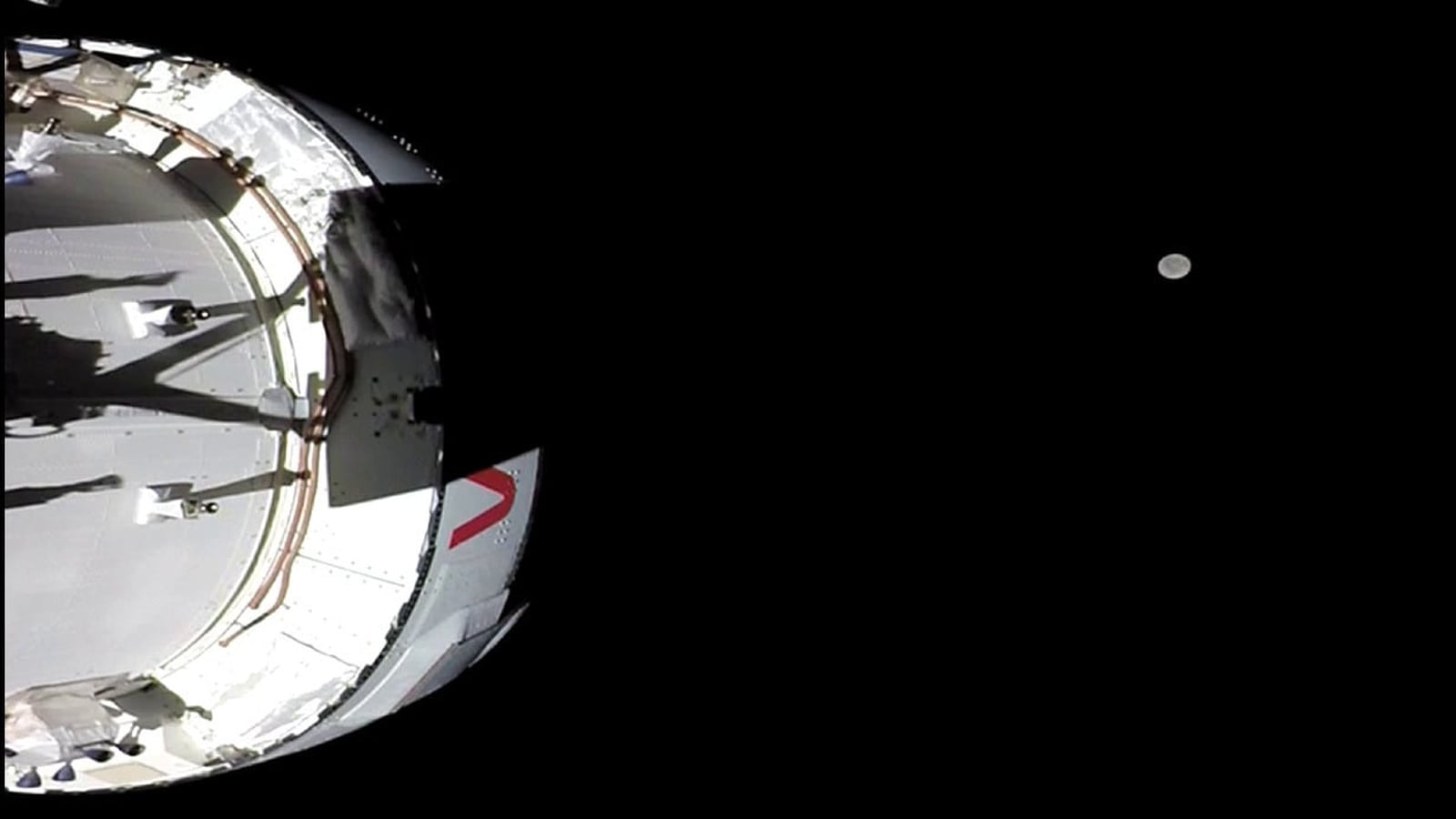
NASA released the first photographs captured by the Artemis II astronauts during their flyby of the Moon. The images, taken by onboard cameras, depict a setting Earth and a solar eclipse observed from lunar distance. The mission involved four crew members who traveled farther from Earth than any humans since the Apollo program.

The Artemis II mission launched on September 29, 2024, and concluded with the crew's return on October 15, 2024. During the journey, the astronauts conducted a 10-day orbital flight around the Moon without landing. The photographs were made public by NASA and the White House shortly after the mission's completion.

The astronauts witnessed a solar eclipse as the Moon passed between Earth and the Sun, an event visible from their position approximately 240,000 miles from Earth.

One image shows Earth partially obscured by the Moon's shadow during this eclipse. The crew reported their observations to mission control, describing the views of the lunar surface and Earth. In a post-mission call, President Donald Trump praised the astronauts for their achievement.

The mission tested the Orion spacecraft's systems for future lunar landings planned under the Artemis program. No contradictions appear in source reporting on the mission's timeline or objectives.

The astronauts shared details of their experiences with the public, including emotional reactions to the lunar views.

NASA emphasized the mission's role in preparing for Artemis III, which aims to return humans to the Moon's surface in 2026. The released photos provide visual documentation of the flyby's key moments, including the Earth-Moon geometry during the eclipse.

This mission has brought expressiveness and emotion about their journey to mission control and the public.

NASA officials, October 2024 (The New York Times)

The imagery highlights the mission's success in capturing high-resolution views from deep space. Sources agree that the photos were taken by the astronauts' cameras during the flyby phase.

Key Facts

Four astronauts
completed lunar flyby in Orion spacecraft
240,000 miles
farthest distance from Earth since Apollo
Solar eclipse
observed and photographed during flyby

Story Timeline

4 events
  1. October 15, 2024

    Artemis II astronauts returned to Earth after completing the 10-day lunar flyby mission.

    1 sourceThe New York Times
  2. October 2024

    NASA and the White House released the first photos captured by the astronauts during the Moon flyby.

    3 sourcesBBC · The New York Times
  3. During flyby, September 2024

    Astronauts observed and photographed a solar eclipse and setting Earth from lunar distance.

    2 sourcesThe New York Times · BBC
  4. September 29, 2024

    Artemis II mission launched with four astronauts aboard the Orion spacecraft.

    1 sourceThe New York Times

Potential Impact

  1. 01

    Artemis III lunar landing mission advances to 2026 following successful Orion tests.

  2. 02

    Public interest in NASA space programs increases due to shared astronaut imagery.

  3. 03

    Data from photos supports refinements in future deep-space photography techniques.

  4. 04

    International collaboration on Artemis program strengthens through mission publicity.

Transparency Panel

Sources cross-referenced4
Confidence score98%
Synthesized bySubstrate AI
Word count318 words
PublishedApr 7, 2026, 8:10 PM
Bias signals removed3 across 2 outlets
Signal Breakdown
Loaded 1Editorializing 1Amplifying 1

Related Stories

NASA Releases Thousands of Photos from Artemis II Lunar MissionNASA / Harrison H. Schmitt / Wikimedia (Public domain)
science5 hrs ago

NASA Releases Thousands of Photos from Artemis II Lunar Mission

NASA has released over 12,000 images from the Artemis II mission, which orbited the moon in April 2026. The photos capture views of Earth, the lunar surface, and a solar eclipse observed during the crew's return. Astronauts from the mission also visited the United Nations headqua…

Nbc News
UN
The Atlantic
Benzinga
Business Insider
5 sources
Three Die in Hantavirus Cases on MV Hondius Cruise Shipdeccanchronicle.com
science15 hrs agoFraming55Framing risk55/100Rewrite largely sticks to facts but inherits mild consensus framing around human-to-human transmission risk and repeatedly centers WHO spokespeople for reassurance.Click to jump to full framing analysis

Three Die in Hantavirus Cases on MV Hondius Cruise Ship

A hantavirus outbreak on the MV Hondius cruise ship has killed three passengers and sickened seven others, prompting an international response coordinated by the World Health Organization. The ship, carrying 147 people from 23 nationalities, is set to sail to Spain's Canary Islan…

Stat
Cbs News
2 sources
Houtman Abrolhos Corals Show High Resilience to 2025 Heatwave, Unlike Global Lossesnewscientist.com
science7 hrs agoDeveloping

Houtman Abrolhos Corals Show High Resilience to 2025 Heatwave, Unlike Global Losses

Coral reefs at the Houtman Abrolhos Islands off Western Australia endured a prolonged heatwave in early 2025 virtually unscathed, unlike widespread global die-offs. Researchers found exceptional heat tolerance across multiple species, with lab tests showing survival rates far exc…

New Scientist
1 source