science
NASA's SPHEREx Maps Water Ice Across Hundreds of Light-Years in Milky Way Stellar Nurseries
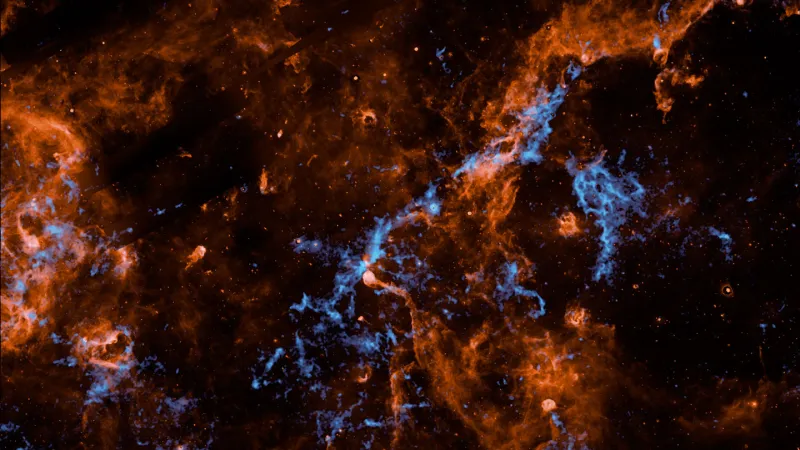
NASA's SPHEREx observatory has charted vast clouds of interstellar water ice in the Cygnus X and North American Nebula regions. The findings, reported in the April 20 Astrophysical Journal, confirm water's widespread presence in space. The maps are dozens of times wider than those from the James Webb Space Telescope.
 Science News
Audio version
Tap play to generate a narrated version.
Developing·Limited corroboration so far. This page will refresh as more sources emerge.
Astronomers have mapped vast clouds of interstellar water ice stretching hundreds of light-years across two active star-forming regions in the Milky Way. The icy formations drape the Cygnus X and North American Nebula stellar nurseries, where dense, dusty areas are threaded with wispy ice clouds.
Science News reported these observations from NASA's SPHEREx observatory, which show large amounts of water ice in dust-rich regions of Cygnus X and the North American Nebula.
Gary Melnick and colleagues detailed the findings in the April 20 Astrophysical Journal. Melnick, affiliated with the Harvard-Smithsonian Center for Astrophysics, stated that the findings confirm predictions that water occurs across huge areas of interstellar space. He added that the ice is dispersed upon the surfaces of countless dust motes in these stellar nurseries.
SPHEREx launched to low Earth orbit in March 2025 for a two-year mission. The observatory will survey the entire sky four times during its mission, using infrared wavelengths to conduct the survey. It discerns ice within clouds of gas and dust because ice absorbs certain wavelengths of infrared light and appears dark in starlight.
Melnick stated that SPHEREx is providing a more zoomed-out view of the environments in which these ices occur. The new SPHEREx maps of interstellar ice are dozens of times wider than previous maps generated by the James Webb Space Telescope. Science News reported that the icy clouds reach hundreds of light-years in length and drape two of the galaxy’s active star-forming regions.
Cygnus X is a stellar nursery.