Unbiased AI-powered news
The nearly $368 million system of 900 deep-sea instruments will be removed from Pacific and Atlantic waters. Alaska's $5.3 billion seafood industry and coastal communities rely on data from the network.
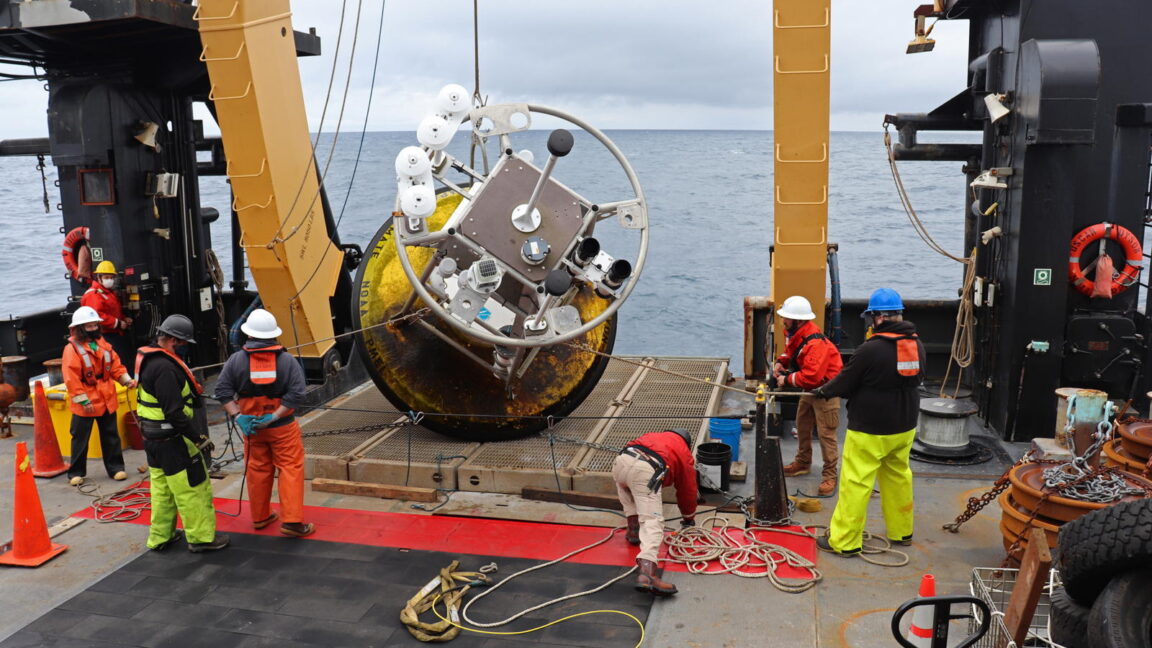
Ars TechnicaThe National Science Foundation announced plans in May to decommission the Ocean Observatories Initiative, a nearly $368 million network of scientific instruments that tracks ocean chemistry, wave action, water temperature, salinity, and other metrics.
The network consists of some 900 deep-sea instruments distributed across the Pacific and Atlantic Oceans. All previously collected data will remain accessible, NSF spokesperson Cassandra Eichner said.
Ocean Station Papa, one of the systems, is situated in the Gulf of Alaska at a depth of nearly 14,000 feet. An Ocean Station Papa buoy floats in the waters of the Gulf of Alaska. 3 billion and employs nearly 42,000 people, according to a McKinley Research Group report prepared for the Alaska Seafood Marketing Institute.
Michelle Stratton, executive director of the Alaska Marine Community Coalition, said the loss of Ocean Station Papa means the state will lose one of its only systems that documents how the ocean is changing in real time. "We're in the middle of salmon crashes, crab collapses, and repeated marine heatwaves, and this decision takes away the data we rely on to understand what's happening and how to manage these fisheries," Stratton said.
Jan Newton, University of Washington affiliate professor of biological oceanography, said the real-time information helps scientists, fishery managers, coastal hazard planners, and the military plan and prepare for the future.
"It helps us see where we're going and what's coming at us," Newton said. Rick Thoman, climate specialist with the University of Alaska Fairbanks who spent 30 years at the National Weather Service, said the oceans remain one of the most unexplored and poorly understood regions of Earth.
"Losing the information provided by Ocean Station Papa on how the ocean is changing with a warming climate is like driving down a dark freeway with no lights on," said Carol Janzen, oceanographer with the Alaska Ocean Observing System.
"The value of this network is that you get oceanographic information from the entire water column," Thoman said. Typhoon Halong largely destroyed the Western Alaska villages of Kipnuk and Kwigillingok last October. The mostly Yupik villages were home to more than 1,000 people.
Many residents evacuated to Anchorage and are still living there while decisions are made about whether to rebuild or move to higher ground. Alaska is preparing for El Niño conditions later this summer. Ocean Station Papa's sensors help weather forecasters and emergency response officials know ahead of time when super-storms are about to arrive.
"We're looking at ocean temperatures, salinity, current, wave height and direction, wind stress," Stratton said. " "We're seeing diseases directly linked to food security, income, intergenerational knowledge, community stability," Stratton added. "So we're not looking at just the biological crisis.
It's economic. It's cultural. " Tim Bristol, executive director of the nonprofit SalmonState, said pulling monitoring instruments out of the ocean seems counterintuitive. "No matter where you are on a particular issue, you hear a desire, a call for more information, better data, more in-depth analysis, and this seems to be, you know, a sprint in the wrong direction," Bristol said.
Thoman said other nations will step in to fill the data void. "You know the Chinese could come and plunk down a buoy there tomorrow if they're inclined," Thoman said. "If anyone thinks that the US, by stopping doing this, is going to stop the monitoring or stop our understanding of this, they are woefully mistaken.
Eichner said the decision aligns with the NSF's wider strategy of a nimbler approach to prioritize support for evolving scientific priorities and emerging technologies, as well as smart lifecycle management within its research infrastructure portfolio. The NSF remains committed to ocean science, Eichner said.
Los Angeles TimesSuper PACs tied to Anthropic and OpenAI have spent more than $37 million on congressional primaries this cycle. The groups have outspent candidates in some races and focused on candidates who back differing approaches to AI regulation.