Substrate
ai

NATO Intelligence Officer States AI Interoperability Standards Needed in Next Three Years

A senior NATO official highlighted interoperability challenges posed by artificial intelligence in geospatial intelligence during a speech at a U.S. symposium. He emphasized the need for agreed standards among the alliance's 32 members to address conflicting reports and governance issues.
Breaking Defense
1 source·May 5, 1:52 PM(16 hrs ago)·2m read
NATO Intelligence Officer States AI Interoperability Standards Needed in Next Three YearsChairman of the Joint Chiefs of Staff / Wikimedia (CC BY 2.0)
Audio version
Tap play to generate a narrated version.
Developing·Limited corroboration so far. This page will refresh as more sources emerge.

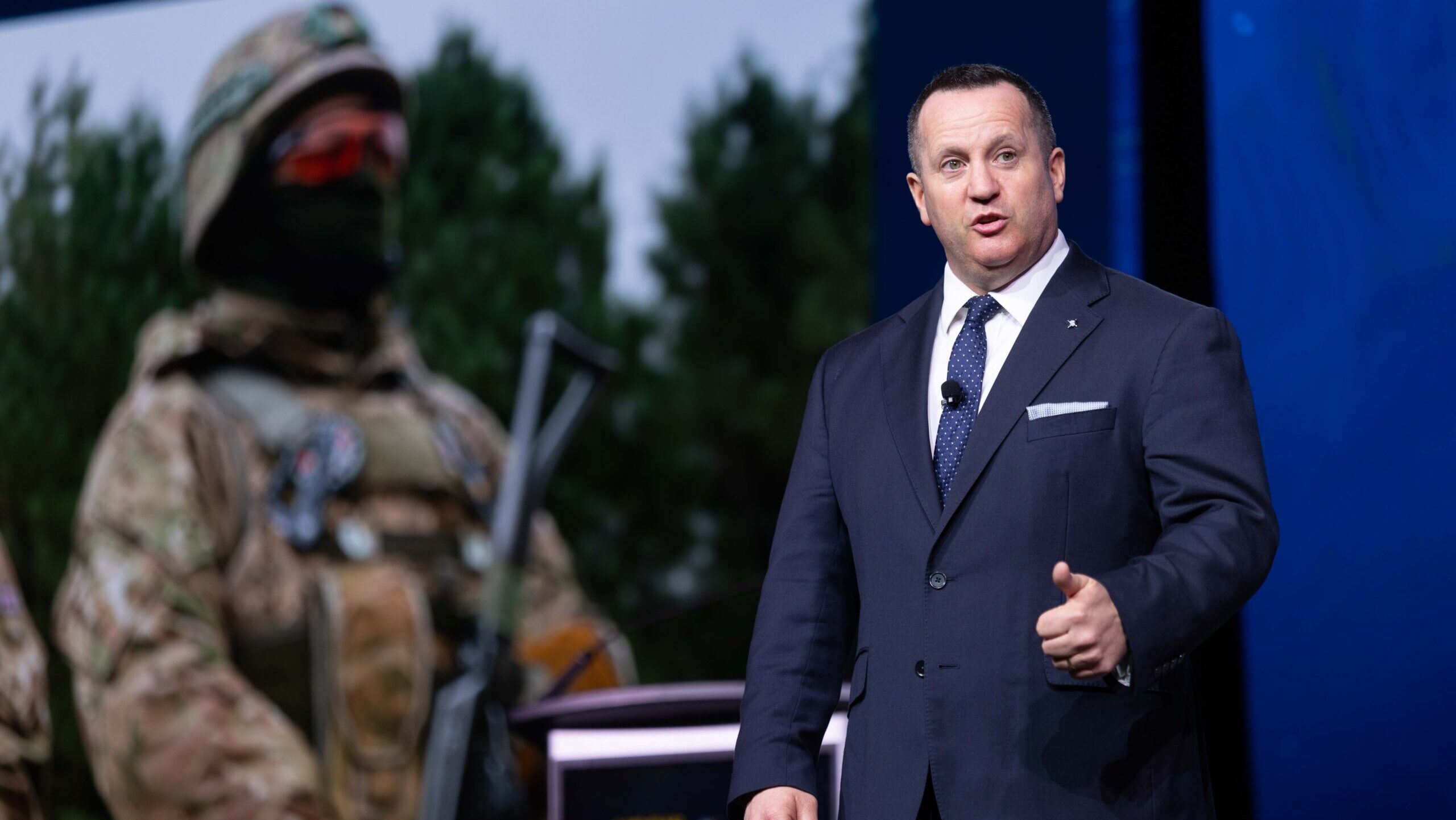
DENVER — Maj. Gen. Paul Lynch, a UK Royal Marine who directs NATO intelligence policy and serves as the alliance's deputy assistant secretary general for intelligence, stated that the growing use of artificial intelligence to enhance monitoring of adversary activities poses significant interoperability challenges for NATO.

Lynch delivered these remarks on Monday at the US Geospatial Intelligence Foundation’s annual GEOINT Symposium in Denver, according to Breaking Defense. He outlined the urgency, saying, 'We have decades of experience or common standards for air defense, maritime awareness, data formats.

Breaking Defense reported that Lynch described how AI-enabled exploitation for imagery analysis, change detection and multisource fusion is transforming capabilities, reducing the time from collection to actionable product and allowing analysts to focus on tasks requiring human judgment rather than pattern recognition at scale.

However, with NATO comprising 32 members, each responsible for developing their own policies, rules and regulations about AI usage and sharing those policies and products, governance challenges arise. In a hypothetical scenario presented by Lynch, two different NATO members each deploy a national AI model trained on their own imagery data set with that country’s labeling conventions and analytical priorities, resulting in conflicting intelligence reports provided to a NATO commander.

Lynch posed key questions: 'Which one does the commander use on what basis, with what confidence?

And I think that’s the AI interoperability challenge for allied GEOINT [geospatial intelligence], and no single nation is able to solve that alone. GEOINT primarily involves providing location and change detection data about human activities and natural phenomena such as wildfires, using satellite imagery, maps, and other types of data, as explained in the context of Lynch's remarks.

He noted that NATO is already grappling with incorporating vast amounts of GEOINT data from commercial satellite constellations into military and intelligence systems to promote member state interoperability.

Lynch stated, 'The problem is that our frameworks for incorporating commercial intelligence into allied decision cycles were built for a different world. He added sardonically that this sounded 'perfectly straightforward,' meaning it is not. Currently, commercial data enters NATO through intelligence systems mostly via exceptions and workarounds, not designed pathways, according to Lynch.

NATO signed its first commercial space strategy last June, and is now undertaking the unglamorous work to develop data use policies, security classification guides, contract frameworks, and releasability rules. The advent of AI complicates these efforts, Lynch explained, particularly as some member states such as the United States are already integrating AI processing to produce GEOINT, while other NATO member states are only just contemplating foundational questions about AI use.

To address these issues, Lynch stated that NATO needs data standards designed for the current world where commercial data, national data, and partner data, increasingly processed by AI, all contribute to the same operational picture.

This includes common meta-data schemes, common AI model documentation, and common interfaces that do not require bespoke integration every time a new partner or new source joins the enterprise.

Key Facts

NATO faces AI interoperability challenges
Maj. Gen. Paul Lynch highlighted risks of conflicting intelligence reports from different national AI models among NATO's 32 members.
Urgency for AI standards
Lynch stated that the decision on AI frameworks must occur within the next three years to keep pace with technology.
Integration of commercial data
Commercial GEOINT data enters NATO systems through exceptions and workarounds, complicating fusion with national and partner intelligence.
Governance focus
Path to AI-enabled intelligence advantage lies in governance, including common data standards and AI model documentation.

Story Timeline

4 events
  1. 2026-05-04

    Maj. Gen. Paul Lynch warned about interoperability challenges for NATO regarding the growing use of artificial intelligence at the US Geospatial Intelligence Foundation’s annual GEOINT Symposium in Denver.

    1 sourceBreaking Defense
  2. 2025-06

    NATO signed its first commercial space strategy.

    1 sourceBreaking Defense
  3. ongoing

    Some NATO member states such as the US are integrating AI processing to produce GEOINT, while others are contemplating foundational questions about AI use.

    1 sourceBreaking Defense
  4. next three years

    Decision on applying rigor to AI standards will be made, according to Maj. Gen. Paul Lynch.

    1 sourceBreaking Defense

Potential Impact

  1. 01

    Increased risk of conflicting intelligence reports affecting allied commanders' decision-making.

  2. 02

    Divergent progress among member states in AI integration, potentially straining alliance cohesion.

  3. 03

    Potential delays in NATO's adoption of AI for geospatial intelligence due to unresolved interoperability issues.

  4. 04

    Advancement in NATO's commercial space strategy through development of data policies and standards.

Transparency Panel

Sources cross-referenced1
Confidence score70%
Synthesized bySubstrate AI
Word count490 words
PublishedMay 5, 2026, 1:52 PM
Bias signals removed3 across 3 outlets
Signal Breakdown
Loaded 3

Related Stories

Brockman Testifies on Heated 2017 Dispute with Musk Over OpenAI's For-Profit Shift in Federal Trialnaturalnews.com
ai36 min agoUpdated

Brockman Testifies on Heated 2017 Dispute with Musk Over OpenAI's For-Profit Shift in Federal Trial

OpenAI President Greg Brockman detailed a heated 2017 confrontation with Elon Musk during testimony in the federal trial Musk v. Altman. He described Musk storming around a table and grabbing a painting after rejecting shared control proposals. The lawsuit seeks $150 billion in d…

The New York Times
Wired
New York Post
BBC News
Business Insider
6 sources
Publishing Houses, Scott Turow Sue Meta Over AI Training Data Copyrightthenation.com
ai2 hrs agoFraming55Framing risk55/100Rewrite inherits negative framing of Meta's actions through loaded verbs and phrases, with lede misdirection centering on lawsuit filing over core infringement allegations.Click to jump to full framing analysis

Publishing Houses, Scott Turow Sue Meta Over AI Training Data Copyright

Five major publishing houses and author Scott Turow filed a class action lawsuit against Meta and CEO Mark Zuckerberg, alleging the company illegally used millions of copyrighted books and journal articles to train its Llama AI model. The suit, filed in federal court in Manhattan…

fortune.com
The Washington Post
Financial Times
NPR
4 sources
Richard Dawkins Claims AI Chatbot Shows Signs of Consciousness After Three-Day ConversationsKarl Withakay / Wikimedia (CC BY-SA 4.0)
ai36 min ago

Richard Dawkins Claims AI Chatbot Shows Signs of Consciousness After Three-Day Conversations

Evolutionary biologist Richard Dawkins engaged in three-day discussions with an AI bot named Claudia, leading him to state that AIs are conscious and human-like. He shared unpublished work and philosophical reflections with the bot, which responded with poems and praise.

ZE
The Guardian
OilPrice.com
3 sources