Neutron Scattering Study Finds Spinon Signatures in Lab-Grown Herbertsmithite and Zinc Barlowite, But Debate Over Quantum Spin Liquids Continues
Young Lee and colleagues at SLAC National Accelerator Laboratory concluded in 2025 that both minerals exhibit quantum spin liquid behavior after inelastic neutron scattering experiments at Oak Ridge National Laboratory. The findings build on the 1970s discovery of the mineral in Iran and years of synthesis challenges.
 interestingengineering.com
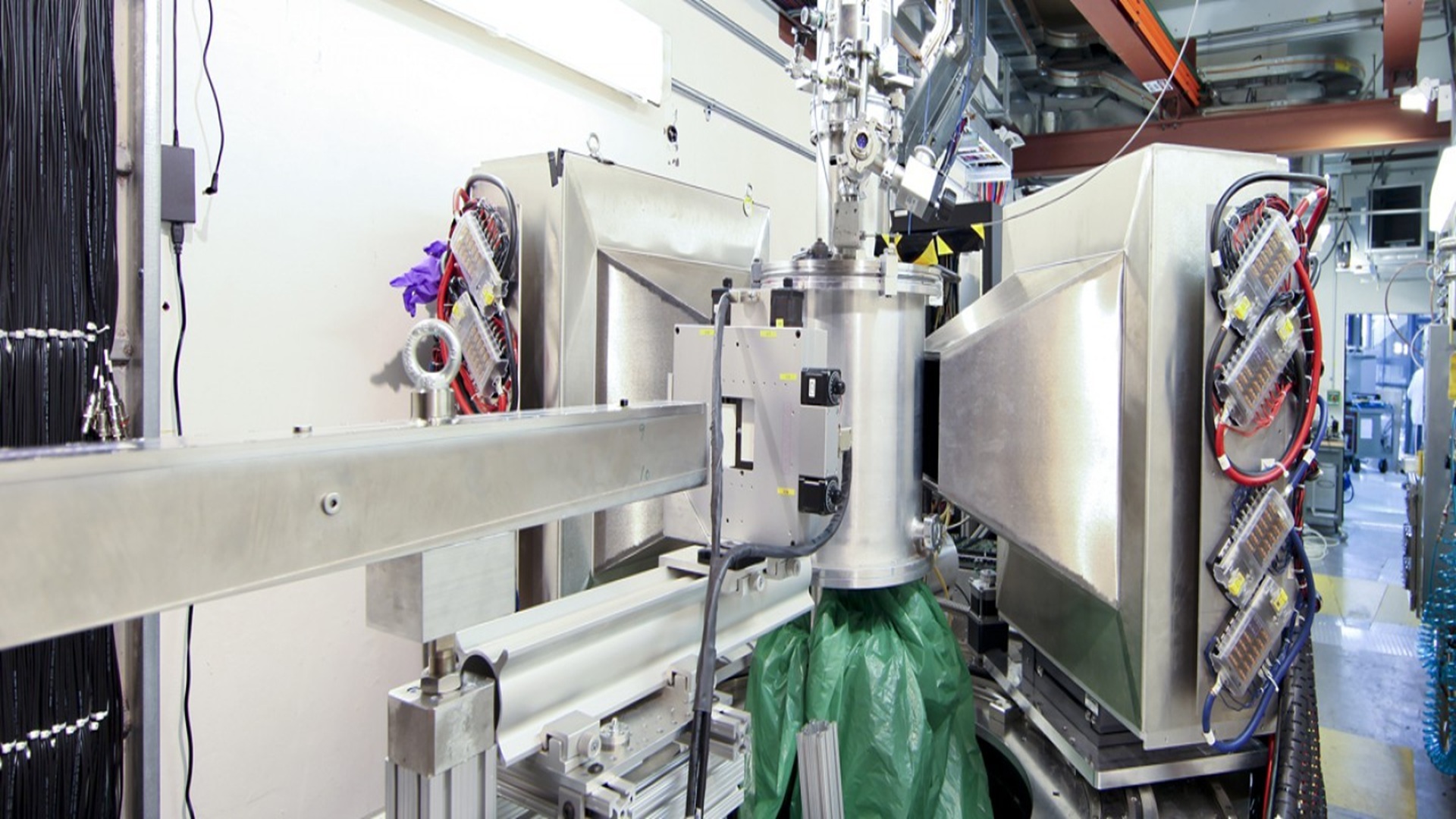
Young Lee at SLAC National Accelerator Laboratory in California and his colleagues performed inelastic neutron scattering on herbertsmithite and zinc barlowite in 2025. The experiments, conducted at Oak Ridge National Laboratory in Tennessee, cooled the samples to 2 kelvin above absolute zero.
Neutrons traveling at hundreds of metres per second struck the crystals, allowing researchers to reconstruct signatures of spinons.
Lee concluded that both herbertsmithite and zinc barlowite are quantum spin liquids based on the 2025 neutron-scattering data. “I certainly have my own biases, but I think reasonable minds should already be convinced,” Lee said. He added that the wish list is to convince the community that we have at least QSLs in herbertsmithite and zinc barlowite.
In the 1970s, Joachim Otteman and Darius Adib discovered a bluish-green glassy mineral in the Kali Kafi mine near Anarak, Iran. They named the newly discovered mineral anarakite. Anarakite was later renamed herbertsmithite, which later turned up in some mines in Chile.
Physicists have recently visited mines in Chile to collect new herbertsmithite samples, Michael Norman at Argonne National Laboratory in Illinois said. Herbertsmithite contains flat layers of magnetic copper atoms separated by non-magnetic zinc atoms arranged in a Kagome pattern. Zinc barlowite is a closely related mineral to herbertsmithite that also has a Kagome structure.
Mathematical models of spins in Kagome patterns show groups of spins that could move without extra energy, consistent with quantum spin liquid behavior. Synthesizing herbertsmithite in the lab takes months and requires waiting up to 10 months for chemical reactions to grow the mineral in quartz test tubes. More than half of the test tubes failed to produce herbertsmithite.
Growing zinc barlowite presented similar difficulties, including an initial chemical mixture that eats test tube walls, requiring Teflon linings. The final herbertsmithite and zinc barlowite crystals grown in the lab could all still fit on the tip of a finger. Individual herbertsmithite and zinc barlowite crystals yielded were tens of milligrams or less.
Researchers align many small herbertsmithite and zinc barlowite crystals like a puzzle to make one bigger crystal for experiments. In 2007 Young Lee and a colleague synthesized herbertsmithite from scratch. The mineral is rare in nature, and laboratory synthesis gave greater control over purity.
Lee has spent his career studying herbertsmithite and its mineral cousins. A team including Zi Yang Meng at the University of Hong Kong found very sharp signatures of spinons in a Kagome-pattern material made from yttrium, copper and bromine. Hitesh Changlani at Florida State University and colleagues observed signatures of QSL behaviour in neutron-scattering data and heat-response measurements for a lab-grown cerium-zirconium-oxygen material with three-dimensional spin arrangement.
Steven Kivelson at Stanford University in California said that to announce that you have found, for sure, the first example of a QSL, you want to have evidence that’s airtight. Norman noted that both minerals contain copper atoms known as orphan spins that do not belong to the patterned planes and can produce signals resembling those from spinons.
Kivelson added that the similar QSL-like features in herbertsmithite and zinc barlowite despite their structural differences strengthen the case that the signals are not merely from disorder.
Philip W. Anderson investigated quantum spin mathematically in 1973. He described a state in which quantum spins remain in constant motion even at extremely low temperatures. @NewScientist reported that Anderson’s work laid the foundation for the concept of quantum spin liquids, though he noted limited knowledge about the state at the time.
Michael Norman at Argonne National Laboratory in Illinois described a quantum spin liquid as an entangled network like a hive mind. Zi Yang Meng said it is not impossible that a future experiment could contradict his team’s findings on spinon signatures, but he considers the evidence good enough. Changlani stated there is now growing evidence that these things, QSLs, are real.
Kivelson observed that researchers have made real progress in weaving a web of evidence for quantum spin liquids. Norman said he would like to see direct detection and manipulation of spinons or visons to settle the question. Lee remains focused on materials science, emphasizing the need to convince the community through continued study of herbertsmithite and zinc barlowite.
Key Facts
Story Timeline
5 events- 1973
Philip W. Anderson mathematically investigated quantum spin and described a potential quantum spin liquid state.
1 source@NewScientist - 1970s
Joachim Otteman and Darius Adib discovered bluish-green glassy mineral in Kali Kafi mine near Anarak, Iran, and named it anarakite, later renamed herbertsmithite.
1 source@NewScientist - 2007
Young Lee and a colleague synthesized herbertsmithite from scratch in the laboratory.
1 source@NewScientist - 2025
Young Lee and colleagues conducted inelastic neutron scattering experiments on herbertsmithite and zinc barlowite at Oak Ridge National Laboratory.
1 source@NewScientist - 2026-05-08
New Scientist article details Lee's conclusion that both minerals are quantum spin liquids along with reactions from other physicists.
1 source@NewScientist
Potential Impact
- 01
Continued debate among physicists on required evidence standards for declaring quantum spin liquids in real materials.
- 02
Strengthened theoretical and experimental focus on spinons and visons detection techniques.
- 03
Potential pathway to harness natural entanglement for quantum computing error correction without engineering each link.
- 04
Increased interest in mining natural herbertsmithite samples from Chile and elsewhere for further validation.
Transparency Panel
Related Stories
 indianexpress.com
WHO Issues First Global Guideline on Infertility Prevention and Treatment
The World Health Organization released its first global guideline calling on countries to improve fertility care by making it safer, fairer and more affordable. Infertility affects an estimated 1 in 6 people of reproductive age. The recommendations cover prevention, diagnosis and…
 Nbc News
Hiker Found Dead From Suspected Bear Attack in Glacier National Park
Search crews discovered the body of a missing 33-year-old Florida man about 50 feet off the Mt. Brown Trail in Glacier National Park on Wednesday. Park officials said his injuries were consistent with a bear encounter. The last fatal bear attack in the park occurred in 1998.
 Substrate placeholder — needs review
Pentagon Releases UFO Documents as Trump Urges Public Review
The Pentagon released UFO documents on Friday. President Trump said the public should "have fun" deciding for itself what the materials show. CBS News reported the release and Trump's statement.