science
Oak Trees Delay Leaf Emergence by Three Days After Caterpillar Infestations, Study Finds
Researchers at the University of Würzburg analyzed satellite data showing oak trees in northern Bavaria postponed bud opening by three days following heavy gypsy moth damage in 2019. The delay reduced leaf consumption by 55 percent in 2020. Separately, Elon Musk testified for three days in his lawsuit against OpenAI this week.
JA
 goodnewsnetwork.org
Audio version
Tap play to generate a narrated version.
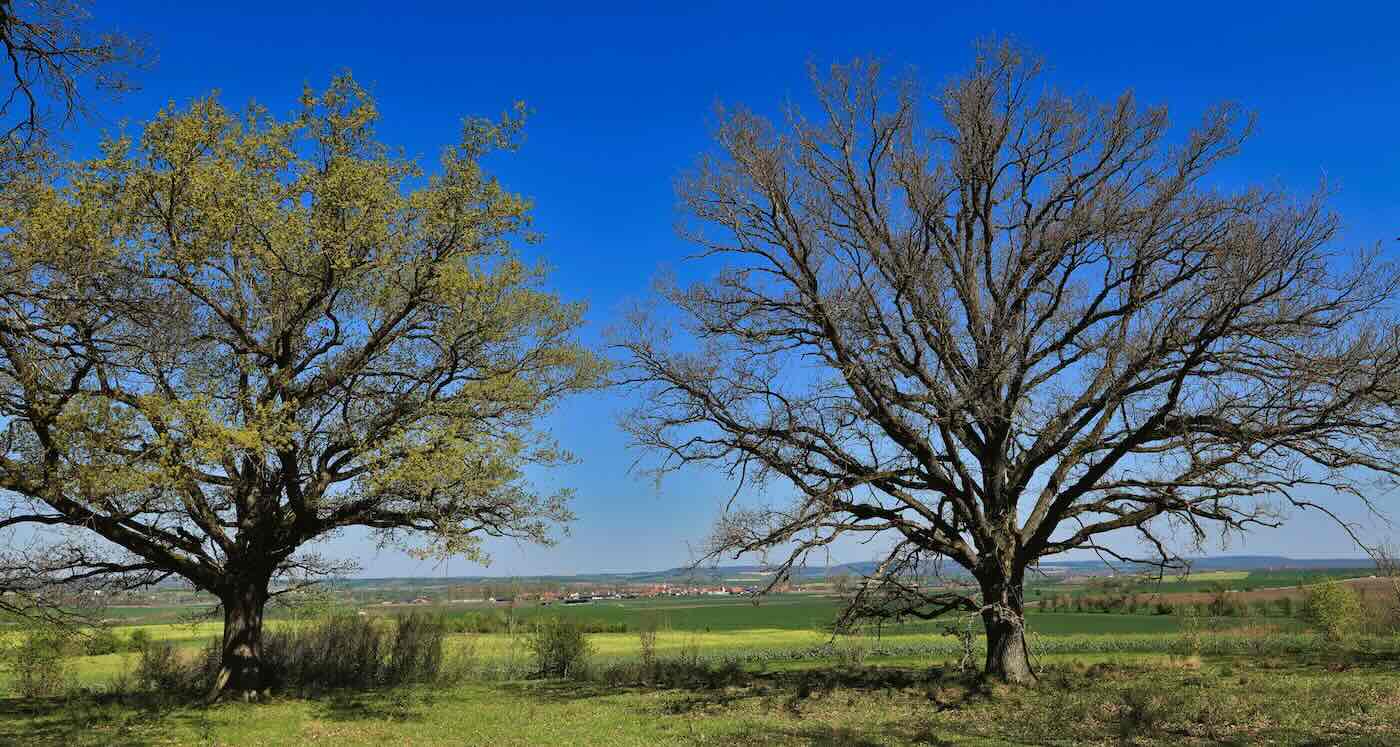
Oak trees infested by caterpillars open their leaves three days later the following spring, a delay that halves the amount of leaves eaten by the insects. Soumen Mallick and colleagues at the University of Würzburg analyzed tree canopy conditions using Sentinel-1 radar satellite images. Their work covered a 2400-square-kilometre area in northern Bavaria, Germany, from 2017 to 2021.
The forests there are dominated by pedunculate oak (Quercus robur) and sessile oak (Quercus petraea). Each pixel in the satellite images represented a 10 by 10 metre area. The team examined 27,500 pixels in total.
In 2019, a massive outbreak of gypsy moths (Lymantria dispar) occurred in the area. The gypsy moth caterpillars feed on tree leaves. Oak trees heavily infested in 2019 had leaves emerge three days later in spring 2020 than non-infested trees.
This delay reduced leaf damage by 55 percent compared to the previous year. Caterpillars hatch at the same time regardless of the delay. 1038/s41559-026-03071-9.
Mallick stated that the delay in bud opening seems more efficient than other oak defenses, such as making leaves tougher to chew or producing aromatic compounds that attract predators to the caterpillars. He thinks other deciduous plants may exhibit similar responses.
James Cahill at the University of Alberta called the finding plausible but noted that the delay correlates with outbreaks, and evidence of causality requires more data from additional events.
Cahill suggested the delay could stem from decreased plant vigor after leaf loss, though data from more than one outbreak would clarify the mechanism. James Blande at the University of Eastern Finland described the mechanisms as intriguing and in need of further research.
Mallick explained the delay could result from physiological constraints like resource depletion, but its consistency across dozens of tree populations—strongest where it most effectively reduced herbivory—points to an adaptation rather than just an individual tree's response.