Substrate
science

Photographers Document Record 304 Humpback Whales in One Day Off South Africa

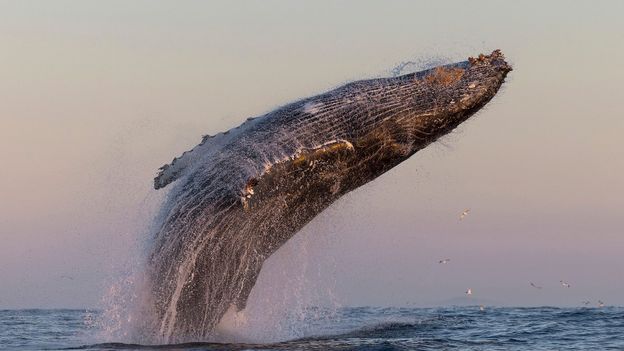
Photographers Monique and Chris Fallows captured images of 304 individual humpback whales in a single day off South Africa's west coast in December 2025. This sighting represents the highest number of large whales identified in one day, according to the photographers. The event highlights the recovery of humpback whale populations following a global whaling moratorium implemented 40 years ago.
bbc.com
1 source·Apr 21, 2:00 AM(15 days ago)·2m read
Photographers Document Record 304 Humpback Whales in One Day Off South Africabbc.com
Audio version
Tap play to generate a narrated version.
Developing·Limited corroboration so far. This page will refresh as more sources emerge.

In December 2025, photographers Monique Fallows and Chris Fallows documented large groups of humpback whales off the west coast of South Africa. Over two days, they photographed 208 individual whales on December 29 and 304 on December 30. Chris Fallows stated that the 304 whales represent the highest number of large whales identified in a single day.

The couple observed the whales feeding in groups, with blows from their exhalations visible up to 7 meters high and traveling at over 300 mph. Monique Fallows described the sound as resembling a big bellows and noted a strong fishy smell from the whales' breath.

They submitted their images to Happywhale, a citizen science project for identifying marine mammals.

whale populations were reduced to less than 5% of pre-whaling numbers due to industrial whaling in the 20th century. A global whaling moratorium took effect 40 years ago, leading to population increases. In the southern hemisphere, humpback numbers have grown by up to 12% per year.

Simon Elwen, a marine biologist at the University of Stellenbosch, stated that humpback super-group sightings off South Africa's west coast increased from 10 to 65 per year between 2015 and 2020. Elwen noted that seeing groups of hundreds of whales in a day has become common.

Super-groups are defined as 20 or more whales within five body lengths of each other.

whales typically form small groups for feeding or mating but gather in larger groups during the austral summer due to upwelling of nutrient-rich water that attracts krill. The whales migrate up to 5,000 miles annually from breeding grounds to feeding areas, transporting nutrients across oceans.


Ted Cheeseman, founder of Happywhale, stated that of the 372 individual whales identified by the Fallows over two days, most had not been previously photographed and are likely under 10 years old. Experts indicate that the reasons for the increase in super-groups may include changes in prey availability or population growth leading to new feeding strategies.

Key Facts

304 humpback whales
identified in one day, a record
Super-groups
defined as 20+ whales within five body lengths
Population growth
up to 12% per year in southern hemisphere
Sightings increase
from 10 to 65 per year between 2015-2020
Migration distance
up to 5,000 miles annually

Story Timeline

4 events
  1. December 30, 2025

    Photographers Monique and Chris Fallows documented 304 individual humpback whales in a single day off South Africa's west coast.

    1 sourcebbc.com
  2. December 29, 2025

    The Fallows photographed 208 individual humpback whales in super-groups off South Africa's west coast.

    1 sourcebbc.com
  3. 2015-2020

    Humpback super-group sightings off South Africa's west coast increased from 10 to 65 per year.

    1 sourcebbc.com
  4. 40 years ago

    A global whaling moratorium came into force, leading to humpback population recovery.

    1 sourcebbc.com

Potential Impact

  1. 01

    Increased super-group sightings could enhance citizen science data collection on whale populations through projects like Happywhale.

  2. 02

    Recovery trends may lead to adjustments in conservation strategies for endangered humpback populations.

  3. 03

    Nutrient transport by migrating whales could support healthier marine ecosystems globally.

  4. 04

    New feeding behaviors observed may prompt further research into prey availability changes.

  5. 05

    Larger whale gatherings might boost ecotourism in South Africa's coastal areas.

Transparency Panel

Sources cross-referenced1
Framing risk0/100 (low)
Confidence score65%
Synthesized bySubstrate AI
Word count334 words
PublishedApr 21, 2026, 2:00 AM
Bias signals removed3 across 2 outlets
Signal Breakdown
Loaded 1Editorializing 1Amplifying 1

Related Stories

NASA Releases Thousands of Photos from Artemis II Lunar MissionNASA / Harrison H. Schmitt / Wikimedia (Public domain)
science5 hrs ago

NASA Releases Thousands of Photos from Artemis II Lunar Mission

NASA has released over 12,000 images from the Artemis II mission, which orbited the moon in April 2026. The photos capture views of Earth, the lunar surface, and a solar eclipse observed during the crew's return. Astronauts from the mission also visited the United Nations headqua…

Nbc News
UN
The Atlantic
Benzinga
Business Insider
5 sources
Three Die in Hantavirus Cases on MV Hondius Cruise Shipdeccanchronicle.com
science15 hrs agoFraming55Framing risk55/100Rewrite largely sticks to facts but inherits mild consensus framing around human-to-human transmission risk and repeatedly centers WHO spokespeople for reassurance.Click to jump to full framing analysis

Three Die in Hantavirus Cases on MV Hondius Cruise Ship

A hantavirus outbreak on the MV Hondius cruise ship has killed three passengers and sickened seven others, prompting an international response coordinated by the World Health Organization. The ship, carrying 147 people from 23 nationalities, is set to sail to Spain's Canary Islan…

Stat
Cbs News
2 sources
Houtman Abrolhos Corals Show High Resilience to 2025 Heatwave, Unlike Global Lossesnewscientist.com
science7 hrs agoDeveloping

Houtman Abrolhos Corals Show High Resilience to 2025 Heatwave, Unlike Global Losses

Coral reefs at the Houtman Abrolhos Islands off Western Australia endured a prolonged heatwave in early 2025 virtually unscathed, unlike widespread global die-offs. Researchers found exceptional heat tolerance across multiple species, with lab tests showing survival rates far exc…

New Scientist
1 source