Physicist’s notes show math solution for choosing among restaurants
Researchers decoded notes left by physicist Richard Feynman that outline an optimal strategy for selecting restaurants over multiple nights. A survey of more than 2,500 people found participants used a simpler approach that produced similar results.
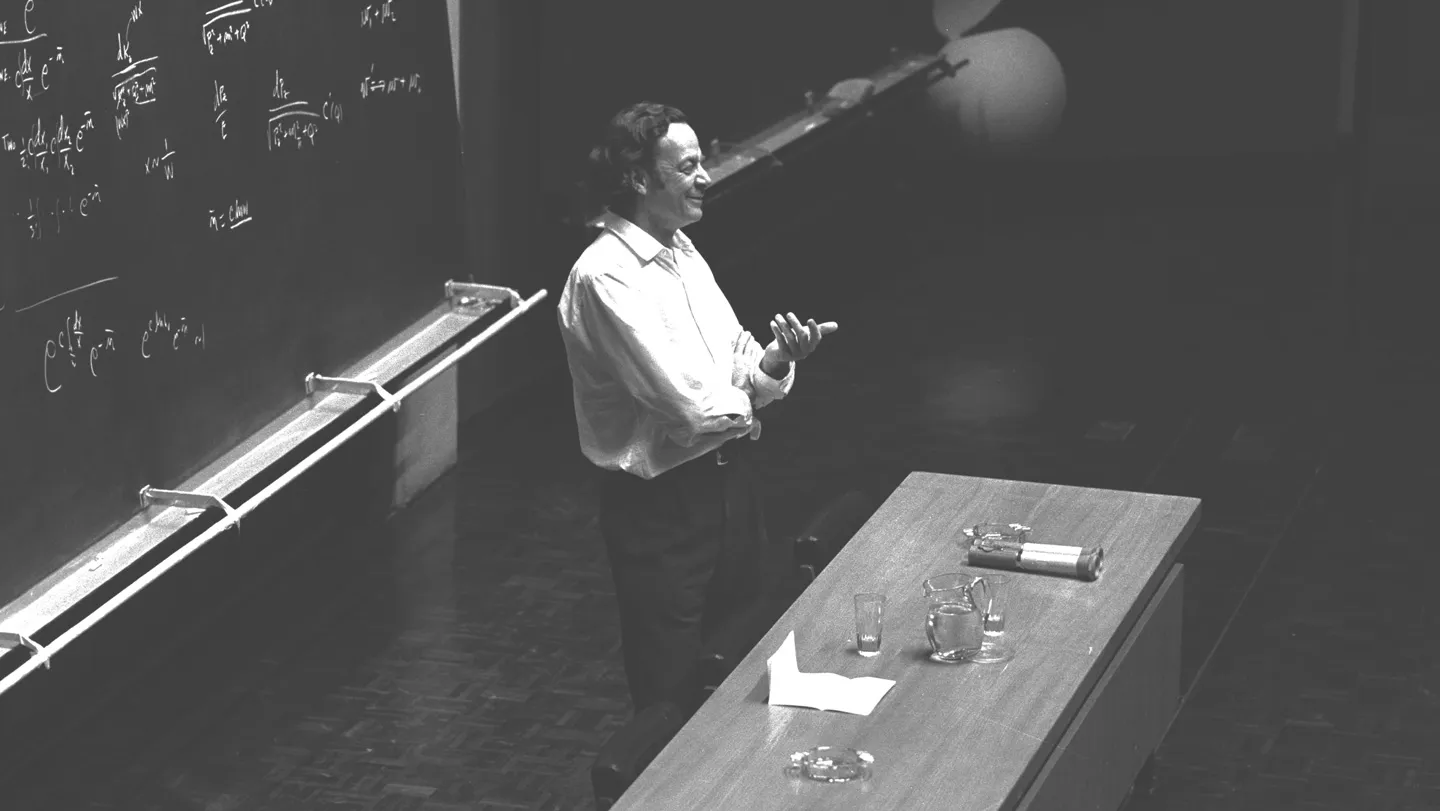 Science News
Researchers decoded handwritten notes from physicist Richard Feynman that outline a mathematical approach to choosing among restaurants over repeated visits. The notes, written in the 1970s, remained unpublished after Feynman’s death in 1988. The notes address a stopping problem: how to decide whether to return to a known restaurant or try a new one when the total number of dining occasions is fixed.
Feynman derived a threshold that declines as the number of remaining nights decreases.
Threshold calculation Early in the sequence, the threshold is set high so that only an exceptionally high-scoring restaurant triggers a return visit. On the final night, the threshold drops to the average score, and any restaurant above that level is selected.
The calculation assumes each restaurant is equally likely to be good, average, or poor. When that distribution changes, the threshold equation adjusts accordingly.
Survey of decision strategies Computational cognitive scientist Brian Christian and colleagues reported the findings June 2 in the Proceedings of the National Academy of Sciences. They also surveyed more than 2,500 people online to compare actual choices with the calculated optimum.
Participants did not follow the exact threshold rule. They applied a simpler method that produced comparable total scores. Christian, of the University of California, Berkeley, stated that people rely on heuristics that approximate the optimal strategy without requiring full computation.
Transparency
Reported by a single outlet. This score reflects source tier and factual specificity — corroboration is limited with one source.
Story details
Related Stories
 New Scientist
Phase 3 Trial Finds Daraxonrasib Extends Median Survival to 13 Months vs 7 Months for Chemotherapy in Second-Line Pancreatic Cancer
A 500-person study found the once-daily pill halted or reversed tumor progression in nearly one-third of patients versus 10 percent on chemotherapy. Median survival rose from less than seven months to roughly 13 months.
 nypost.com
Bundibugyo Ebola Strain Shows High Survival Rate in DRC; Suspected Cases Reported in Brazil and Italy
Four nurses and one laboratory worker have recovered from Ebola caused by the Bundibugyo strain in the Democratic Republic of Congo. Suspected cases linked to travel from affected countries are under investigation in Brazil and Italy.
Wildfire Insured Losses Hit $54 Billion in 2025, Highest on Record
A new analysis published Sunday found that insured losses from wildfires worldwide hit at least $54 billion in 2025, the highest level on record. The Los Angeles fires and blazes in South Korea and Spain drove the total.