Research Details Prehistoric Mining, Octopus Species, Cat Behavior
Ars Technica reported on five scientific studies published in May covering prehistoric copper smelting, neural wiring in singing mice, a newly identified octopus species, acoustic properties of slapsticks, and mathematical patterns in abstract art.
 Ars Technica
Ars Technica compiled five research findings from May that had received limited coverage. The stories span archaeology, neurobiology, marine biology, acoustics, and computational analysis of art.
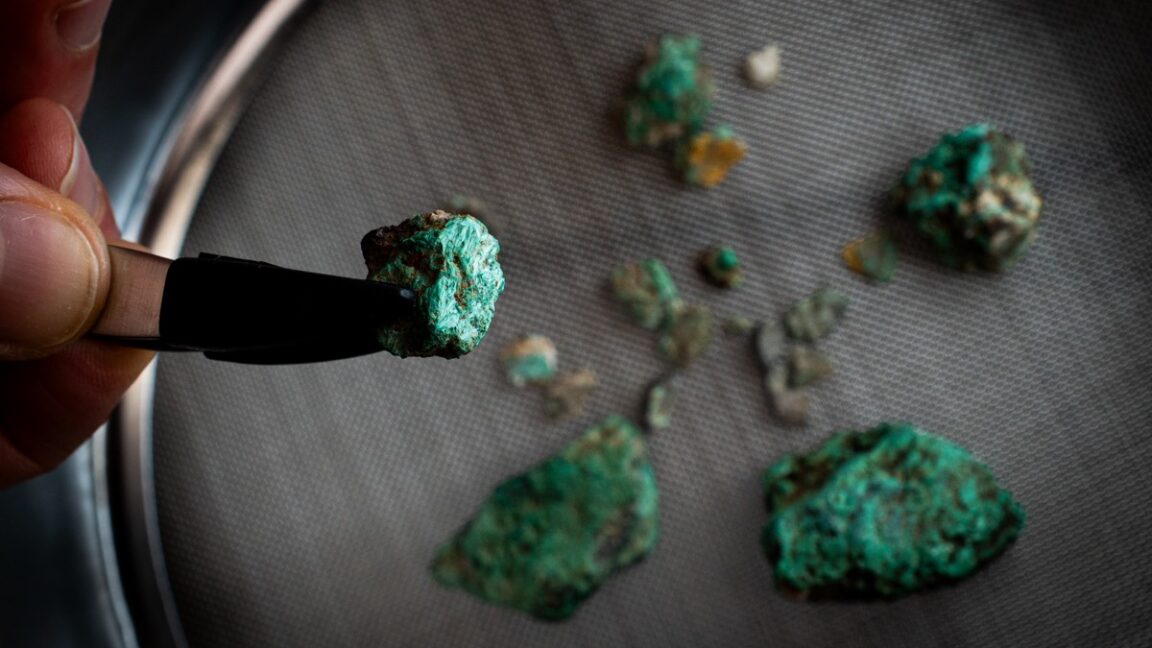
Prehistoric copper smelting site Spanish archaeologists excavated a cave in the eastern Pyrenees between 2021 and 2023. They identified 23 hearths containing burned green mineral fragments resembling malachite, a copper ore. The hearths date between 4,000 and 5,500 years old.
The team recovered two prehistoric pendants, a human finger bone, and an 11-year-old child's tooth. Researchers published the findings in Frontiers in Environmental Archaeology.
Neural wiring in singing mice Singing mice in Costa Rican cloud forests produce call-and-response duets. Cold Spring Harbor Laboratory researchers mapped neuron connections using molecular barcoding. They found roughly three times as many neurons linking mouth-movement and hearing regions compared with related species.
The study appeared in Nature. The authors suggest similar wiring changes could enable ordinary lab mice to produce comparable vocalizations.
New octopus species from Galapagos Researchers collected a small blue octopus at 5,800 feet depth during a 2015 Galapagos expedition. Mini-CT scans revealed short arms, few suckers, no ink sac, smooth skin, and a large rachidian tooth. The specimen was named Microeledone galapagensis and described in Zootaxa.
Acoustic testing of slapsticks Daniel Ludwigsen of Kettering University tested five commercial slapsticks in an anechoic chamber. Smaller models with spring hinges performed best at high frequencies; longer models performed better at low frequencies. Results were presented at the Acoustical Society of America meeting.
Mathematical patterns in abstract art Researchers applied persistent homology analysis to paintings by Jackson Pollock, Wassily Kandinsky, and Mark Rothko. The method distinguished these works from AI-generated images. Eye-tracking and brain-activity measurements showed more stable processing when viewers examined the original artworks. The study was published in PLoS Computational Biology.
Transparency
Reported by a single outlet. This score reflects source tier and factual specificity — corroboration is limited with one source.
Story details
Related Stories
 japantoday.com
Anthropic Confidentially Files for IPO After Raising $65 Billion
The artificial intelligence company behind the Claude chatbot submitted its filing on Monday, weeks after completing a funding round that more than doubled its valuation from February. Anthropic did not disclose the size or terms of the offering. The move comes as the global IPO…
 New York Post
Florida Attorney General Sues OpenAI and Sam Altman, Alleging ChatGPT Caused Harm to Users
Florida Attorney General James Uthmeier filed an 83-page civil complaint Monday in the state's 10th Judicial Circuit against OpenAI and its chief executive Sam Altman.
 finance.yahoo.com
Alphabet to Raise $80 Billion Through Stock Offerings, Including $10 Billion Sale to Berkshire Hathaway
Alphabet announced plans to raise $80 billion through stock sales to fund AI infrastructure investments. The company reached an agreement to sell $10 billion of stock to Berkshire Hathaway.