science
Robot Dinosaur Experiments Test Whether Proto-Wings Could Flush Insects
Scientists tested a robotic Caudipteryx and animated versions on live insects and locusts, finding visual displays with protowings triggered stronger escape responses. The studies, conducted in Seoul and published in 2024 and 2026, explore possible behaviors of early pennaraptoran dinosaurs.
May 8, 1:00 PM·2m read1 source
 Science News
Audio version
Tap play to generate a narrated version.
Developing·Limited corroboration so far. This page will refresh as more sources emerge.
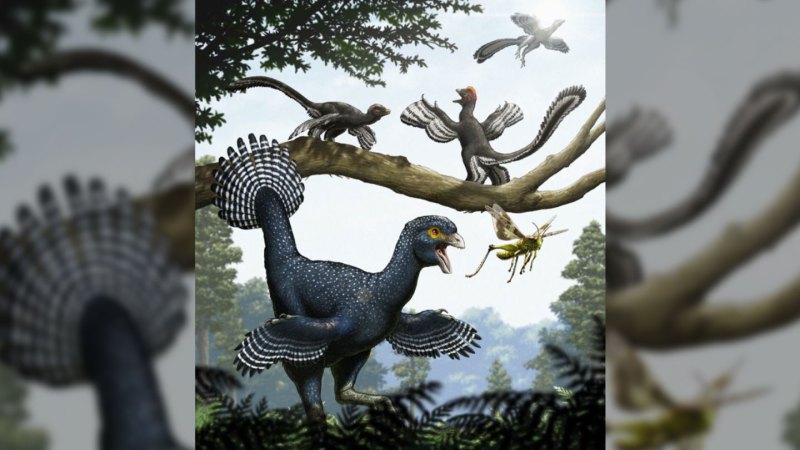
Experiments with a robot dinosaur named Robopteryx confronted wild grasshoppers on a paved path in a natural area in Seoul, South Korea. The robot, modeled on the turkey-sized Caudipteryx, performed flush displays by opening its wings out to its sides or tipping toward the insect and catapulting its tail forward. Hundreds of flush displays were performed over two summers.
Flush displays were more effective with protowings than without, according to results published in Scientific Reports in 2024. Jinseok Park, an ornithologist now at the Max Planck Institute for Biological Intelligence in Planegg, Germany, led the fieldwork with the robot.
Piotr Jablonski, a zoologist at the Museum and Institute of Zoology of the Polish Academy of Sciences in Warsaw, heads the research team that built on observations of modern birds flinging out wings to lure insects.
A follow-up study posted on bioRxiv on April 7, 2026, used domesticated locusts. Researchers hooked one electrode to each locust’s nerve cord and pinned another to its abdomen. Visual displays elicited stronger neural responses when the animated Caudipteryx had protowings instead of bare forelimbs.
Minyoung Son, a vertebrate paleontologist at the University of Minnesota in Minneapolis, stated that pennaraptoran protowings had surface area too small to create the aerodynamic force needed for flight. The ranges of pennaraptoran wing joints would have limited their movements for flight. Pennaraptoran feathers in the fossil record do not have the asymmetrical shape required to be aerodynamic.
Corwin Sullivan, a paleontologist at the University of Alberta in Edmonton, Canada, said there is not enough information about pennaraptorans to conclude that their protowings were used for flush displays. "What this shows, rather elegantly and persuasively, is that it’s possible," Sullivan stated.