Unbiased AI-powered news
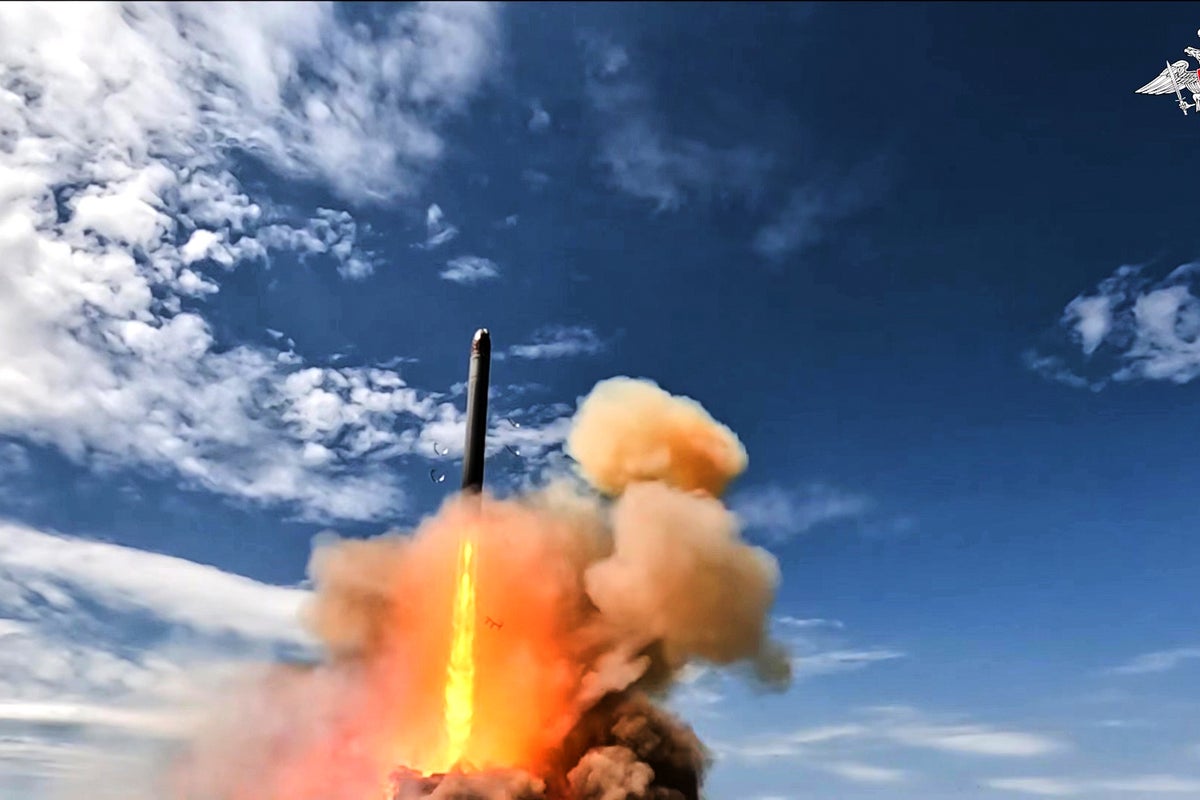
Russia conducted a test launch of its nuclear-armed Sarmat missile on Tuesday, the second confirmed successful test of the weapon designed to replace Soviet-era systems. President Vladimir Putin hailed the launch and said the missile would enter combat service later this year.
The IndependentRussia test-fired a Sarmat intercontinental ballistic missile on Tuesday as part of efforts to modernise its nuclear forces. President Vladimir Putin hailed the test and said the nuclear-armed Sarmat missile would enter combat service at the end of the year.
The missile, designated “Satan II” in the West, was built to replace the aging Soviet-built Voyevoda and is meant to replace about 40 such missiles.
Moscow launched the Sarmat rocket weighing 208 tonnes and standing as high as a 14-storey building. The intercontinental missile reached speeds of up to 15,880 mph. Strategic Missile Forces commander Sergei Karakayev confirmed to Mr Putin that the test had succeeded.
Putin described the Sarmat weapon as the most powerful missile system in the world. He said the total yield of the Sarmat delivered warhead is more than four times greater than that of any existing most powerful Western equivalent. Putin stated that the combined power of the Sarmat’s individually targeted warheads is more than four times higher than that of any Western counterpart.
Putin said the Sarmat is capable of suborbital flight and has a range of more than 35,000 kilometers, which equals 21,700 miles. He added that this allows for a range of over 35,000 kilometres while simultaneously doubling its missile defence performance.
Putin said the Sarmat has the ability to penetrate all existing and prospective missile defence systems. He confirmed the Sarmat weapon would be deployed on combat duty later this year. It marks only the second confirmed successful test of the nuclear missile.
The last confirmed successful test of the Sarmat came in April 2022. Before Tuesday, the Sarmat missile had only one known successful test. Development of the Sarmat began in 2011. The Sarmat reportedly suffered a massive explosion during an abortive test in 2024.
A hypersonic missile detonated on its launch platform at the Plesetsk cosmodrome in September 2024. A further test in November 2025 ended catastrophically when the rocket fell shortly after launch causing an enormous explosion. Putin declared the Sarmat is the most powerful missile in the world and said it is as powerful as the Voyevoda but with higher precision.
The Sarmat is part of a slew of new weapons that Vladimir Putin revealed in 2018. Putin has overseen efforts to upgrade the Soviet-built components of the Russian nuclear triad since coming to power in 2000. Russia has deployed hundreds of new land-based intercontinental ballistic missiles.
Russia has commissioned new nuclear submarines. Russia has modernised nuclear-capable bombers. Russia’s nuclear forces modernisation pushed the United States to launch a costly modernisation of its arsenal.
U.S. expired in February. Russia has also commissioned the new nuclear-capable Oreshnik intermediate-range ballistic missile. Russia used the conventionally-armed version of the Oreshnik twice to strike Ukraine.
The first Avangard hypersonic glide vehicles have already entered service. The Avangard hypersonic glide vehicle is capable of flying 27 times faster than the speed of sound.
Putin announced Russia was in the final stages of the development of the nuclear-armed Poseidon underwater drone. Putin announced Russia was in the final stages of the development of the Burevestnik cruise missile powered by miniature atomic reactors. The Poseidon is designed to explode near enemy coastlines and cause a radioactive tsunami.
The Burevestnik has virtually unlimited range thanks to nuclear propulsion. Russia sent troops into Ukraine in February 2022. After overseeing a military parade on Red Square on Saturday commemorating the defeat of Nazi Germany in World War II, Vladimir Putin declared the conflict in Ukraine is coming to an end.
The military parade on Red Square on Saturday did not include heavy weapons for the first time in nearly two decades. Kremlin spokesman Dmitry Peskov said that Moscow was receptive to American efforts to mediate an end to the war. Vladimir Putin indicated he would meet with Ukrainian President Volodymyr Zelensky in a neutral nation once an agreement had been finalised.
Putin said a meeting in a third country is also possible but only once final agreements have been reached on a peace treaty. Putin’s claims about the Sarmat could not be independently verified.
These outlets didn't split into competing frames — coverage was uniform.
jns.orgThe United States targeted Iranian air defense systems, radar sites and anti-ship capabilities in southern Iran. Iran responded with strikes on Bahrain and Jordan plus attacks on two tankers in the Strait of Hormuz.
theiranproject.comBrent crude reached a one-month high above $86 a barrel on Tuesday after President Trump said the United States would reinstate its naval blockade of Iranian ports. The U.S. military will reimpose the blockade at 4 p.m. Eastern time. The announcement followed a third night of U.S…
en.protothema.grRepublican Senator Lindsey Graham of South Carolina died Saturday night at his Capitol Hill residence. The medical examiner ruled the cause a ruptured aortic aneurysm tied to cardiovascular disease. Graham had returned from Ukraine the previous day and announced bipartisan progre…