world
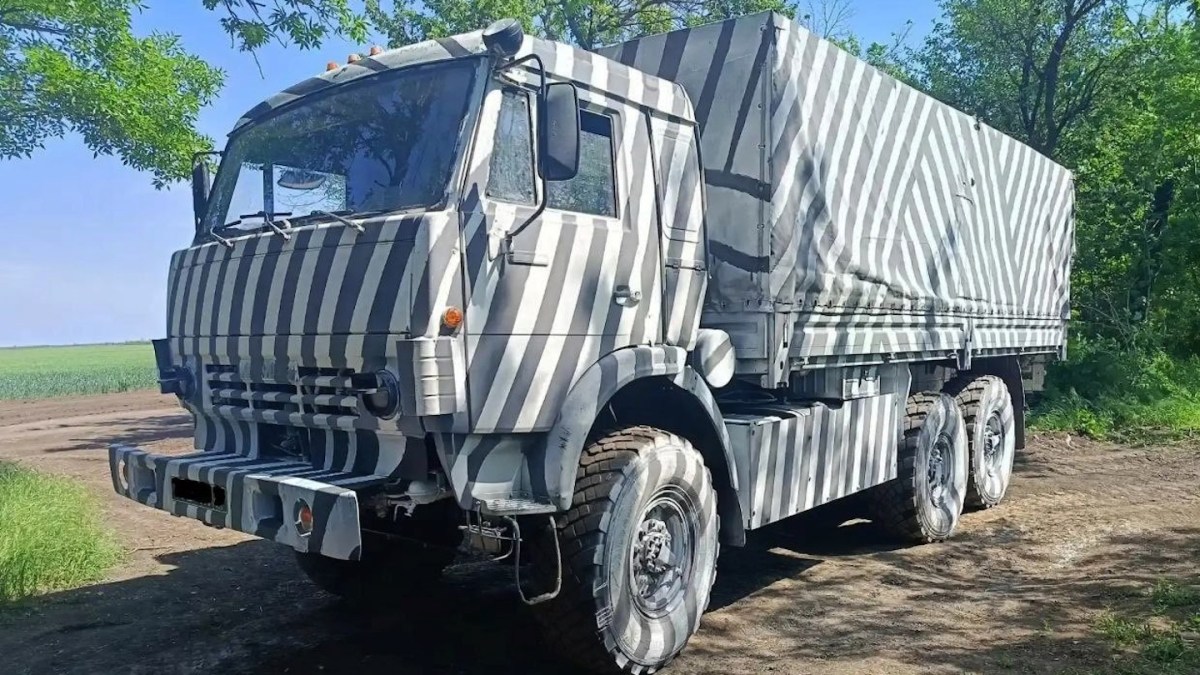
Russian Forces Deploy Low-Cost Dazzle Paint to Counter AI Drones
Russian military logistics vehicles are being painted with high-contrast geometric patterns intended to disrupt machine-vision systems on Ukrainian drones. The measure follows earlier improvised defenses such as log armor and tire coverings on aircraft.
Jun 1, 7:45 PM·2m read2 sources
TH
Drone EdgeRussian Counters
 The War Zone
Audio version
Tap play to generate a narrated version.
Developing·Limited corroboration so far. This page will refresh as more sources emerge.
Russian military trucks have begun receiving high-contrast geometric paint schemes designed to interfere with AI-enabled drone targeting systems. Images circulating on social media in recent days show both Ural and KAMAZ heavy trucks covered in either zebra-style straight lines or leaf-like swirling patterns. The designs extend across most external surfaces, including wheels and tires.
Background on the Tactic The paint follows the principle of World War I-era naval dazzle camouflage, which used contrasting blocks to distort an observer’s perception of range, speed, and shape. In the current conflict the intended observer is an electro-optical or infrared camera feeding an AI model rather than a human eye.
Ukrainian drones increasingly employ machine vision to identify, classify, and track targets without continuous human input. The paint is meant to prevent a vehicle from meeting the recognition threshold that would trigger an autonomous strike.
Earlier adaptations on the Russian side have included logs strapped to trucks for protection against kinetic attack and tires placed on strategic bombers to confuse image-matching missiles. Similar shading has also been applied to naval vessels based in Crimea.
A senior U.S. military technologist previously confirmed that tire coverings on aircraft were intended to degrade computer-vision models. The same logic appears to underpin the new truck patterns.
The schemes are only useful in areas unlikely to be observed by human Ukrainian forces, as the patterns are more conspicuous than standard camouflage. AI systems could potentially be retrained to recognize the new markings as hostile by default. Different sensors will be affected unevenly; electro-optical cameras may struggle while longer-wavelength infrared may remain effective.