SETI Radio Scans of Interstellar Comet 3I/Atlas Detect No Technosignatures
The SETI Institute reported Wednesday that more than seven hours of radio observations detected no artificial signals from the third known interstellar object to visit the solar system.
 The Independent
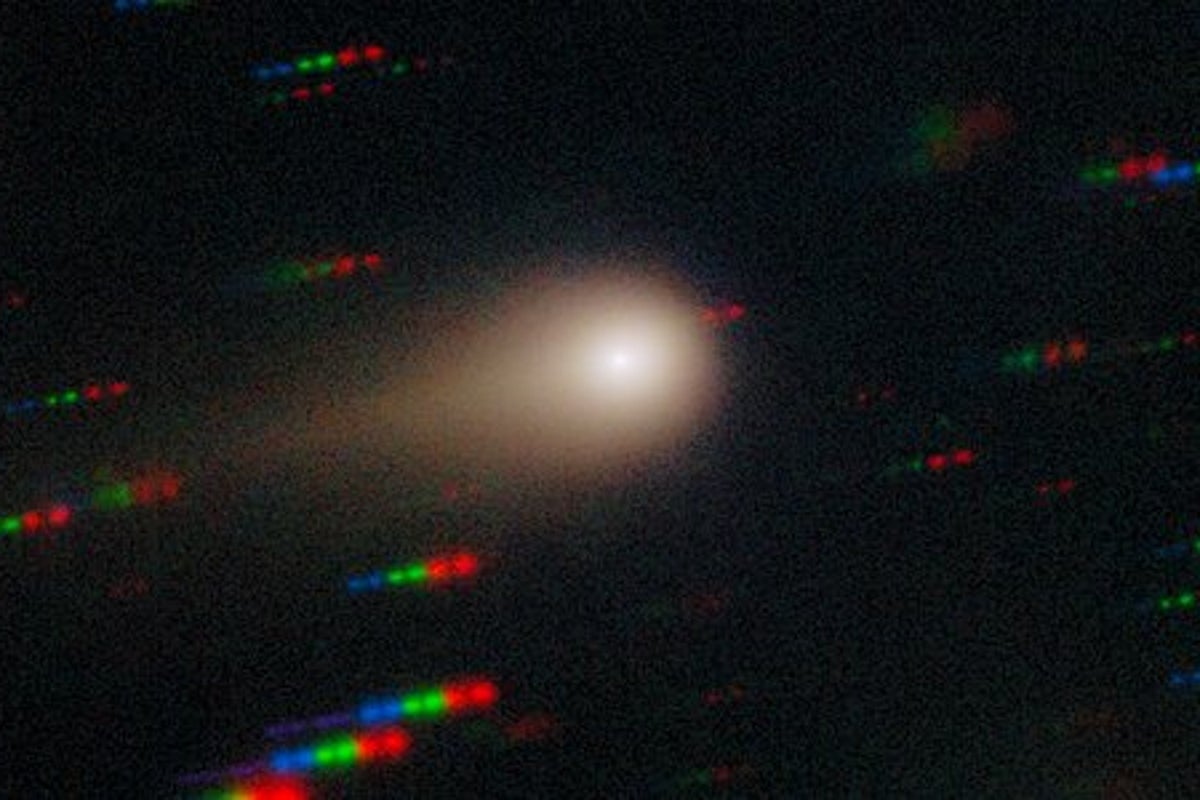
The SETI Institute announced Wednesday that radio scans of interstellar comet 3I/Atlas found no signs of otherworldly technology. Extensive observations were conducted with the institute's Northern California telescope. SETI searched a wide range of radio signals during more than seven hours of observations in July.
Nearly 74 million narrow-band signals were detected. Just over 200 signals remained after filtering for human interference. All remaining signals were traced back to technology on the surface of the Earth or Earth-orbiting satellites.
Comet 3I/Atlas was discovered last summer and was quickly identified as a comet from another star. It is the third known interstellar object to enter the solar system. All three have been deemed natural.
NASA spacecraft observed 3I/Atlas as it swung past Mars in October. The comet ventured within 19 million miles of Mars. Its closest approach to Earth occurred in December at a distance of 167 million miles.
The results were published in the Astronomical Journal. Sofia Sheikh is the lead author of the paper. Valeria Garcia Lopez of Furman University, a co-author, said these results show how realistic it is to detect a signal with the technology we have today.
"That is why it is important to keep searching for technosignatures, even from objects we might not expect to have signals," Garcia Lopez said. Sofia Sheikh and her team noted that NASA's Voyager spacecraft will one day become interstellar objects. They wrote that Voyager and similar probes will eventually become interstellar objects in other stellar systems, adding that no extrapolation is needed for the idea of interstellar technological objects because there is a proof by existence.
The comet is almost 1 billion miles away and is making its way back to interstellar space. It will never return to the solar system. 5 miles in size.
Scientists suspect it could be as old as 11 billion years, twice as old as the sun.
Transparency
Reported by a single outlet. This score reflects source tier and factual specificity — corroboration is limited with one source.
Story details
Related Stories
 upi.com
NASA Retires MAVEN After 11 Years of Mars Atmosphere Discoveries Following Unrecoverable Anomaly
The agency confirmed Wednesday that the orbiter, launched in 2013, is beyond recovery following a fast spin that drained its batteries. MAVEN completed more than a decade of atmospheric observations at Mars.
 foxnews.com
Trump Budget Reduces CDC Wastewater Surveillance Funding From $125M to $25M Annually
President Donald Trump's budget plan reduces annual funding for the CDC's National Wastewater Surveillance System from $125 million to $25 million, limiting national coverage after September 30, 2026.