ai
Sony's AI Robot Ace Beats Human Pros at Table Tennis in Milestone Study
Sony's robotic arm named Ace has defeated professional table tennis players using reinforcement learning, marking a key advance in adaptive robotics. The study, published in Nature, highlights the robot's ability to compete at expert human levels. Researchers emphasize fairness and comparability to human skills.
FO
 robohub.org
Audio version
Tap play to generate a narrated version.
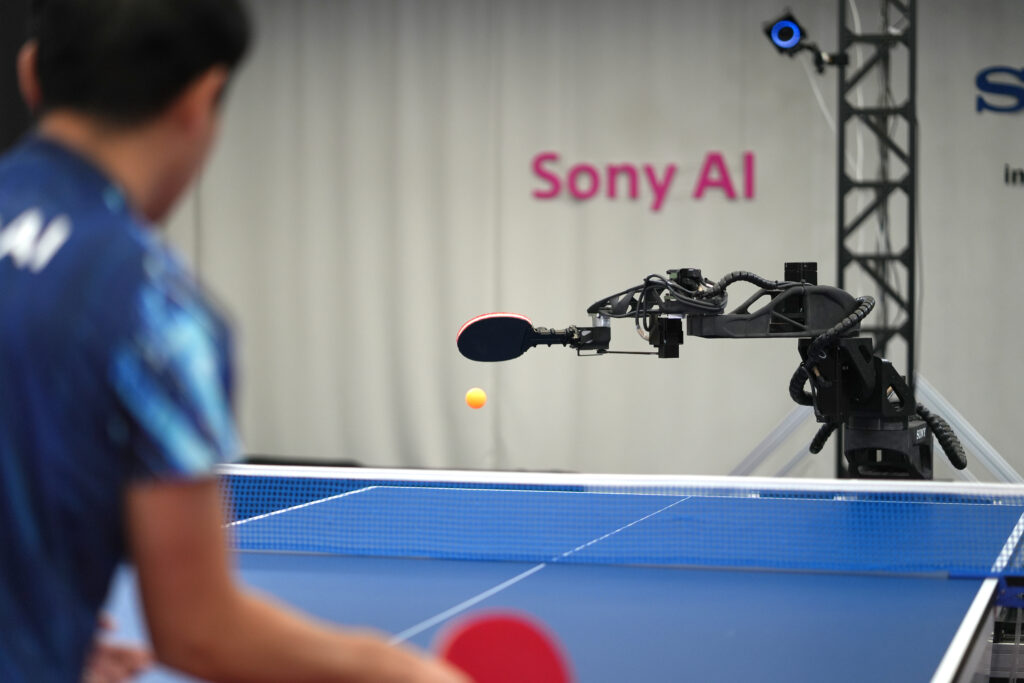
A robotic arm developed by Sony, named Ace, has defeated professional table tennis players, achieving expert-level performance in a competitive sport, according to a study published Wednesday in the journal Nature. Sony pitted Ace against high-skill athletes and reported that the robot won against all but one of four players in matches held in December.
The company built an Olympic-sized table tennis court at its headquarters in Tokyo for these experiments, ensuring a level playing field.
Ace learned to play table tennis through reinforcement learning, a method that relies on experience rather than manual programming. A Sony AI researcher and co-author of the study said, “There’s no way to program a robot by hand to play table tennis.
” The robot features nine camera eyes positioned around the court and follows the ball’s logo to measure its spin.
The custom-built robot has eight joints that direct its movements, enabling it to position the racket, execute shots, and respond swiftly to opponents. ” Sony designed Ace's speed, arm’s reach, and performance to be comparable to a skilled athlete.
The robot plays by official table tennis rules on a typically sized court. The president of Sony AI said, “It’s very easy to build a superhuman table tennis robot. You build a machine that sucks in the ball and shoots it out much faster than a human can return it.
But that’s not the goal here. ” Sony stated that Ace represents the first time a robot has achieved human expert-level play in a commonly played competitive sport in the physical world. Some athletes expressed surprise at Ace's prowess during the experiments.
@FortuneMagazine reported that Japanese professional players Minami Ando and Kakeru Sone competed against the robot, with umpires from the Japanese Table Tennis Association judging the games. Another expert, Kinjiro Nakamura, who competed in the 1992 Barcelona Olympics, observed Ace perform a shot and said no one else would have been able to do that, adding that it means there is a possibility a human could do it too.