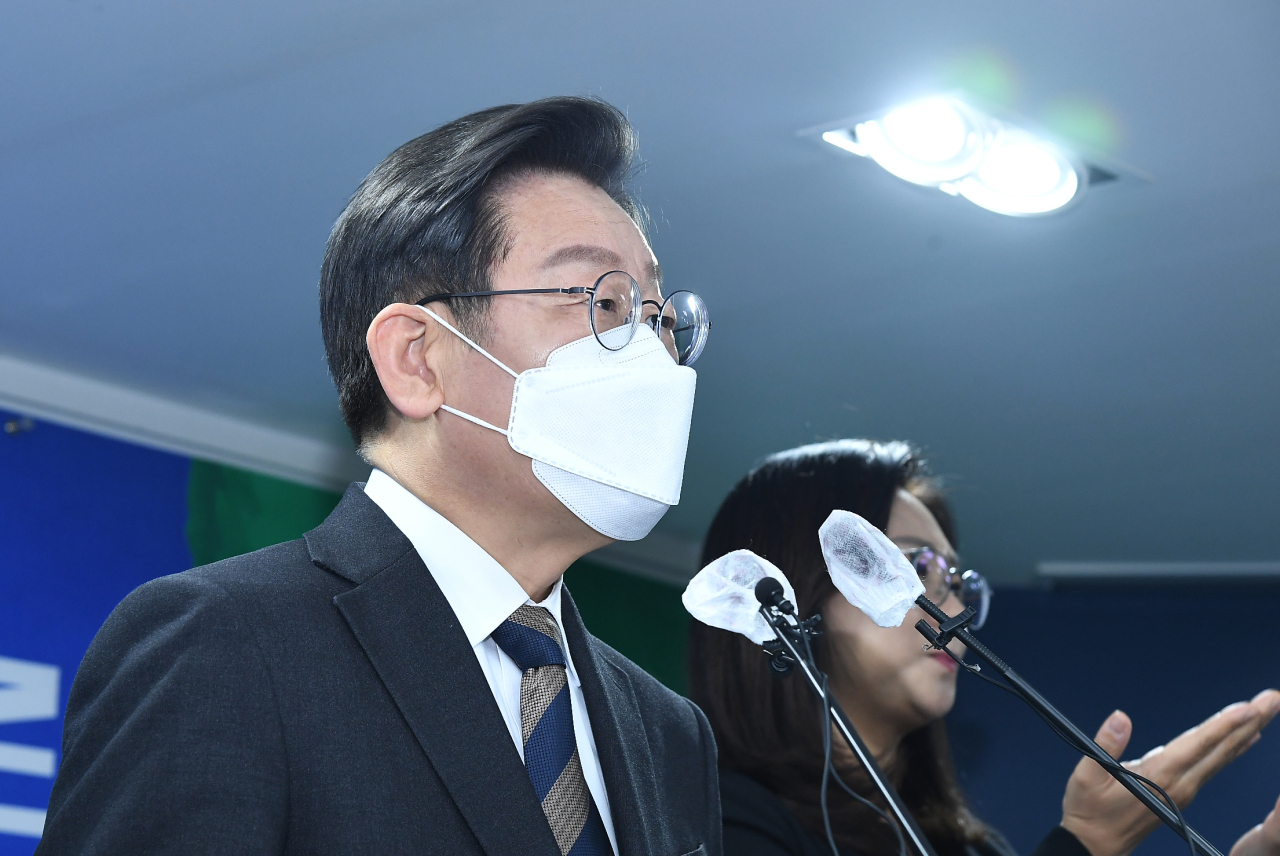
South Korea Marks One Year of Lee Jae Myung Presidency
President Lee Jae Myung reaches one year in office this week with the KOSPI at record highs, yet faces external shocks from Middle East tensions and domestic housing concerns.
koreaherald.comPresident Lee Jae Myung is set to mark one year in office this week as his administration prioritizes reviving economic growth and supporting the capital market. The benchmark Korea Composite Stock Price Index reached 8,000 points this month, up from roughly 2,680 points a year earlier, fueled by semiconductor exports and government measures to boost shareholder returns.
The Bank of Korea kept its key interest rate at 2.5 percent last week but signaled a possible shift toward tighter policy to address rising inflation. The central bank raised its 2026 growth forecast to 2.6 percent from 2.0 percent in February, citing strong semiconductor shipments and a supplementary budget, while lifting its inflation projection to 2.7 percent from 2.2 percent.
Transit through the Strait of Hormuz stands at about 10 percent of pre-conflict levels, with full recovery expected to take considerable time due to mine clearance, safety, and insurance issues.
Industrial output fell 0.6 percent month-on-month in April, with retail sales and facility investment also declining amid uncertainties tied to the Middle East situation. Apartment prices in Seoul rose 0.28 percent in the second week of May, the fastest weekly gain since late January, prompting the government to plan delivery of 90,000 rental units for young residents in the greater Seoul area by 2027.
The administration implemented the yellow envelope act in March, extending bargaining rights to subcontracted workers and limiting corporate damage claims against unions. Labor organizations welcomed the measure, while business groups expressed concern that it could intensify labor-management disputes.
“Oil supply disruptions have sharply driven up gasoline and diesel prices. Shortages of such raw materials as naphtha and urea are posing a threat to a wide range of people's livelihoods.”
Transparency
1 core fact confirmed by 2+ independent outlets, though all from one ideological lane. 21 single-source, 0 disputed.
Corroborating outlets share one lane and are mostly lower-tier — treat as weakly verified.
2 outlets classified · 0 left · 2 center · 0 right. Coverage drawn from a single ideological lane.
- Yonhap reported: The Bank of Korea raised its 2026 economic growth forecast to 2.6 percent from a previous forecast of 2.0 percent.
- Yonhap reported: The Bank of Korea raised its 2026 inflation forecast to 2.7 percent from a previous forecast of 2.2 percent.
- Yonhap reported: The Bank of Korea held its key interest rate at 2.5 percent in its latest decision in May 2026.
- Yonhap reported: Transit volume through the Strait of Hormuz is currently at about 10 percent of pre-war levels.
- Yonhap reported: The KOSPI stock index reached 8000 points in May 2026.
- Yonhap reported: South Korea's industrial output fell 0.6 percent month-on-month in April 2026.
- Yonhap reported: President Lee Jae-myung stated in an early April 2026 budget speech that oil supply disruptions have sharply driven up gasoline and diesel prices and caused shortages of naphtha and urea threatening production of plastics, everyday products and fertilizers.
- Yonhap reported: Retail sales and facility investment declined in April 2026 due to economic uncertainties from the Middle East war.
- Yonhap reported: The KOSPI stood at approximately 2680 points one year prior to May 2026.
- Yonhap reported: Full normalization of transit through the Strait of Hormuz is expected to take considerable time due to mine clearance, safety concerns and insurance constraints.
- Yonhap reported: Apartment prices in Seoul rose 0.28 percent in the second week of May 2026, the highest weekly gain since the fourth week of January 2026.
- Yonhap reported: The South Korean government has prioritized reviving economic growth and reinvigorating the capital market.
- Yonhap reported: President Lee Jae-myung stated that the government must prepare stronger responses because the Middle East situation may not end soon and that a state of emergency requires extraordinary measures.
- Yonhap reported: The government implemented measures including a supplementary budget that partially offset the Middle East-driven supply shock.
- Yonhap reported: The Lee administration enacted the 'yellow envelope act' in March 2026 to guarantee bargaining rights for indirectly employed and subcontracted workers and to prohibit companies from filing damage claims against unionized workers.
- Yonhap reported: The KOSPI first broke above 3000 points on June 20 2025.
- Yonhap reported: The KOSPI surpassed 4000 points in October 2025.
- Yonhap reported: The KOSPI hit 5000 points intraday on January 22 2026.
- Yonhap reported: The KOSPI touched 6000 points on February 25 2026.
- Yonhap reported: The KOSPI touched 7000 points on May 6 2026.
- Yonhap reported: The South Korean government plans to supply 90000 rental housing units for young people in the greater Seoul area by 2027.
Story details
Related Stories
Israeli Forces Cross Litani River, Seize Beaufort Castle in Lebanon
Israeli troops crossed the Litani River and seized the historic Beaufort castle near Nabatieh on Sunday. The move marks Israel's broadest ground incursion into Lebanon in 25 years.
ForbesBundibugyo Ebola Outbreak in Congo: Five Patients Recover as Cases Reach 134 Confirmed with 18 Deaths
WHO reports five recoveries as 134 confirmed cases and 18 deaths are tallied across Congo and Uganda. A new treatment center opened in Bunia amid security and community challenges.
FortuneU.S. Military Accelerates AI Integration for Targeting and Intelligence While Facing Pushback from AI Contractor
Adm. Frank Bradley cautioned on AI lethality at a Tampa conference while Defense Secretary Pete Hegseth advances rapid AI adoption. The Pentagon ended a $200 million Anthropic contract after a supply-chain designation.